

Cross-border payment execution is an operational workflow, not a single transfer. A team must coordinate beneficiary data, currency conversion, compliance, funding, settlement, monitoring, and reconciliation.
A payment corridor is the route between a sending market and receiving market, including the currencies and settlement rails involved. Know-your-business (KYB) means verifying a business and its ownership or operating information. Foreign exchange (FX) is the conversion between currencies. Stablecoin rails are digital-asset settlement routes that may operate alongside banking infrastructure.
Before starting, the team needs an approved beneficiary, an invoice or payment purpose, source-of-funds information, required entity documents, funding access, and an internal approval policy. Provider capabilities, corridor availability, licensing, pricing, timing, and eligibility should be confirmed for the specific business and transaction.
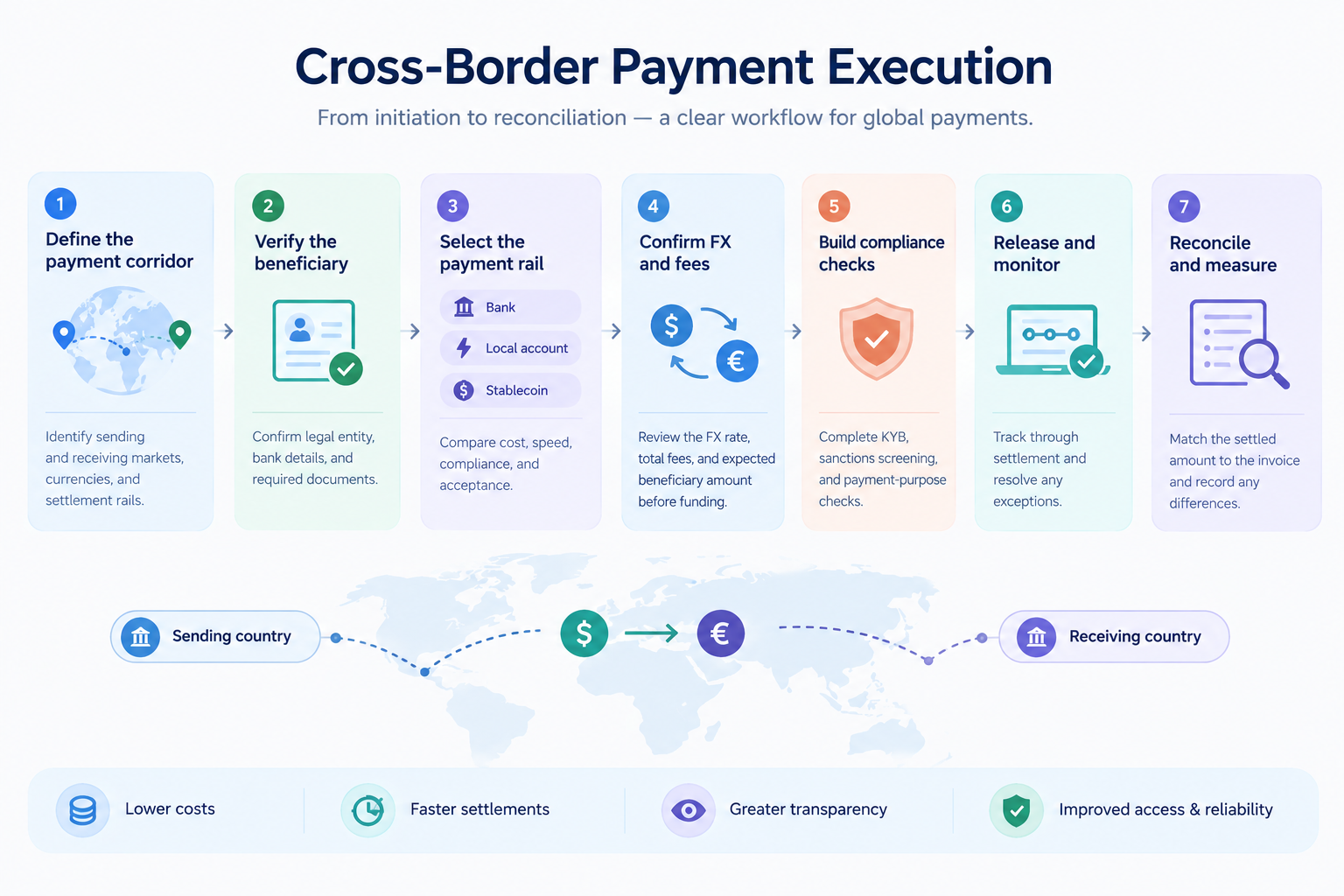
Define the payment corridor, beneficiary, and settlement requirement
Start by documenting exactly what the beneficiary must receive, in which currency, and by when. Cross-border payments may involve multiple institutions, currencies, operating hours, compliance regimes, and settlement accounts. These dependencies can make them slower, more expensive, and less transparent than domestic payments.
Separate the commercial obligation from the payment mechanics. The invoice amount, currency conversion, fees, beneficiary receipt, and final settlement should be recorded as distinct fields.
| Payment requirement | Record before funding |
|---|---|
| Sending entity | Legal entity and sending country |
| Beneficiary | Legal entity, country, and verified bank or wallet details |
| Source currency | Currency leaving the treasury account |
| Delivery currency | Currency the beneficiary must receive |
| Corridor | Sending market, receiving market, and selected rail |
| Amount | Gross payment amount and expected beneficiary receipt |
| Required date | Requested value date or delivery deadline |
| Payment purpose | Invoice, contract, or other documented purpose |
| Documents | Required invoice, contract, and compliance evidence |
| Approval owner | Person or function authorized to release funds |
For example, a U.S. company paying an Indian supplier should document whether the supplier must receive INR, whether the invoice is denominated in USD or INR, which entity is paying, and whether a local-account or stablecoin-enabled route is permitted by company policy.
The payment request is ready when it contains a complete corridor specification and an identified beneficiary.
Select the payment rail and compare execution options
Choose the rail that meets the beneficiary’s currency and timing requirements with a documented total cost and fallback plan. Traditional correspondent banking routes may require intermediary institutions. They can also introduce additional FX, funding, operating-hour, and settlement dependencies.
Compare more than the transfer fee. Review the delivered currency, corridor availability, total fees, quoted FX rate, expected settlement time, tracking, failure handling, compliance responsibilities, and reconciliation output.
| Option | Best suited to | Key checks |
|---|---|---|
| Bank wire | Teams with established bank relationships | Intermediary fees, delivery currency, value date, and beneficiary bank acceptance |
| Local account | Payments requiring local collection or payout access | Corridor availability, account eligibility, local compliance, and settlement evidence |
| Stablecoin-enabled route | Treasury teams holding stablecoins when the recipient needs fiat | Conversion, liquidity, beneficiary acceptance, regulated payout, and return handling |
| Fuze Business workflow | Teams needing one place for payment, conversion, tracking, and reconciliation | Supported corridor, currency matrix, account eligibility, pricing, and settlement timing |
Fuze Business supports fiat currencies and stablecoins, local-account capabilities, stablecoin-enabled settlement, difficult-market access, and real-time transaction monitoring. Its current corridor and currency availability should be confirmed before onboarding.
For a supplier that requires local currency while the treasury team holds USDC, compare the expected delivered amount, conversion rate, fees, compliance requirements, and settlement evidence before selecting the route. Stablecoin rails do not remove the need for regulated conversion, sanctions controls, beneficiary validation, and local payout capability.
Complete KYB, sanctions, and transaction documentation checks
Do not release funds until the entity, beneficiary, purpose, route, and required documents have passed the applicable review. Cross-border payment systems must account for differences between jurisdictions, transaction-data requirements, and sanctions or financial-crime risks.
KYB documentation commonly supports verification of the business, ownership, operating activity, source of funds, beneficiary identity, and payment purpose. The exact document set depends on the provider and jurisdictions involved.
A practical compliance file may include:
•Certificate of incorporation and ownership information
•Authorized signatory details
•Invoice or contract
•Beneficiary bank details
•Source-of-funds evidence
•Sanctions-screening result
A payment to a new overseas supplier should pause if the beneficiary name differs from the invoice, the bank account changed without independent verification, or the transaction purpose is inconsistent with the company profile.
The compliance gate is complete when the payment has an approved KYB and compliance status, a documented purpose, and no unresolved beneficiary or sanctions exception.
Fund the account, confirm FX and fees, and release the payment
Confirm the amount the beneficiary should receive, not only the amount leaving the treasury account. FX conversion introduces market, liquidity, and settlement considerations. The approval record should specify when the rate is quoted or locked and who bears rate movement before settlement.
Record the gross amount, source currency, quoted FX rate, fees, delivery currency, expected beneficiary amount, value date, and approval of the owner.
With Fuze Business, users can send, receive, and convert currencies or stablecoins through one account, with FX rates and fees shown before confirmation. The published rate, spread, and fee schedule should be reviewed for the specific transaction.
Before confirming a USD-to-EUR supplier payment, compare the displayed FX rate and all fees with the approved invoice amount. Save the confirmation record before releasing the payment.
The payment is ready to release when the authorized amount, delivery currency, quoted cost, and beneficiary instructions match the approved payment request.
Monitor settlement, resolve exceptions, and reconcile the payment
Treat payment initiation, payment release, beneficiary credit, and invoice reconciliation as separate control points. Separating payment messaging, reconciliation, and settlement can create operational friction. Inconsistent operating hours and payment-system processes can increase delay and resolution risk.
Track each stage from initiation through final reconciliation:
•Payment initiation
•Compliance review
•Funding
•Conversion
•Release
•Intermediary processing
•Beneficiary credit
•Failure or return
•Final reconciliation
With Fuze Business, users can monitor transaction status and reconcile balances through a unified dashboard. These capabilities should be validated against the selected account, corridor, and accounting requirements.
If a payment shows as released but the supplier has not confirmed receipt, check the provider status, expected value date, beneficiary details, returned-funds activity, and account statement before retrying. Preserve the original payment ID and avoid duplicate release.
Common exception categories include pending compliance review, insufficient funds, invalid beneficiary details, an unavailable corridor, an expired FX quote, a returned payment, or an uncredited beneficiary.
Do not mark the invoice paid solely because the payment was initiated. Close it when settlement evidence matches the approved obligation. Reconciliation should match the settled amount and currency to the invoice while recording FX differences, fees, returns, and timing differences separately.
A repeatable workflow for reliable cross-border payment execution
Reliable cross-border payment execution depends on both the payment rail and the controls around it. BIS and G20 workstreams identify lower cost, faster execution, greater transparency, and improved access as core cross-border payment objectives.
Use this repeatable sequence:
1.Define the corridor and settlement requirement.
2.Verify the beneficiary.
3.Select the payment rail.
4.Complete KYB and transaction checks.
5.Confirm FX and fees.
6.Fund and release the payment.
7.Monitor status and resolve exceptions.
8.Reconcile settlement against the invoice.
A team is ready to scale a corridor when it can execute a test payment, evidence the delivered amount and timing, resolve an exception, and reconcile the transaction without manually reconstructing the record across multiple systems.
The final control check is straightforward:
•Corridor data is complete.
•The beneficiary is approved.
•Compliance is cleared.
•FX and fees are visible.
•Settlement status is documented.
•The invoice is reconciled.
Cross-border payment execution is less about pressing send and more about controlling the path from an approved obligation to verified settlement. A consistent operating procedure should produce the same auditable payment record for every approved transaction.
How Fuze Business supports cross-border payment execution
Cross-border payment execution requires coordination across payment, conversion, compliance, settlement, tracking, and reconciliation. Bringing these activities into a consistent workflow can make recurring international payment operations easier to manage.
With Fuze Business, businesses can manage payments, collections, currency and stablecoin conversions, transaction tracking, and reconciliation through one account across supported corridors.
For businesses managing recurring international payment flows, this can help bring payment activity and transaction information into one place while providing access to banking and stablecoin settlement rails.
Businesses should confirm supported currencies, corridors, pricing, regulatory requirements, settlement terms, and account eligibility for their specific use case.