

Cross-border payments allow businesses to send and receive money across different countries and jurisdictions. They are used to pay overseas suppliers, collect international customer payments, fund subsidiaries, pay contractors, settle marketplace transactions, and move funds between business entities.
Although sending money internationally can appear as simple as transferring funds from one account to another, the underlying process can involve multiple currencies, payment networks, banks, compliance checks, clearing, settlement, and reconciliation.
This guide explains how cross-border payments work, the payment methods businesses can use, the costs and FX considerations involved, compliance requirements, payment tracking, and how to choose the right payment provider.
What are cross-border payments?
A cross-border payment is a transfer of value in which the payer and payee, or the financial institutions serving them, are in different jurisdictions. The transaction may be domestic on one or both sides, while the overall payment remains international.
A cross-border payment is not one action between two bank accounts. It is a coordinated process across jurisdictions. The process may include several financial institutions, currencies, payment systems, compliance checks, and settlement steps.
Common business use cases include:
| Use case | Typical payment relationship |
|---|---|
| Supplier invoice | Business-to-business |
| Payroll | Business-to-employee |
| Customer collection | Customer-to-business |
| Intercompany transfer | Company-to-company |
| Marketplace payout | Platform-to-seller or contractor |
Businesses should classify the payment before choosing a method. The classification affects the required information, expected timing, controls, and receiving process.
For example, a United States business paying a Korean supplier in Korean won should identify the payer, beneficiary, currencies, delivery method, expected timing, total charges, FX treatment, and reconciliation reference. It should also confirm whether the payment is business-to-business and whether the recipient must receive Korean won.
Cross-border payments often involve more complexity than domestic payments. They can span multiple participants, time zones, currencies, operating systems, and regulatory regimes.
The four recurring performance dimensions used by the G20 and Financial Stability Board are cost, speed, transparency, and access.
How do cross-border payments work?
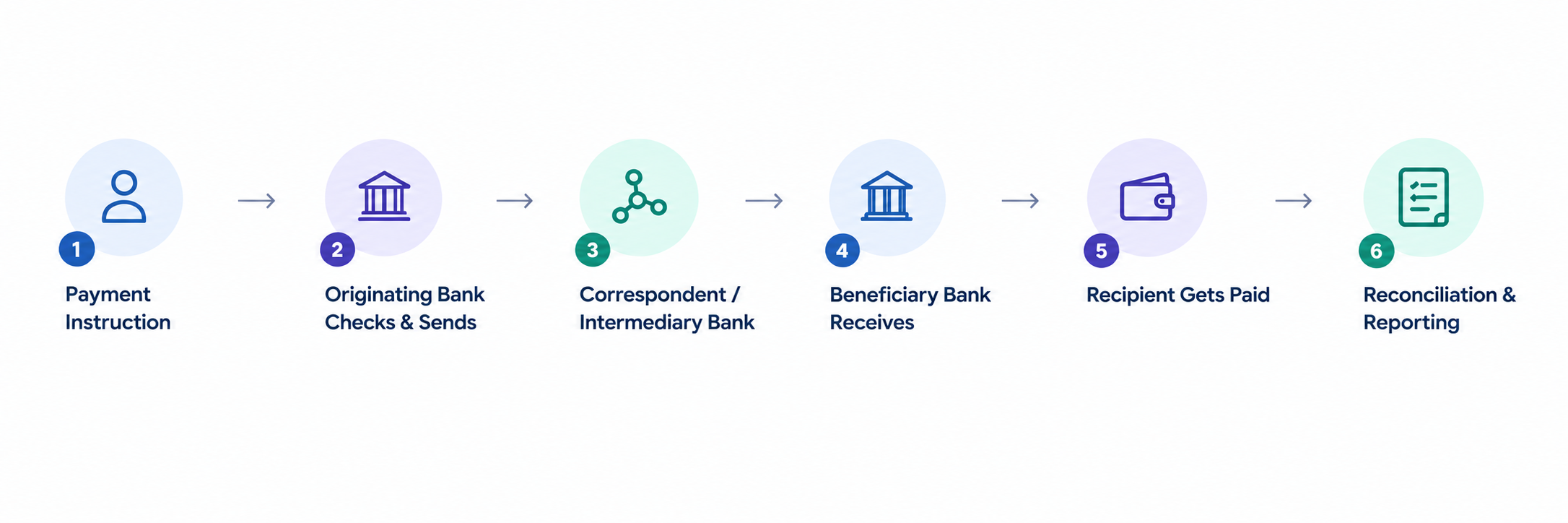
How correspondent banking works
Correspondent banking enables one bank to provide payment and related services to another bank in a different jurisdiction.
A simplified correspondent-banking flow looks like this:
1.The payer instructs the originating bank to make the payment.
2.The originating bank checks the instruction and sends payment messages.
3.An intermediary or correspondent bank may route the payment and support settlement.
4.The beneficiary bank receives the relevant message and value.
5.The beneficiary bank performs applicable checks and credits the recipient.
6.The institutions update accounts and retain information for reconciliation and reporting.
Payment messaging vs. settlement
The payment message is not identical to the settlement of funds. Messages communicate instructions and status. Account updates, clearing, and settlement move or record value between institutions. Later reporting and reconciliation connect the payment to the business transaction.
Nostro and vostro accounts can support settlement in foreign currencies. The terms describe the same account from the perspectives of the holding and respondent banks.
In a simplified account-ledger explanation, no physical money crosses the border. Institutions coordinate messages, account balances, and settlement arrangements. The exact process differs by payment rail and currency.
For a United States dollar-to-Korean won supplier payment, the United States bank may debit the payer. A correspondent relationship can support the dollar leg. FX conversion or local-currency funding can support the won leg. The Korean bank then credits the supplier.
There is no single international payment and settlement platform for all cross-border payments. Correspondent networks remain a major model.
Types of cross-border payment methods
Cross-border payment arrangements can be grouped into correspondent banking, closed-loop models, payment-infrastructure models, and peer-to-peer models. This is a taxonomy, not a rule that every provider fits only one category.
| Method or rail | Typical use | Strengths | Trade-offs |
|---|---|---|---|
| Correspondent banking | Broad business and bank transfers | Wide currency and geographic reach | Intermediaries, cut-off times, fees, and more complex tracking |
| Closed-loop network | Payments between connected users or accounts | Simpler experience within the network | Coverage, account requirements, and provider rules vary |
| Linked payment infrastructure | Corridors supported by connected local or instant-payment systems | Fewer handoffs and potentially faster processing | Availability depends on connected jurisdictions and providers |
| Peer-to-peer model | Transfers between users on a shared platform or network | May simplify the payment interface | Access, limits, settlement, and compliance rules vary |
| Digital assets, stablecoins, or central-bank digital-currency projects | Emerging or experimental use cases | May offer new settlement designs | Legal treatment, liquidity, implementation, and counterparty issues vary |
Bank wires using correspondent networks can provide broad reach. They may also involve several institutions, currency conversions, additional fees, and more complicated status tracking.
Closed-loop or provider-network models can simplify the user experience when both sides connect to the same network. Their usefulness depends on corridor coverage, account requirements, and provider rules.
Local payment-system access or linked instant-payment systems may reduce handoffs where the relevant jurisdictions and providers are connected. Interoperability can shorten transaction chains and support faster processing.
Digital assets, stablecoins, and central-bank digital-currency projects should be treated as emerging or experimental models. They are not universally available business payment rails. Their implementation, legal treatment, liquidity, and counterparty risks vary by jurisdiction.
Choose the rail by corridor and receiving requirement. Do not choose it only because it is labelled “instant” or “international.”
How much do cross-border payments cost?
The total cost of a cross-border payment can include the transfer fee, sending or receiving fees, intermediary charges, and FX conversion costs. Manual exception handling and reconciliation can create additional operational costs.
A provider’s advertised fee is not necessarily the business’s total cost. Finance teams should compare the amount debited from the payer with the amount received. They should also identify who bears charges when the payment method supports different charge arrangements.
Cross-border payment fees
A useful internal calculation is:
Total business cost = transfer fee + intermediary or receiving fees + FX spread or conversion charge + operational cost of reconciliation and exception handling.
The quoted FX rate matters because a lower visible fee can accompany a less favourable conversion rate. Businesses should record the quoted rate, any available reference rate, the payer’s debited amount, and the recipient’s expected amount.
How long do cross-border payments take?
Delivery time depends on the corridor, currency, payment rail, cut-off times, weekends, holidays, compliance reviews, intermediary routing, and recipient-bank processing. Funds credited to an intermediary may not yet be available to the final recipient.
The FSB's end-2027 retail target calls for 75% of cross-border retail payments to make funds available within one hour and the remainder within one business day. This is a global policy target, not a guarantee for an individual transaction.
For context, the World Bank reported an average global remittance cost of 6.36% in its August 18, 2025 update. This remittance statistic should not be treated as business-payment pricing. The samples and transaction types differ.
For a $10,000 invoice, record the following before sending:
•USD amount debited
•Quoted FX rate
•Benchmark or reference rate, if available
•Visible fees
•Expected recipient amount
•Actual recipient amount
•Any difference requiring investigation
Finance should be able to reconcile the difference without relying on an unexplained residual.
Cross-border payment compliance and security
Cross-border payments can require customer and beneficial-owner verification, sanctions screening, transaction monitoring, and information sharing across institutions and jurisdictions. Inconsistent AML/CFT implementation can increase cost, reduce speed, limit access, and reduce transparency.
Payment instructions may be delayed, rejected, or returned because of incomplete beneficiary information, name or address mismatches, sanctions screening, unusual transaction patterns, insufficient documentation, local restrictions, or missing purpose-of-payment data. The exact trigger depends on the institutions and jurisdictions involved.
FATF standards emphasize complete originator and beneficiary information for wire transfers. They also require ongoing measures to identify and mitigate illicit-finance risks.
Information needed for a cross-border payment
Before release, prepare the information the corridor and provider require:
•Beneficiary legal name
•Beneficiary account or local payment identifier
•Bank identifier
•Destination country
•Amount and currency
•Beneficiary address, where required
•Invoice or payment purpose
•Supporting contract or other documentation, where required
•Sanctions and KYC/KYB data
•Internal approval record
Requirements vary by corridor and provider. Businesses should confirm the receiving institution's exact requirements before initiating recurring payments.
ISO 20022 supports richer, structured payment data. This can improve automation, processing, and reconciliation. Implementation differences can reduce those benefits.
“Fast” does not mean exempt from compliance review. A payment passes operational review when beneficiary data matches the receiving institution's requirements, required fields are complete, the transaction has an approval trail, and the payment connects to an invoice, payroll record, contract, or other business purpose.
How to track and reconcile cross-border payments
Businesses can track payments using provider status updates and unique transaction references. The Unique End-to-end Transaction Reference, or UETR, is an identifier that supports tracking along the payment chain.
Status labels vary by provider. A business may see statuses such as initiated, accepted, processing, held for review, sent to an intermediary, credited to the beneficiary bank, available to the beneficiary, rejected, returned, or cancelled.
Payment tracking and UETR
A practical operations workflow is:
1.Capture the transaction reference.
2.Monitor the payment status.
3.Notify relevant internal or external stakeholders.
4.Investigate exceptions.
5.Confirm beneficiary receipt.
6.Reconcile the payment in the ledger.
7.Retain payment evidence.
Reconciliation and exceptions
Reconciliation should match the payment against the relevant invoice, purchase order, payroll batch, customer account, or intercompany record. It should account for FX differences, fees, partial payments, and returns.
Service-level agreements can define minimum service levels for correspondent relationships, payment-system links, and payment instruments. They matter for businesses managing recurring or high-value flows.
For each exception, assign an owner, next action, and escalation time. A finance team should be able to locate a transfer by its reference, identify the stage causing a delay, and match the final received amount to the accounting record.
How to choose a cross-border payment provider
Businesses should compare providers using the exact route, currency pair, payment type, amount band, and delivery requirement. General provider claims may not describe the performance of a specific corridor.
The FSB framework provides a useful evaluation lens: cost, speed, access, and transparency.
A provider scorecard can include:
| Evaluation area | Questions to ask |
|---|---|
| Reach | Does the provider support the originating and destination countries? |
| Currency | Can the recipient receive the required currency? |
| Total cost | What is the landed cost after fees and FX conversion? |
| Delivery | When will funds be available to the final recipient? |
| Settlement model | Which banks, networks, or payment systems support the transfer? |
| Compliance | What information and review steps are required? |
| Tracking | What references and status updates are available? |
| Reconciliation | Can the business export payment and settlement data? |
| Integration | Does the provider support the required funding or integration method? |
| Support | How are returns, holds, and other exceptions handled? |
| Resilience | What controls support recurring and high-value flows? |
| Permissions | Does the provider have the relevant legal or regulatory permissions? |
Operational controls matter alongside price. Recurring flows may require beneficiary validation, approval workflows, dual control, role-based access, transaction limits, audit trails, reconciliation files, and exception-management procedures.
Providers and banks may use service-level agreements to specify expectations and responsibilities across correspondent or payment-system arrangements.
Require each shortlisted provider to quote the same transaction scenario. Request the expected recipient amount, total charges, delivery estimate, tracking method, and exception process.
The lowest visible fee is not necessarily the lowest total cost. FX differences, returns, manual work, and delayed settlement can change the result.
Cross-border payments: key takeaways for businesses
Cross-border payments combine messaging, compliance, FX, clearing, settlement, beneficiary delivery, tracking, and reconciliation. The transfer button represents only part of the process.
Correspondent banking remains an important model. Closed-loop, infrastructure-linked, peer-to-peer, and emerging digital-asset or tokenised arrangements may serve different corridors and use cases.
Before authorizing a payment, answer five questions:
1.Who is paying?
2.Who is receiving?
3.In what currencies?
4.Through which rail?
5.What is the all-in cost and expected availability?
The answers should include the recipient's required currency, compliance information, approval trail, tracking reference, and reconciliation plan.
Businesses should evaluate each payment using total cost, expected availability, recipient currency, compliance requirements, access, transparency, tracking, and reconciliation. The G20 and FSB policy direction is toward payments that are cheaper, faster, more transparent, and more accessible while retaining safety and security.
How Fuze Business helps with cross-border payments
Cross-border payments involve more than simply moving money from one country to another. Businesses need to consider FX rates, payment speed, recipient-currency certainty, compliance, tracking, and reconciliation at every step.
The right payment infrastructure can make this process faster, more predictable, and easier to manage.
Fuze Business helps businesses send and receive cross-border payments with competitive FX, faster settlement, and access to multiple international payment corridors through a single platform.
Businesses can use payment infrastructure such as this to manage international payment flows while keeping important payment information and transaction activity in one place.
Whether you're paying overseas suppliers, settling with international partners, or managing recurring cross-border payments, Fuze Business gives businesses infrastructure designed to move money globally with greater speed and control.