

A cross-border transaction involves parties, accounts, payment systems, currencies, or legal jurisdictions in different countries. It is more complex than a domestic transaction because it may involve correspondent institutions, foreign-exchange conversion, multiple compliance regimes, different operating hours, fragmented data formats, and additional settlement steps.
For finance managers, global trade companies, and supply chain managers, the goal is not only to move money internationally. Teams also need to predict delivery time, total cost, compliance requirements, currency outcomes, and reconciliation effort.
This guide explains the process from initiation to reconciliation. It also compares payment methods and provides practical controls for reducing friction.
What are cross-border transactions?
A cross-border transaction is a payment or transfer that crosses at least one national or jurisdictional boundary. It can involve different parties, accounts, payment systems, currencies, or legal frameworks.
The Bank for International Settlements describes cross-border payments as a broad category that includes more than consumer remittances. Business examples include:
•International trade payments
•Supplier invoices
•Payroll
•Treasury transfers
•Marketplace payouts
•Customer refunds
•Other transfers between countries
Cross-border payments commonly involve additional foreign-exchange, liquidity, compliance, legal, and settlement considerations. The Financial Stability Board identifies cost, speed, access, and transparency as central outcome dimensions.
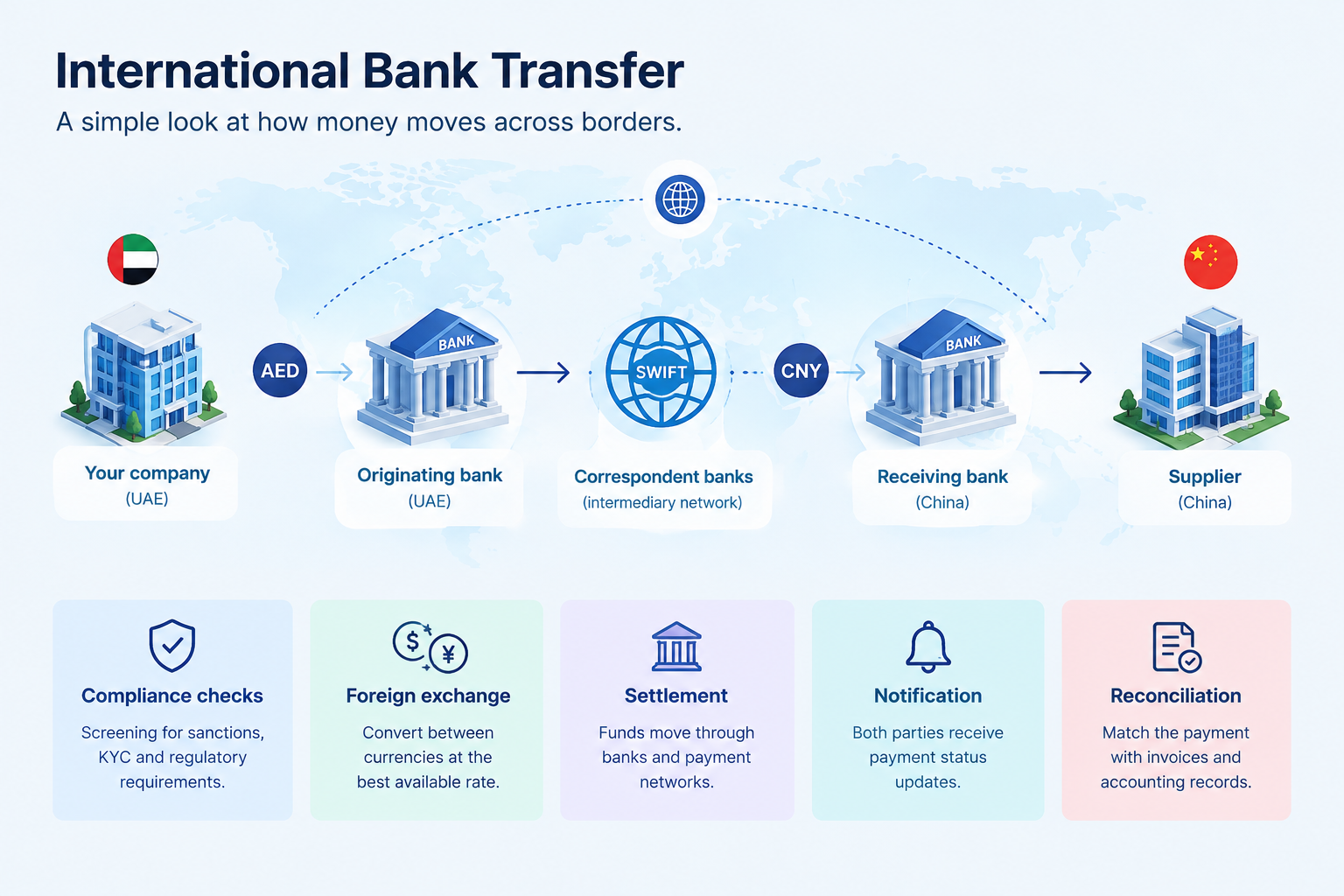
For example, a company in the United Arab Emirates paying a supplier in China is handling a cross-border transaction. This remains true if both parties use business bank accounts and the payment is initiated digitally.
The company must still decide the payment currency, receiving account, compliance checks, and settlement route. A domestic transaction usually operates within one primary jurisdiction and currency system. A cross-border transaction may involve multiple jurisdictions, currencies, intermediaries, and rule sets.
Cross-border transactions are broader than cross-border payments. Payments are one of the most common forms of cross-border transaction, but the broader transaction can also involve the underlying trade, invoice, shipment, payroll, refund, or other business event.
How the cross-border payment process works from initiation to reconciliation
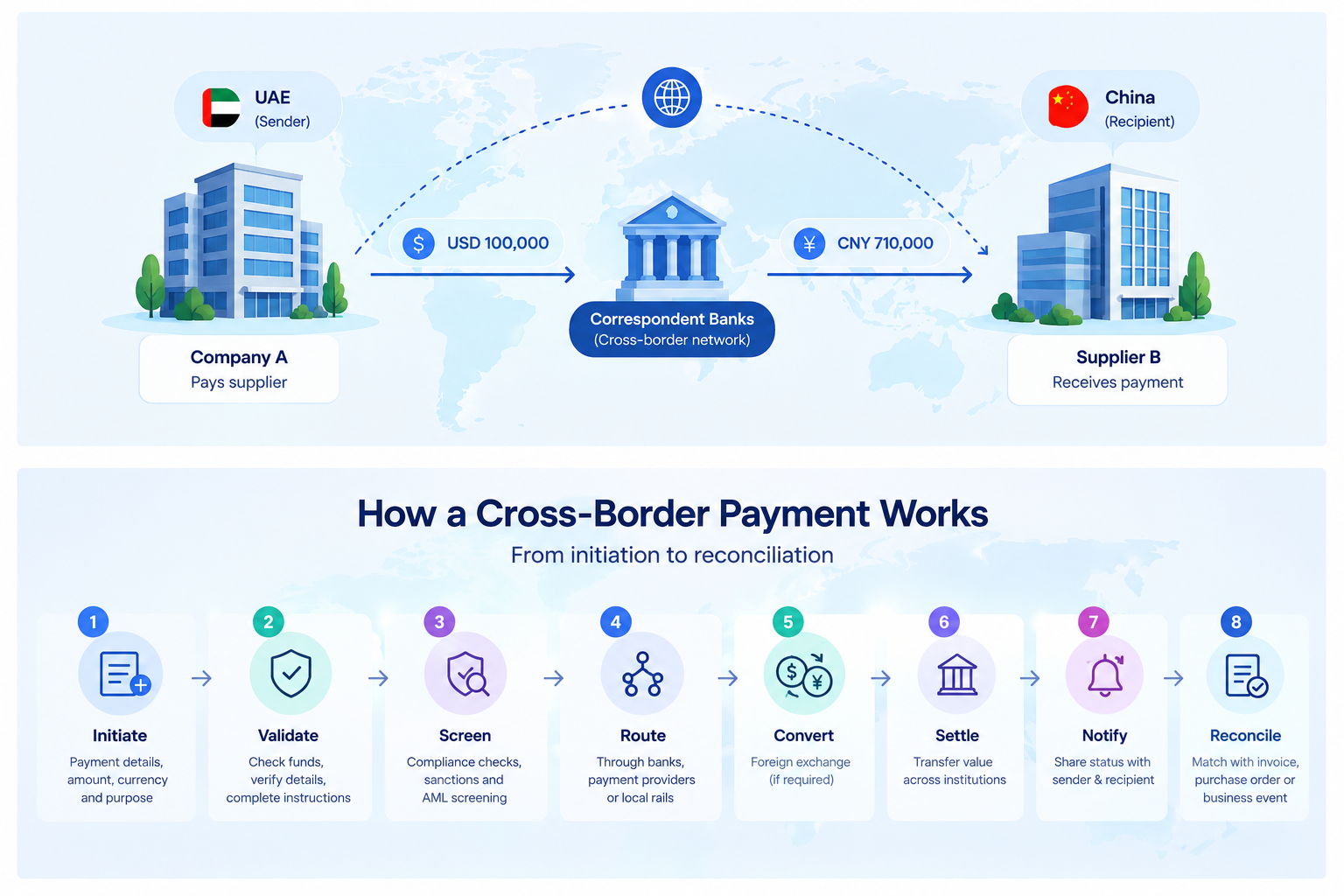
A cross-border payment moves through several stages. The exact route depends on the payment method, corridor, currencies, providers, and compliance requirements.
Process flow:
Initiate → Validate → Screen → Route → Convert → Settle → Notify → Reconcile
1.Initiate: The payer provides the beneficiary details, amount, currency, purpose, and required reference information.
2.Validate: The originating provider verifies the payer, checks available funds, and confirms that the payment instructions are complete.
3.Screen: The transaction is checked against applicable compliance requirements. Additional documentation or review may be required.
4.Route: The payment moves through a direct connection, correspondent banking chain, payment service provider, local payment rail, or another supported arrangement.
5.Convert: Foreign exchange may occur before the payment is sent, within the payment chain, or when the beneficiary receives the funds.
6.Settle: Participating institutions transfer value and complete their settlement obligations.
7.Notify: The provider reports the payment status to the sender and, where applicable, the recipient.
8.Reconcile: The finance team matches the payment with the related invoice, purchase order, shipment, payroll file, refund, or ledger entry.
Payment system standards and oversight help explain why payment information, processing arrangements, and settlement steps must work across institutions. Cross-border payment providers also face regulatory expectations that can affect onboarding and transaction review.
Delays can occur when information is incomplete, a compliance review is triggered, a cut-off time is missed, liquidity is unavailable, or intermediary instructions are rejected.
For a UAE-to-China supplier payment, a debit confirmation does not prove that the process is complete. Completion requires confirmation that the beneficiary received the intended currency and that the payment can be matched to the supplier invoice. Every payment should have a traceable status and reconciliation record.
Cross-border payment methods: comparing banks, payment providers, cards, and linked payment rails
No single payment method is best for every use case. The right choice depends on corridor availability, supported currencies, total cost, delivery speed, compliance requirements, transaction limits, data visibility, and reconciliation support.
| Method | Typical use case | Strengths | Constraints to evaluate | Best-fit business scenario |
|---|---|---|---|---|
| Correspondent banking | Bank-to-bank international transfers | Broad institutional reach and established banking relationships | Multiple intermediaries, variable fees, processing times, and visibility | Large or recurring transfers where banking access is available |
| Non-bank payment service provider | Business payments, collections, and payouts | Alternative channels, specialized corridors, and workflow tools | Licensing, supervision, corridor coverage, limits, and provider terms | Businesses seeking operational flexibility or specialized routes |
| Card networks | Cross-border purchases and customer payments | Familiar acceptance, authorization controls, and broad consumer access | Foreign-exchange conversion, cross-border fees, merchant pricing, and limits | One-time customer purchases and card-based commerce |
| Digital wallets and account-based providers | Local collections and payouts | Local payout options and potentially faster access | Availability depends on corridor coverage, wallet type, and local rules | Marketplaces, platforms, and businesses serving local recipients |
| Linked fast-payment systems and multilateral platforms | Faster cross-border account transfers | Potentially fewer intermediaries and improved speed | Governance, oversight, interoperability, and corridor availability | Payments supported by connected systems and approved arrangements |
Multilateral platforms are being examined as a way to improve cross-border payment outcomes. Linked fast-payment systems may also reduce friction when the relevant systems and rules are compatible.
Choose the route based on the corridor and the business requirement, not only the advertised transfer fee. A recurring supplier payment may favor an account-based provider with predictable foreign exchange and reconciliation. A one-time customer purchase may favor a card route.
Before approval, confirm that the method supports the corridor, currency, beneficiary, total cost, and required delivery window.
The four main challenges: cost, speed, access, and transparency
Cross-border payments generally remain slower, more expensive, and less transparent than domestic payments. The Financial Stability Board’s cross-border payments work organizes the main outcomes around cost, speed, access, and transparency.
Cost
The total cost may include sender fees, receiving fees, intermediary charges, foreign-exchange spreads, liquidity costs, and operational handling costs.
A low headline fee does not guarantee a low total transaction cost. A provider may charge little for the transfer while applying a less favorable exchange rate or passing on intermediary deductions.
The World Bank reported a 6.36% global average cost for sending remittances in the third quarter of 2025. This figure concerns remittances. It should not be treated as the average cost of all business cross-border transactions.
Speed
Delivery time is affected by time-zone differences, operating hours, cut-off times, batch processing, manual reviews, and the number of intermediaries.
A payment may leave the sender’s account quickly but remain unavailable to the beneficiary during further checks or settlement. The expected delivery window should therefore describe when funds become available to the recipient.
Access
Access depends on the corridor, currency, provider, beneficiary type, local infrastructure, and regulatory requirements.
A route may support one currency but not another. It may support business beneficiaries but restrict individuals, or accept a payment from one country while limiting payouts to another.
Transparency
Transparency means the payer can understand the total charges, exchange-rate treatment, expected delivery time, payment status, and service terms before approval.
If a provider quotes a transfer fee but does not disclose the exchange rate, intermediary deductions, or expected delivery window, the payment fails the transparency check. A complete quote should show total cost, foreign-exchange treatment, delivery estimate, tracking status, and applicable terms.
How compliance, foreign exchange, settlement risk, and reconciliation affect outcomes
Cross-border transactions can be subject to different anti-money-laundering, counter-terrorist-financing, sanctions, customer-due-diligence, data-protection, licensing, and reporting requirements. The FATF recommendations provide an international framework that influences many of these controls.
Payment information may be checked more than once when a transaction passes through multiple institutions or jurisdictions. Incomplete or inconsistent payer and beneficiary information can interrupt automated processing and trigger manual review.
| Risk or control area | What the finance team should verify |
|---|---|
| Identity and sanctions screening | Payer and beneficiary identity, ownership information, and applicable screening results |
| Payment data quality | Complete account or wallet details, purpose, references, and required corridor information |
| Foreign-exchange exposure | Exchange rate, conversion timing, currency received, and pricing treatment |
| Liquidity and funding | Available funds, settlement currency, funding timing, and account balances |
| Settlement finality | Whether both sides of the currency exchange settle as expected |
| Reconciliation evidence | Payment status, beneficiary receipt, supporting documents, and accounting match |
Foreign-exchange conversion introduces pricing, liquidity, market, and settlement considerations. Foreign-exchange settlement risk occurs when one party delivers one currency but does not receive the other currency as expected. Payment-versus-payment arrangements are designed to reduce this risk.
Reconciliation should connect the payment record to the underlying business event. That event may be an invoice, purchase order, shipment, payroll file, or customer refund.
A payment can be technically transmitted but operationally incomplete if it cannot be reconciled to the correct invoice. The same applies if the beneficiary receives a different amount after intermediary deductions and foreign-exchange conversion.
The finance team should be able to identify the payer, beneficiary, purpose, route, foreign-exchange treatment, settlement status, and accounting match from one audit trail. Compliance information should be treated as payment data, not as an after-the-fact exception.
Practical ways businesses can reduce cross-border payment friction
Businesses can reduce avoidable friction by controlling the payment process before funds are released. The most effective measures address data quality, corridor planning, cost visibility, approvals, tracking, and reconciliation.
A practical implementation sequence is:
•Map corridors: Document origin countries, destination countries, beneficiary types, currencies, and approved routes.
•Define required currencies: Specify the source currency and the currency the beneficiary must receive.
•Standardize payment data: Use consistent beneficiary details, purpose information, references, and supporting documents.
•Compare total delivered cost: Include transfer fees, foreign-exchange treatment, intermediary deductions, receiving fees, and operational costs.
•Set approval controls: Define payment limits, foreign-exchange approval rules, required reviews, and documentation standards.
•Track status: Record payment initiation, review, routing, settlement, delivery, returns, and exceptions.
•Reconcile outcomes: Match the final payment to the invoice, shipment, payroll file, refund, or other business event.
•The G20 roadmap for cross-border payments supports work focused on improving these payment outcomes.
For businesses managing multiple currencies and trade corridors, a unified operating layer can reduce the need to coordinate separate sending, receiving, conversion, and compliance workflows. Fuze Business provides unified access for sending, receiving, and converting funds, along with banking network connectivity, currency and stablecoin conversion, enterprise-grade compliance, and cross-border payment capabilities across supported corridors.
A global trade company could create a corridor policy that specifies the approved provider, source currency, beneficiary currency, required documents, maximum delivery time, foreign-exchange approval rule, and reconciliation owner. The policy is working when it reduces manual exceptions and assigns an owner from initiation through reconciliation.
Cross-border transaction readiness checklist for finance and supply-chain teams
Do not release a cross-border payment until the route, total cost, delivery expectation, and compliance evidence are clear.
Before approval, confirm:
•Corridor: Origin and destination countries, supported route, and local requirements
•Counterparty: Payer and beneficiary identity, account or wallet details, and beneficiary type
•Currency: Source currency, receiving currency, and required conversion
•Cost: Sender, receiver, intermediary, foreign-exchange, and other known charges
•Compliance: Required identity information, purpose details, screening, and supporting documents
•Cut-off: Operating hours, local holidays, cut-off times, and expected settlement window
•Status: Tracking reference, processing stage, and exception process
•Settlement: Expected receipt, settlement confirmation, and returned or partially received funds
•Reconciliation: Invoice, purchase order, shipment, payroll, refund, or ledger reference
A payment is ready for release when beneficiary data is validated, the route and currency are supported, required documents are available, the total delivered cost is approved, and the reconciliation reference is assigned.
An independent reviewer should be able to reproduce why the payment was sent, through which route, at what expected cost, and with what delivery expectation. Failed, delayed, returned, or partially received payments should be treated as operational exceptions rather than ordinary settlement outcomes.
Use a unified platform to manage cross-border payments
Cross-border transactions require coordination across payment initiation, compliance, routing, foreign-exchange conversion, settlement, and reconciliation. The most useful solution depends on the business’s actual corridors, currencies, settlement expectations, compliance needs, and operational workflow.
Fuze Business is positioned for finance managers, global trade companies, and supply-chain managers that need to send, receive, and convert funds through one unified platform. Its listed capabilities include access to difficult trade corridors, AED, CNY, and EUR support, banking network connectivity, instant currency and stablecoin conversion, enterprise-grade compliance, cross-border payments, and faster settlement.
If cross-border payments are creating avoidable cost, delay, or operational complexity, explore how Fuze Business can help your team send, receive, and convert funds through one unified platform.