

Cross-border transactions involve payments across more than one jurisdiction, currency, payment system, or regulatory regime. The full transaction may also include trade documentation, tax, customs, and foreign-exchange exposure.
The advertised transfer fee is only one part of the cost. A better approach evaluates the complete lifecycle: payment initiation, intermediary processing, currency conversion, settlement, beneficiary availability, compliance review, and reconciliation.
This guide follows a practical workflow that starts with defining the corridor and calculating the true landed cost, then moves through payment-route selection and complete payment-data preparation. It also covers compliance validation, settlement monitoring, and reconciliation so businesses can measure performance and improve each transaction flow.
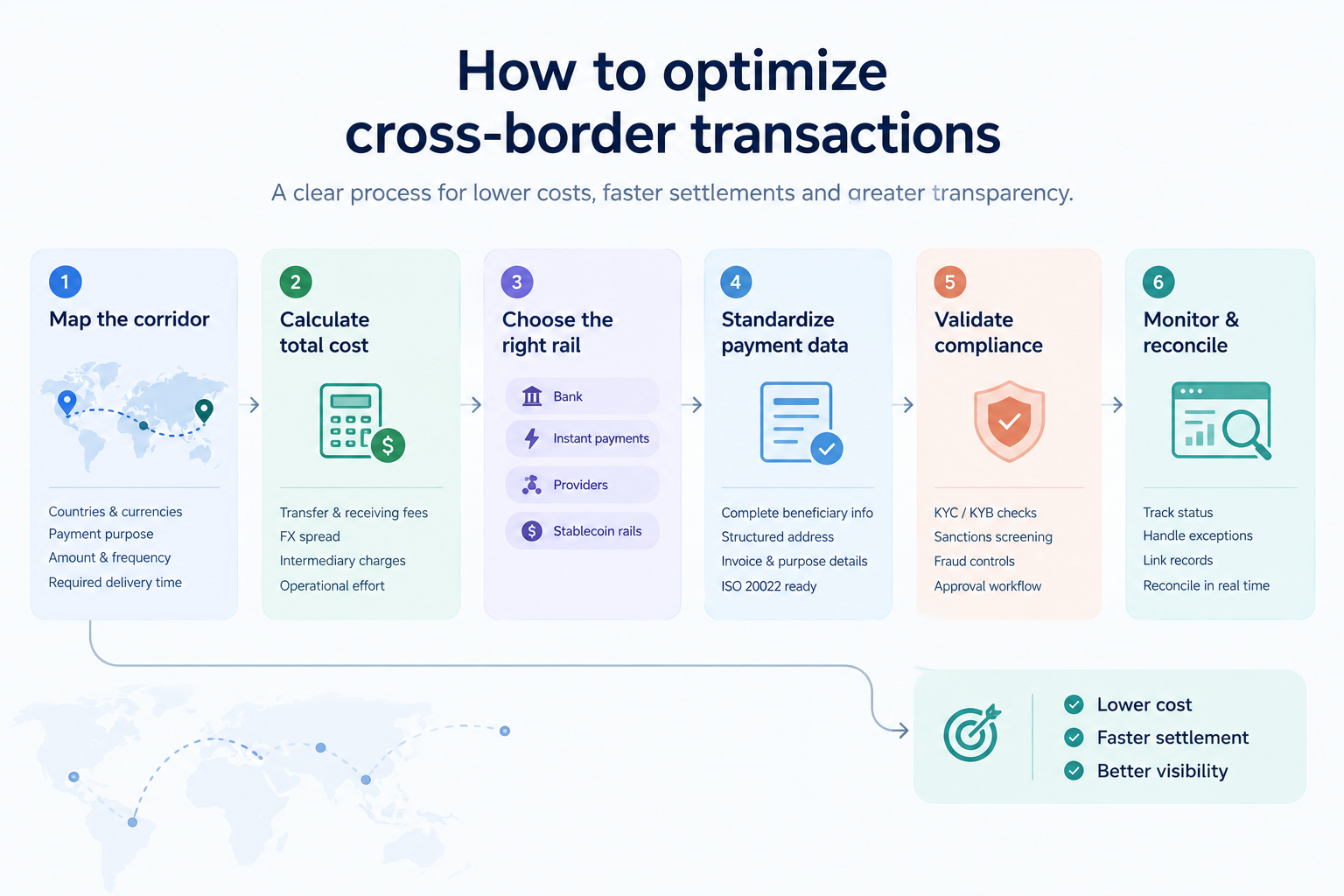
The framework shows how these steps connect across the full cross-border payment lifecycle.
Before starting, gather your destination countries, currencies, transaction values, payment frequency, beneficiary types, required delivery times, existing banking or payment-provider relationships, and internal compliance responsibilities. Requirements vary by jurisdiction and transaction type. Review them with qualified legal, tax, and compliance professionals.
Define the transaction objective and map the full payment flow
Start by defining the outcome the business needs. A company may prioritize lower cost, faster delivery, predictable settlement, broader access, or stronger auditability. The best payment rail depends on that priority and the specific corridor.
The Financial Stability Board identifies cost, speed, transparency, and access as core challenges for cross-border payments. Its end-2027 retail targets include a global average cost of no more than 1%, no corridor above 3%, and funds available to recipients within one hour for at least 75% of payments. These are policy targets, not guarantees for individual transactions.
Payment complexity can come from multiple currencies, foreign-exchange conversion, compliance checks, payment infrastructure, settlement assets, and operating procedures. Correspondent-bank chains may add further parties, which can increase cost, delay processing, and reduce payment-status visibility.
Create a corridor map before comparing providers. Record each handoff, conversion point, fee, control, and status update.
| Field | What to record |
|---|---|
| Corridor | Sending and receiving countries |
| Currency pair | Payer and beneficiary currencies |
| Payment purpose | Supplier payment, collection, payroll, or another purpose |
| Amount | Transaction value and expected frequency |
| Required arrival time | Target for beneficiary funds availability |
| Current route | Bank, provider, payment system, or other rail |
| Total cost | Fees, FX spread, and operational costs |
| Compliance requirements | Screening, documentation, and approvals |
| Reconciliation owner | Person or system responsible for matching records |
For example, a company paying a foreign supplier should identify the payer currency, beneficiary currency, intermediary institutions, FX conversion point, expected settlement time, sanctions and anti-money-laundering checks, fees, and reconciliation output.
The map is complete only when every handoff, conversion, fee, and status update has an owner or system.
Calculate total cost and compare available payment rails
Compare routes using the amount the payer spends and the amount the beneficiary receives. A lower advertised fee does not necessarily create a lower beneficiary-adjusted cost.
Total cost may include sending fees, receiving fees, intermediary charges, FX spreads, currency-conversion charges, liquidity costs, and manual work caused by payment exceptions. The FSB’s transparency targets call for relevant charges and FX information to be disclosed.
BIS identifies liquidity costs, long transaction chains, fragmented regulation, and technical differences as contributors to payment friction.
Compare each route using the same assumptions:
•Visible sending and receiving fees
•FX rate and spread
•Intermediary charges
•Expected delivery window
•Net funds received
•Tracking availability
•Refund or recall process
•Compliance documentation required
•Manual effort and exception handling
Potential routes include correspondent banking, linked instant-payment systems, payment service providers, multicurrency platforms, and tokenized or stablecoin-based settlement arrangements. Their suitability depends on jurisdiction, compliance controls, liquidity, counterparty risk, and acceptance by customers or suppliers.
For the same invoice, compare a bank wire, a specialist payment provider, and a platform supporting local or stablecoin settlement. Select a route only after calculating net funds received, total payer cost, expected settlement time, failure or recall handling, and operational effort.
With Fuze Business, businesses can review the FX rate and fees before payment confirmation and use one account for payments, collections, and conversions. These capabilities should be validated for the relevant corridor and use case.
The selected route should have a documented all-in cost and a written explanation for any accepted trade-off.
Choose the provider and settlement rail for each corridor
Treat the corridor as the primary unit of optimization. One provider or rail may work well for supplier payments in one country pair but perform poorly for collections or high-value transfers elsewhere.
No single rail is optimal for every corridor. Countries differ in currency availability, operating hours, regulatory requirements, local payment infrastructure, liquidity, and access to correspondent relationships.
Linked domestic faster-payment systems can improve speed, cost, access, and transparency. However, bilateral connections may be time-consuming and expensive to implement at scale.
Evaluate each provider and rail against the business requirement:
•Best use case and payment type
•Settlement method
•Currency coverage
•Expected speed and funds availability
•Price visibility
•Payment tracking
•Compliance model
•Integration effort
•Failure and recall handling
•Beneficiary acceptance
Use a bank rail when institutional acceptance and conventional settlement are the priority. Consider a specialist or alternative rail when speed, access, visibility, or difficult-corridor coverage is the documented constraint.
Stablecoins can be one possible settlement mechanism, but they are not a universal recommendation. Potential benefits may include speed or access. Relevant risks include issuer concentration, currency substitution, legal treatment, custody, redemption, liquidity, sanctions, anti-money-laundering obligations, and counterparty exposure.
Fuze Business provides a unified account for paying, collecting, converting, holding, and tracking across selected currencies and corridors. It also presents regulated stablecoin rails as one settlement option. Confirm corridor availability, regulatory permissions, onboarding requirements, fees, and controls directly before adoption.
A trading company might retain bank wires for high-value payments requiring established correspondent relationships. It could test a specialist provider for recurring supplier payments in a corridor with slower banking infrastructure.
The pilot should pass only if beneficiary acceptance, compliance review, settlement timing, funds receipt, and accounting reconciliation work without material exceptions.
Standardize payment data and prepare for ISO 20022 requirements
Improve payment data before changing payment rails. Complete, structured information can reduce avoidable repairs while supporting compliance, automation, and reconciliation.
ISO 20022 is a structured messaging standard that supports richer and more granular payment data. Swift associates it with improved transparency, analytics, compliance processing, fraud prevention, and straight-through processing.
Swift’s cross-border payment instruction coexistence period between MT and ISO 20022 ended on November 22, 2025. Swift also identifies structured or hybrid postal addresses as an upcoming requirement for relevant CBPR+ messages in November 2026. Unstructured postal addresses will no longer be accepted for those relevant messages.
Standardize customer, supplier, invoice, beneficiary, purpose, address, account, and remittance-information fields. A practical validation process should:
•Validate the beneficiary name.
•Use structured address fields.
•Capture invoice or payment-purpose data.
•Normalize currency codes.
•Store end-to-end transaction identifiers.
•Reject incomplete records before release.
Better payment data is an operational control, not only a messaging-format upgrade.
For example, a payment file should fail pre-submission validation when the beneficiary address is incomplete, the account identifier conflicts with the destination country, or the required payment purpose is missing.
The payment should pass automated data-quality checks without manual rekeying or post-submission repair.
Build compliance, sanctions, and fraud controls into the workflow
Apply compliance controls before payment release, not after a payment is interrupted. Different jurisdictions may apply different sanctions-screening, anti-money-laundering, and financial-crime requirements. Incomplete information can cause repeated checks or payment delays.
Faster settlement can increase the need for effective fraud controls. Funds may move quickly and become difficult to recover. BIS also identifies the challenge of obtaining complete transaction data when payments cross different networks.
Controls should be risk-based. Align them with the relevant jurisdictions, counterparties, products, currencies, payment purposes, and regulatory obligations. The exact control set requires jurisdiction-specific review.
Before releasing a payment, confirm the following:
•Know-your-business and know-your-customer checks
•Beneficial ownership information
•Sanctions screening
•Payment purpose
•Counterparty risk
•Approval thresholds
•Exception escalation
•Retained audit evidence
For a high-value supplier payment, require approval after screening the counterparty, confirming beneficiary details, checking the payment purpose, and recording the decision.
Fuze Business operates through regulated entities and uses enterprise-grade compliance controls across the markets it serves. These claims should be independently validated during provider due diligence.
Every released payment should have a traceable compliance decision. The workflow should also provide an exception path for false positives and missing information.
Automate monitoring, exception handling, and reconciliation
Track the payment after submission until the beneficiary receives the expected funds. Initiation speed is not the same as settlement speed or funds availability.
The FSB’s transparency targets include expected delivery time, payment-status tracking, total transaction cost, and terms of service as information payment service providers should make available.
ISO 20022’s richer data model can support improved analytics, reduced manual intervention, compliance processing, and end-to-end automation when systems implement it consistently.
Use linked records to connect the original instruction, fees, FX conversion, settlement confirmation, beneficiary receipt, and accounting entry. Do not treat the bank statement as the only source of truth.
Useful measures and alerts include:
•Straight-through processing rate
•Exception rate
•Average settlement time
•Percentage delivered within the service-level agreement
•Total cost by corridor
•FX variance
•Unreconciled items older than one business day
•Recall or failure rate
•Beneficiary not credited by the expected deadline
•Unexpected fee deducted
•FX rate outside tolerance
•Compliance review pending
•Payment returned
With Fuze Business, users can monitor transaction status, reconcile balances, and receive alerts through a unified dashboard. Test these capabilities against the company’s accounting and treasury requirements.
Set an alert when a payment does not reach the expected status within the corridor service-level agreement. Route the exception to treasury, operations, or compliance based on the failure reason.
The team should be able to locate payment status, expected value date, fees, conversion rate, and reconciliation state from linked records without contacting multiple intermediaries.
Measure performance by corridor and improve iteratively
Review performance by country pair, payment type, value band, provider, and rail. Cross-border payment performance can vary because of infrastructure, rules, currencies, operating hours, correspondent relationships, and provider access.
The G20 framework measures progress through cost, speed, access, and transparency targets. It does not rely on one average transaction time or advertised fee.
Separate payer cost from beneficiary net receipt. Also separate advertised settlement speed from actual funds availability.
A corridor scorecard can include:
•Corridor and payment type
•Transaction value band
•Provider and rail
•All-in cost
•FX spread
•Funds-available time
•Failure rate
•Exception rate
•Compliance-review time
•Reconciliation time
•Provider or rail concentration
Fuze Business offers transparent pricing, multiple payment functions, real-time monitoring, and selected currency and corridor coverage. Assess these capabilities using the company’s own transaction data.
After 30 to 50 comparable transactions in a corridor, compare the selected route with the previous route. Review all-in cost, funds-available time, exception rate, and reconciliation effort.
High-volume corridors can be reviewed monthly. Low-volume or high-risk corridors can be reviewed quarterly, subject to internal governance.
Retain the route only when it meets the predefined service-level and cost thresholds without creating unacceptable compliance, liquidity, or counterparty risk.
A practical framework for optimizing cross-border transactions
Effective optimization requires attention to cost, speed, transparency, access, compliance, data quality, and operational control. Selecting a provider based on one headline feature is not enough.
The practical sequence is:
1.Map the transaction and identify every handoff.
2.Calculate all-in cost and net beneficiary receipt.
3.Choose a suitable provider and settlement rail.
4.Standardize payment data.
5.Embed compliance and fraud controls.
6.Automate monitoring, exceptions, and reconciliation.
7.Measure performance by corridor.
ISO 20022 creates an industry-wide opportunity for richer payment data and greater automation. The operational benefit depends on implementation quality and data completeness.
Fuze Business can be evaluated as a contextual option for unified payments, collections, conversions, tracking, and alternative settlement capabilities. Its availability, regulatory scope, pricing, and suitability must be validated for each use case.
Before rollout, answer these questions for every priority corridor:
•What will the beneficiary receive?
•When will the funds be available?
•What will the payer pay in total?
•What data and compliance evidence are required?
•How will the payment be tracked and reconciled?
The strongest cross-border payment strategy is measurable, corridor-specific, and designed around the complete movement of funds rather than only the moment a payment is sent.
How Fuze Business helps with cross-border transactions
Cross-border transactions involve more than simply moving money from one country to another. Businesses need to consider FX rates, payment speed, recipient-currency certainty, compliance, tracking, and reconciliation at every step.
With Fuze Business, businesses can manage payments, collections, currency conversions, and cross-border transaction activity through one account. The platform supports selected currencies and corridors and provides access to banking and stablecoin settlement rails.
For businesses managing recurring international payment flows, this can help bring payment activity and transaction information into one place, making cross-border operations easier to manage and monitor.
Businesses should confirm supported corridors, currencies, pricing, regulatory requirements, and settlement terms for their specific use case.