
A USD business account is an account or account-like payment arrangement that lets a business receive, hold, convert, and send US dollars. It supports cross-border collections when clients, marketplaces, or partners pay the business in USD.
The business can retain those funds in USD and pay USD suppliers or other recipients without converting into local currency between each step. Whether conversion is needed depends on the recipient’s currency and payment route.
Payment-rail availability, eligibility, settlement timing, fees, and account functionality depend on the provider, corridor, payer, recipient, and compliance review. Fuze Business offers named USD accounts for eligible businesses without requiring a US entity, subject to onboarding and eligibility requirements.
What a USD business account does in a cross-border payment flow
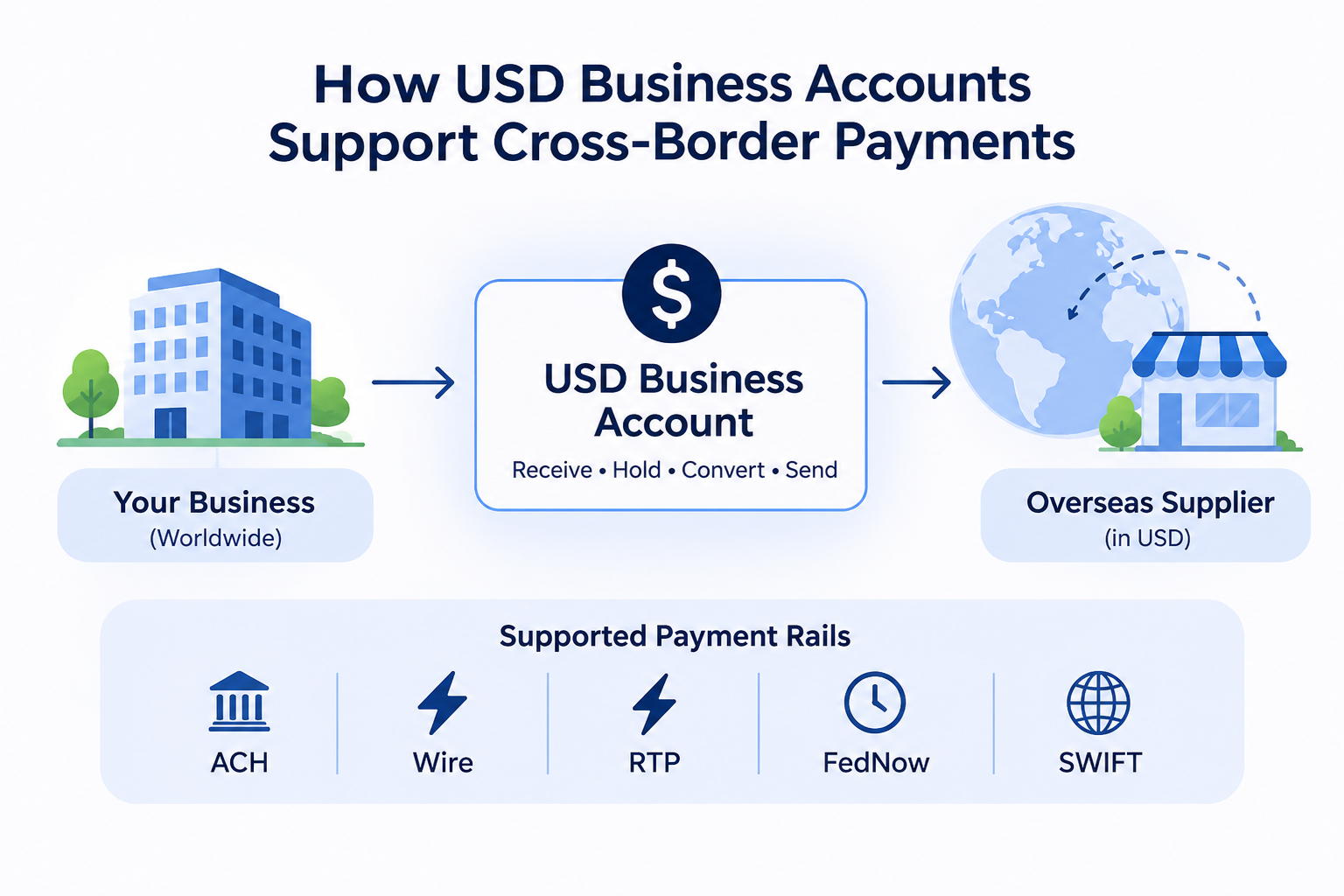
A USD business account holds a balance denominated in US dollars. It can support collections from clients, marketplaces, and platforms, as well as payouts to suppliers, partners, and other recipients.
The account may provide business account details that payers can use to send USD. The business can then keep the funds in dollars or convert them when needed.
Holding USD can reduce unnecessary conversion steps when incoming funds and outgoing obligations are both in dollars. It does not guarantee that every recipient or payment route will support USD.
The core function is to collect, hold, convert and pay out USD.
For example, a European software company could receive a USD subscription payout, keep the balance in USD, and use it to pay a US contractor. It would not need to convert USD to EUR and later buy USD again for that contractor payment.
This differs from a standard local-currency account that requires conversion before a USD payout.
How USD collections work with account and routing details
A business generally shares its account details with clients, platforms, marketplaces, or other payers. The payer then uses those details to initiate a USD payment.
ACH, or Automated Clearing House, is a US electronic payment network for account-to-account transfers. Federal Reserve definitions distinguish ACH from Fedwire and FedNow transfers.
Local US payment rails may suit domestic collections. SWIFT may support international payment instructions for eligible corridors. The available route depends on the account, payer, recipient, and provider.
A typical collection process is:
1.Share the named account details with the payer.
2.Confirm the payer’s required rail and beneficiary information.
3.Receive the USD payment.
4.Reconcile it against the payer and invoice reference.
For example, a marketplace may request a US account number and routing number. The business can provide the details associated with its USD account and confirm the marketplace’s required payment rail before collection begins.
Collection setup is complete when the payer has the correct beneficiary name, account number, routing information, payment purpose, and reference requirements.
How USD payouts work to suppliers and partners
A business can use its USD balance to pay a supplier or partner in USD when the relevant payout route is supported. This can help avoid converting the balance into local currency before making a dollar-denominated payment.
Domestic US payouts may use ACH, Fedwire, RTP, or FedNow. Access depends on participant eligibility, payment requirements, limits, and provider support.
Fedwire is a Federal Reserve funds-transfer system. FedNow is a Federal Reserve instant-payment service. Neither is the ACH network.
SWIFT provides standardized financial messaging for supported international payment instructions. It is not a deposit account and does not guarantee settlement speed. International payments may involve correspondent institutions and additional processing.
With Fuze Business, eligible businesses can use supported ACH, wire, or SWIFT routes to make USD payouts. Availability remains dependent on the account and payment route.
Before sending a payout, confirm the recipient’s legal name, account details, selected rail, currency, payment purpose, expected timing, and total fees.
For example, a business might pay a US supplier by ACH for a routine invoice. For a time-sensitive or high-value payment, it should check whether the supplier requires a wire instead.
The right account is not only about receiving dollars. It is also about getting those dollars to the next counterparty without an unnecessary conversion.
USD payment rails compared: ACH, wire, RTP, FedNow, and SWIFT
Payment rails serve different use cases. Their fees, limits, cutoff times, reversibility, and settlement experience vary by provider and corridor.
| Payment rail | Typical use | Domestic or international | Speed considerations | Questions to confirm |
|---|---|---|---|---|
| ACH | Routine US account-to-account payments | Mainly domestic US | Timing depends on processing windows and the receiving institution | Does the payer support ACH? What are the processing times and limits? |
| Wire or FedWire | Time-sensitive or high-value payments | Mainly domestic for Fedwire; wires may also be international | Confirm cutoffs and expected settlement timing | Is a wire required? What are the fees and beneficiary details? |
| RTP | Instant-payment use cases | US domestic | Both sides must connect to the relevant network | Does the recipient’s institution participate? |
| FedNow | Instant-payment use cases | US domestic | The sending and receiving institutions must participate | Is FedNow available for this account and recipient? |
| SWIFT | International payment instructions | International | The route may involve correspondent institutions and additional processing | Which correspondent route applies, and what are the total charges? |
ACH may suit a routine domestic invoice. Fedwire or another wire may suit an urgent or high-value payment. RTP and FedNow may suit eligible instant-payment use cases. Businesses can also explore USD payment trends to understand the broader developments shaping dollar payments.
SWIFT may support an international supplier payout, but the end-to-end experience depends on the institutions and corridor involved. Treasury payment mechanisms provide further context on how payment methods differ.
If a supplier says “wire only,” do not assume an ACH credit will satisfy the instruction. Verify the required rail and beneficiary information before submitting the payout.
How to open and operate a USD account without a US entity
Traditional US bank-account onboarding may require entity, ownership, business-activity, source-of-funds, and compliance documentation. Exact requirements vary by provider.
To apply through Fuze Business, businesses create an account, submit their details for KYB review, and apply for the required currency account
The process is generally:
1.Create a Fuze Business account.
2.Submit the business details required for KYB.
3.Apply for the USD account.
4.Complete any additional eligibility or compliance review.
5.Receive the account details.
6.Confirm supported collection and payout routes before using the account.
Fuze Business can support from regions including the Americas, Europe, Africa, the Middle East, and Asia without first setting up a US entity. The country list and eligibility requirements may change.
A business incorporated outside the US may complete KYB, receive approval, and confirm that the USD account’s beneficiary name matches the business name used with clients and suppliers.
The setup is operational when KYB is approved, USD account details are issued, supported rails are confirmed, and a first or test payment can be reconciled.
What to check before collecting or paying USD
A USD account can simplify cross-border money movement. It does not remove the need to check counterparty details, payment purpose, compliance requirements, or corridor availability.
Account availability, payment methods, transaction limits, fees, settlement times, and supported corridors can vary by business, country, counterparty, currency, and compliance status.
Before relying on an account, confirm:
•The account is dedicated to the business and shows the correct legal beneficiary name.
•The intended platform or marketplace accepts the account type.
•The required collection and payout rails are supported.
•The countries and payment corridors are available.
•Provider fees, foreign exchange treatment, and intermediary charges are clear.
•Settlement timing, limits, and cutoff times fit the payment.
•The business can provide the required compliance documents.
•Incoming and outgoing payments can be matched to invoices, purchase orders, customers, or suppliers.
•The recipient’s payment instructions match the selected rail.
The business should compare the total payment cost. This can include provider fees, foreign exchange spread, intermediary charges, and any conversion required at the receiving end.
For a first marketplace payout, the finance team should confirm that the marketplace accepts the account type. It should record the expected USD amount, check fees and conversion treatment, and match the payout to the relevant sales report.
A payment process passes review when the team can answer who paid or was paid, why, through which rail, for how much, at what cost, and where the transaction is recorded.
Use Fuze Business to open a named USD account without a US entity
Fuze Business is a cross-border payments platform for sending, receiving, and converting fiat currencies and stablecoins from one account.
Eligible businesses can apply for a named USD account without setting up a US entity. They can receive and pay out in USD where the relevant route is supported.
The process is to create an account, complete KYB, apply for the required currency account, and start collecting once the account is issued. Fuze Business allows businesses to manage sending, receiving, converting, and transaction tracking from one unified account, subject to eligibility and account availability.
This does not guarantee approval, universal rail access, or a fixed issuance time. Eligibility, onboarding, account type, compliance review, and payment-route support still apply.
Get Started with Fuze Business to review eligibility and begin onboarding.