
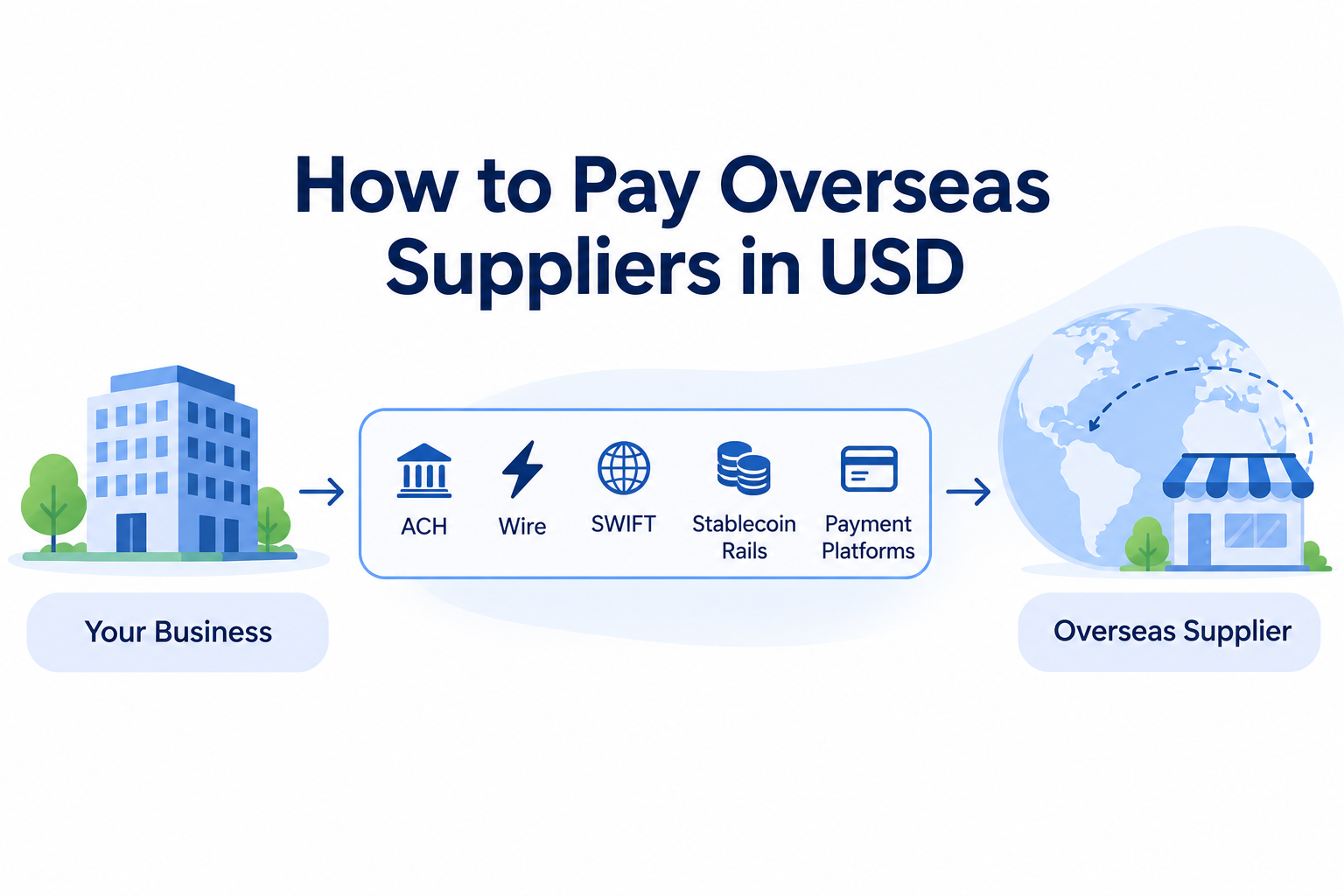
Finance, treasury, payments operations, global trade, and supply-chain teams often need to pay overseas suppliers in USD. Paying in USD means settling the supplier’s invoice in US dollars.
The payment may start from a bank account, payment platform, or stablecoin balance. A stablecoin balance must be converted and settled into USD when the supplier requires fiat currency.
Before starting, prepare the approved supplier invoice, beneficiary legal name, and account details. You may also need routing information, SWIFT/BIC and intermediary-bank details, payment purpose, compliance checks, internal approval, and fee instructions.
The right payment rail depends on the supplier’s receiving capability, destination market, amount, urgency, documentation, and reversibility requirements. It also depends on whether your business already holds USD or stablecoins.
Confirm supplier payment requirements before choosing a payment method
Start by confirming the supplier’s required receiving currency and account type. An invoice denominated in USD does not determine the payment method.
The supplier may need USD credited to a US account, USD credited through an international bank, or a local-currency payout calculated from the USD value. These are different settlement requirements.
Ask whether the supplier accepts ACH, Fedwire, SWIFT, platform payouts, or stablecoin settlement. Do not assume that accepting USD invoices means accepting every USD payment rail.
ACH is an electronic network for consumer, business, and government transactions in the United States, according to Nacha’s ACH overview. SWIFT provides financial messaging between institutions rather than directly moving customer funds, as explained by SWIFT’s network description.
Collect and verify the following information:
•Currency received
•Beneficiary legal name
•Account number and routing number, where applicable
•SWIFT/BIC and intermediary-bank details for international wires
•Bank address and supplier address
•Invoice number and payment purpose
•Required value date
•Fee allocation
•Required payment reference or proof of payment
•Supporting trade and compliance documents
A payment is ready for the next step only when the supplier confirms both the receiving currency and exact rail or bank details. If the supplier cannot confirm them, validate the instructions independently before proceeding.
Compare banks, payment platforms, and stablecoin rails side by side
No single payment rail is best for every overseas supplier. Businesses comparing international payment options can also explore this guide to cross-border payments to understand payment methods, costs, and settlement considerations. Choose based on the supplier’s account, deadline, payment certainty, cost, and operational requirements.
| Rail | Best fit | What the supplier receives | Typical operational trade-off | Main validation step |
|---|---|---|---|---|
| ACH | Planned payments to eligible US accounts | USD through a supported US account | Timing depends on submission windows, providers, and receiving institutions | Confirm the account and cross-border route are eligible |
| Fedwire | Time-critical bank transfers | USD through a participating bank | Higher wire costs may apply | Confirm beneficiary instructions, fees, and receiving-bank crediting |
| SWIFT | International bank connectivity | USD or another supported currency through banks | Intermediaries, compliance checks, and local processing can affect timing | Obtain complete wire and intermediary-bank instructions |
| Stablecoin rail | Digital-dollar movement with conversion or on-ramp requirements | A supported token, or converted USD | Adds token, network, wallet, redemption, and compliance risks | Confirm the token, network, wallet, conversion path, and settlement currency |
| Payment platform | Consolidated workflows across multiple rails | The currency and method supported by the platform | Availability, limits, fees, and corridors vary by provider | Confirm destination, rail, currency, timing, and account support |
ACH supports business-to-business and scheduled payments. Same Day ACH can settle eligible payments on the same banking day, subject to provider rules and limits, according to Nacha’s payment facts.
Fedwire is a Federal Reserve real-time gross settlement service for time-critical, high-value payments. Accepted payments are final and irrevocable at the service level, according to Federal Reserve Fedwire information.
FedNow supports instant payments through participating US financial institutions. It offers real-time availability around the clock, but access depends on participating institutions and account relationships, as described by the Federal Reserve’s FedNow service.
A stablecoin is a cryptoasset designed to maintain a stable value relative to a specified asset or basket. That design does not guarantee permanent stability, as noted in Basel Committee stablecoin guidance.
USDC and USDT are examples of USD-referenced stablecoins. Their issuers describe them as backed by reserves through Circle’s USDC information and Tether’s USDT information. Businesses should still assess issuer, redemption, blockchain, counterparty, compliance, and operational risks.
Choose ACH when the supplier has an eligible US account and the payment is planned. Choose Fedwire when speed and payment finality matter more than wire cost. Use SWIFT when the beneficiary is reached through international banking.
Consider a stablecoin rail only when both sides and the provider support the exact token, network, conversion process, and compliance workflow.
Prepare the USD supplier payment for approval and compliance review
Verify the beneficiary against the supplier record, purchase order, contract, and invoice. This helps prevent payments to altered or fraudulent instructions.
Use a maker-checker process for new beneficiaries, changed bank details, unusual amounts, urgent requests, and payments outside normal procurement channels.
Record the invoice number, payment purpose, goods or services description, amount, currency, requested value date, fee allocation, and supporting documents. Screen the parties, destination, intermediary institutions, and transaction context under your applicable sanctions, anti-money laundering, know-your-business, and internal-risk procedures.
The Financial Action Task Force defines relevant terms in its anti-money laundering glossary. Its guidance also addresses virtual assets and virtual asset service providers in its risk-based guidance.
Stablecoin payments require additional checks:
•Token name
•Blockchain network
•Destination wallet
•Wallet ownership or control
•Required transaction confirmations
•Conversion path
•Ability to settle into the supplier’s required currency
The payment passes the preparation gate when two authorized reviewers can trace the amount from the approved invoice to the exact beneficiary account or wallet and documented payment rail.
Send USD through a bank using ACH, Fedwire, or SWIFT
Select the bank rail that matches the supplier’s account, deadline, and required payment certainty. Review the final amount and fee option before release.
ACH generally fits recurring or planned payments to eligible US accounts. Timing depends on the ACH type, submission window, provider, and receiving institution.
Fedwire supports time-sensitive transfers. Payment orders settle individually in real time when accepted, and Federal Reserve materials describe them as final and irrevocable at the service level.
SWIFT carries payment instructions between financial institutions. The receiving bank’s processing, local regulations, compliance checks, intermediary relationships, and beneficiary-crediting process can affect final availability.
For an overseas supplier, a USD wire may still require intermediary-bank information. Ask the supplier to confirm the complete wire template before initiating payment.
Bank fees may include sending fees, receiving fees, intermediary deductions, foreign-exchange spreads, and repair or investigation charges. Confirm the expected amount received with both the sending and receiving institutions.
Use this release sequence:
1.Select ACH, Fedwire, or SWIFT based on the verified beneficiary account and deadline.
2.Enter the beneficiary, currency, amount, reference, and fee option.
3.Review the final payment summary against the approved invoice.
4.Complete the required approval and compliance checks.
5.Release the payment through the bank.
6.Save the transaction reference or confirmation.
Do not use ACH merely because the invoice is in USD. ACH requires an eligible account and supported receiving path.
The bank payment was released correctly when the confirmation shows the beneficiary, amount, currency, requested execution date, and selected rail.
Use a payment platform or stablecoin rail when consolidation or corridor access matters
A payment platform can help when your business needs to hold USD, convert currencies or stablecoins, send cross-border payments, and reconcile activity from one account.
Fuze Business is a cross-border payments platform for businesses to send, receive, and convert fiat currencies and stablecoins from one account. Its capabilities include USD, AED, GBP, EUR, stablecoin conversion, cross-border payments, payouts, banking-network access, stablecoin wallets, and enterprise-grade compliance.
Businesses can obtain a named USD account with account and routing details without setting up a US entity. This remains subject to onboarding and know-your-business requirements.
Fuze Business also describes workflows for payment, collection, conversion, stablecoin wallets, transaction tracking, and corridor access through one account. Confirm the specific destination, rail, limits, fees, and settlement timing before promising a supplier a payment date. Businesses can manage supported payment, collection, conversion, and transaction-tracking workflows from one account. Check Fuze Business for current product and availability information.
A platform route may suit your business when it supports the supplier’s:
•Destination
•Receiving currency
•Payment rail
•Token and blockchain network, where applicable
•Conversion path
•Compliance requirements
•Settlement timing
•Fee expectations
Stablecoin transfers require the token, network, wallet address, amount, and confirmation policy to match exactly. A stablecoin’s intended USD reference does not remove blockchain, issuer, redemption, compliance, or counterparty risk.
Hold USD when the supplier needs USD. Convert only when the receiving corridor requires another currency. Keep the payment record attached to the transaction.
Confirm receipt and reconcile the supplier payment
A payment is not complete when it is submitted. Close it only after the supplier or receiving account confirms credit.
Save the invoice, approval record, payment instruction, transaction reference, bank confirmation or blockchain transaction hash, conversion record, fee breakdown, and supplier acknowledgment together.
Reconcile the amount debited from the business against the amount expected by the supplier. Investigate differences caused by fees, foreign-exchange conversion, intermediary deductions, or incorrect beneficiary details.
For bank payments, track the payment until the supplier confirms credit. A SWIFT payment may reach the destination bank before it reaches the beneficiary account.
For stablecoin payments, verify the transaction on the correct blockchain. Confirm the required number of confirmations and obtain acknowledgment that the supplier received the correct token and amount.
Use clear status labels:
•Submitted
•Processing
•Settled
•Supplier confirmed
•Returned
•Exception
•Needs investigation
Fuze Business provides transaction tracking and reconciliation capabilities through one dashboard, helping businesses monitor payment activity and maintain transaction records. Available reporting and reconciliation features depend on the account and product configuration
Close the payable only when supplier acknowledgment or receiving-account evidence matches the approved invoice amount, currency, beneficiary, and payment reference.
Get a USD account and manage supplier payments from one place
Use a bank rail when the supplier and deadline fit traditional banking. Use a platform when consolidation and corridor access matter. Consider stablecoin rails only after confirming the token, network, compliance, and settlement requirements.
Fuze Business is for businesses that need to send, receive, and convert fiat currencies and stablecoins from one account. Businesses can get a USD account in their business’s name without setting up a US entity, subject to eligibility and onboarding requirements.
The account features include dedicated account details and USD collection and payouts through ACH, Fedwire, RTP, FedNow, and SWIFT. Confirm current corridor availability, limits, eligibility, and rail support during onboarding.
Manage global money movement, payment tracking, and reconciliation from one place with Fuze Business.