

This guide is for finance managers, global trade companies, and supply-chain teams paying mainland Chinese suppliers in CNY. Three terms are often confused: SWIFT/BIC, CIPS, and CNAPS.
A SWIFT/BIC identifies an institution and supports financial messaging. CIPS provides cross-border RMB clearing and settlement. CNAPS supports domestic RMB payment routing in mainland China.
The correct payment route determines which details you need. A payer may need a SWIFT/BIC, CNAPS code, CIPS participant identifier, or a combination. The sending institution, beneficiary bank, payment corridor, and payment format all matter.
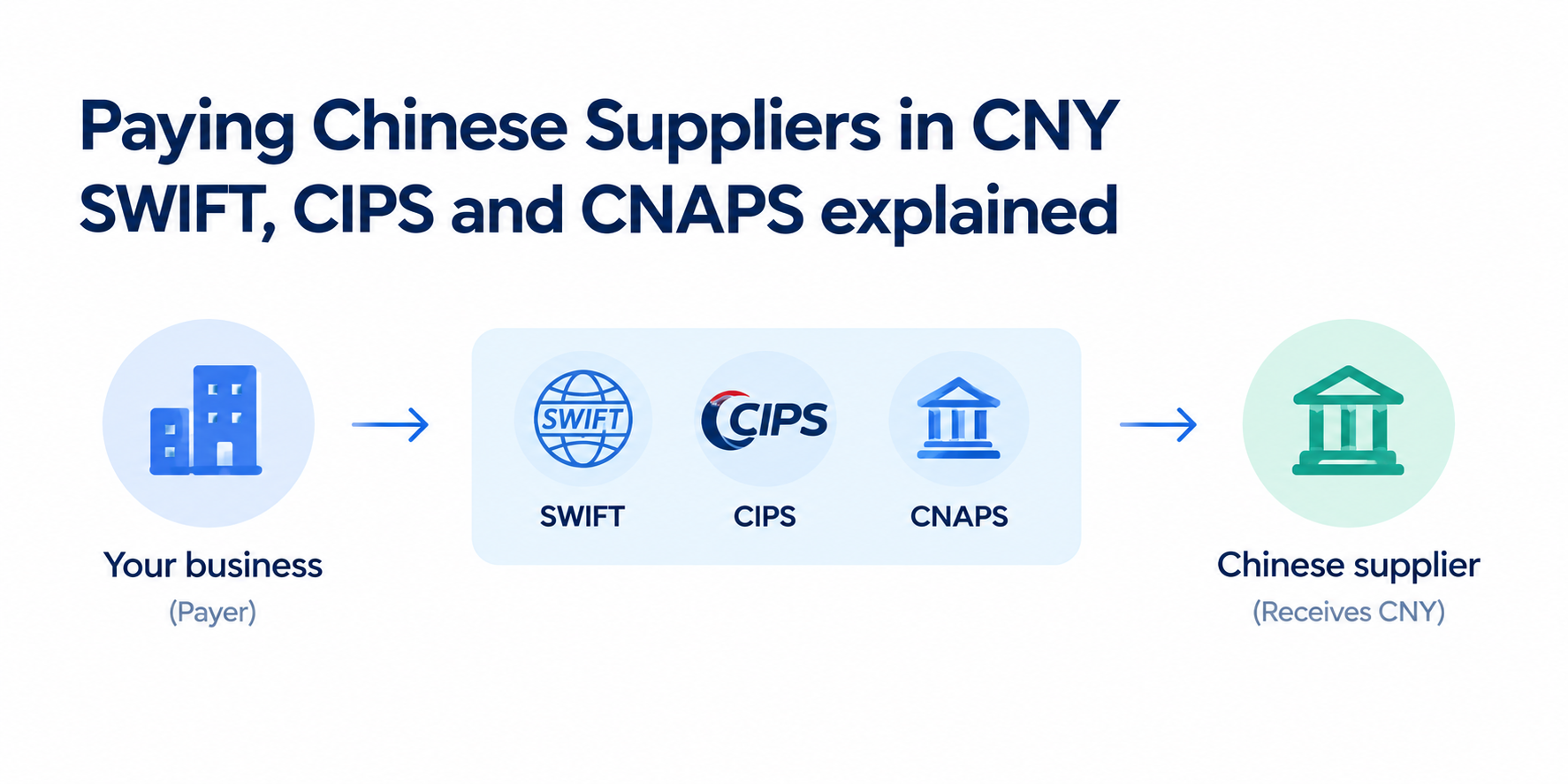
Understand what SWIFT, CIPS and CNAPS each do
SWIFT/BIC, CIPS, and CNAPS serve different purposes. They should not be entered as substitutes for one another.
•SWIFT/BIC: A Bank Identifier Code, or BIC, is an ISO 9362 business identifier. It identifies financial and non-financial institutions, addresses messages, and helps route business transactions. A BIC has eight characters, with an optional three-character branch identifier. SWIFT explains BIC structure.
•CIPS: The Cross-border Interbank Payment System is approved by the People’s Bank of China. It provides cross-border RMB clearing and settlement services. CIPS participants can be direct participants or indirect participants using a direct participant to process transactions. CIPS describes its participant model.
•CNAPS: CNAPS is a mainland China RMB payment system. Participating banks receive CNAPS bank codes, commonly described as 12-digit identifiers used for payment routing. Bank guidance explains CNAPS routing.
A BIC does not automatically mean that the institution connects to the SWIFT network. SWIFT distinguishes between connected and non-connected BICs.
The practical summary is simple: SWIFT/BIC identifies an institution; CIPS provides a cross-border RMB rail; CNAPS identifies a mainland RMB clearing destination.
If a supplier provides only a bank name and account number, pause the payment. Ask your provider whether it also needs a SWIFT/BIC, CNAPS code, CIPS identifier, payment-purpose code, or additional beneficiary data.
Each requested code should map to a specific field in the payment form. It should not be entered as a replacement for another code.
Compare SWIFT, CIPS and CNAPS routes for CNY supplier payments
Do not choose a code first. Identify the payment route, then provide the identifiers that route requires.
SWIFT is a messaging and addressing framework. It does not itself hold funds or perform the underlying settlement. CIPS provides clearing and settlement services for eligible cross-border and offshore RMB transactions. CNAPS is associated with RMB payment processing within mainland China.
A cross-border CNY payment may use a correspondent route, CIPS connectivity, CNAPS-based domestic delivery, or several systems in sequence. Access to a CIPS route depends on the payer’s bank or payment provider. A corporate payer does not usually access CIPS independently.
| Route or identifier | Primary role | Typical scope | Who usually supplies the code | What can go wrong | Best validation question |
|---|---|---|---|---|---|
| SWIFT/BIC | Identifies an institution and supports financial messaging | International payment instructions | Supplier, beneficiary bank, or payment provider | Incorrect institution or branch details | Does this route require a BIC for the beneficiary bank? |
| CIPS | Provides cross-border RMB clearing and settlement infrastructure | Cross-border RMB payments | Payment provider or participating bank | The chosen provider may not support the required participant route | Can this provider settle this payment through a supported CIPS route? |
| CNAPS | Identifies a mainland RMB clearing destination | Domestic RMB routing in mainland China | Supplier or beneficiary bank | Missing or incorrect branch code | Is this the exact CNAPS code for the beneficiary account and branch? |
For a mainland Chinese supplier, the provider may request the legal name, account number, bank branch, CNAPS code, SWIFT/BIC, and payment purpose. It may also request a CIPS participant identifier or other route-specific data.
The payment instruction is ready when the provider accepts the data without a missing-routing warning. It should also confirm the intended CNY settlement route.
Collect the complete beneficiary instruction before sending CNY
Request a complete payment instruction from the supplier before approving the transfer. The exact fields vary by provider, corridor, account type, currency, and beneficiary bank.
Bank remittance forms commonly request the following information:
•Legal beneficiary name and account name
•Account number
•Beneficiary address
•Bank and branch name
•Beneficiary bank address
•Payment currency
•SWIFT/BIC, where requested
•CNAPS or another clearing identifier, where requested
•CIPS participant identifier, where requested
•Invoice or payment reference
•Payment-purpose code or description
•Charge arrangement
Bank of China’s remittance guidance includes the beneficiary account number, name, full address, remittance purpose, beneficiary bank name and address, SWIFT code, and a beneficiary-bank clearing code where applicable. Its remittance guidance lists these details.
CNAPS codes are commonly presented as 12-digit identifiers for Chinese bank or branch routing. Obtain the exact code from the supplier or beneficiary bank. Do not infer it from the bank name alone.
CNY cross-border instructions may also require a payment-purpose code or description. Common categories include goods trade, service trade, capital transfer, current-account transactions, charity donations, and bank fund transfers. HSBC outlines RMB payment-purpose categories.
Before releasing a purchase-order payment, compare the supplier’s bank certificate with the invoice and saved beneficiary record. The legal name, account number, branch, currency, invoice reference, and purpose should agree.
If bank details have changed, verify the change through an independent, trusted channel. Do not rely only on a new email or message containing revised payment instructions.
Check CNY payment instructions for errors, compliance gaps and avoidable delays
Missing or invalid routing information can cause a payment to be delayed, rejected, held for repair, or returned. Bank guidance warns that missing CNAPS information may make a CNY instruction insufficient for processing. Remittance guidance highlights CNAPS requirements.
Missing or invalid payment-purpose information can also lead to rejection, delay, or additional charges for cross-border RMB payments. HSBC describes these payment-purpose risks.
The purpose should describe the real commercial activity. A supplier payment for manufactured goods should not be coded as a service, capital, or personal transfer.
The beneficiary name should match the name held by the receiving bank. Differences in transliteration, abbreviations, branch information, or account ownership can trigger manual review.
Use this pre-release sequence:
1.Validate the beneficiary and payment details.
2.Complete required screening and compliance checks.
3.Confirm the payment route and currency.
4.Submit the instruction for settlement.
5.Confirm the beneficiary received the funds.
6.Reconcile the final amount and payment records.
Retain invoices, purchase orders, contracts, shipping or trade documents where relevant, payment confirmations, and compliance correspondence. Follow your internal controls and applicable requirements.
A successful payment submission is not the same as beneficiary credit. Monitor the payment through settlement and reconcile the final amount received.
For example, a payment may be placed on hold because its purpose code says service trade while the invoice describes manufactured goods. Resolve this by confirming the correct category with the provider, updating the instruction, and retaining the supporting invoice and approval record.
Choose between traditional bank transfers and a unified cross-border payment workflow
Traditional bank transfers can involve multiple institutions, correspondent banking chains, FX conversion, compliance checks, and separate reconciliation steps. A unified workflow may centralize more of these activities where the corridor is supported.
The appropriate route depends on:
•Source currency and required settlement currency
•Beneficiary location and account type
•Payment purpose
•Bank and provider coverage
•Compliance requirements
•Total cost
•Required settlement timing
•Reconciliation and tracking needs
Compare more than the visible transfer fee. Review the FX spread or conversion charge, intermediary fees, receiving fees, and final amount received.
| Approach | Strengths | Points to review |
|---|---|---|
| Traditional bank chain | Familiar banking process and established payment relationships | Potentially fragmented routing, multiple fees, FX steps, and reconciliation work |
| Unified payment workflow | Can centralize sending, receiving, conversion, and payment operations where supported | Corridor availability, eligibility, pricing, settlement timing, and required compliance checks |
Fuze Business supports sending, receiving, and converting funds through one unified account. Its listed capabilities include access to difficult trade corridors, banking-network connectivity, CNY, cross-border payments, instant currency and stablecoin conversion, enterprise-grade compliance, and faster settlement. See Fuze Business’s platform overview.
When comparing a USD-funded CNY supplier payment, use the same invoice amount for each route. Confirm corridor eligibility, applicable FX and fees, required supplier data, and the settlement or tracking outcome before choosing.
How Fuze Business Supports Global Supplier Payouts
Paying Chinese suppliers in CNY requires the correct beneficiary bank details, a supported payment route, and complete payment instructions. Businesses paying suppliers across multiple countries may also need currency conversion and reliable local payout options.
Businesses can use Fuze Business to facilitate CNY payouts to suppliers in China through supported payment workflows. For suppliers in other countries, Fuze Business can also support USD payouts across eligible international corridors, subject to the destination, payment route, and applicable requirements.
Depending on the supported corridor, businesses may be able to fund payments using a held currency or stablecoin while recipients receive funds in the required payout currency. Availability, FX rates, fees, compliance requirements, and settlement times depend on the transaction and destination.
The correct SWIFT/BIC, CIPS, or CNAPS details are only one part of a successful supplier payment. The beneficiary's bank instructions, supported route, payment purpose, and compliance checks must also be in place.
If your business pays suppliers in China or manages payouts across multiple countries, explore Fuze Business global payout capabilities or learn how global supplier payments work.