

Global payouts involve more than sending money to another country. A business must identify the payee, validate the payment purpose and account details, select the currency and route, estimate total cost and settlement timing, complete relevant compliance and tax checks, and reconcile the result.
Suppliers, distributed teams, and partners are different payee groups. Suppliers may follow invoice schedules. Teams may require recurring payroll or contractor payments. Partners such as distributors, agents, and logistics providers may have different documentation, urgency, and currency requirements.
The final outcome can also depend on corridor availability, local banking infrastructure, foreign exchange liquidity, regulatory requirements, payment-system hours, and data quality. This guide provides a foundational process. Tax and compliance treatment remains specific to the payer, payee, payment type, and jurisdictions involved.
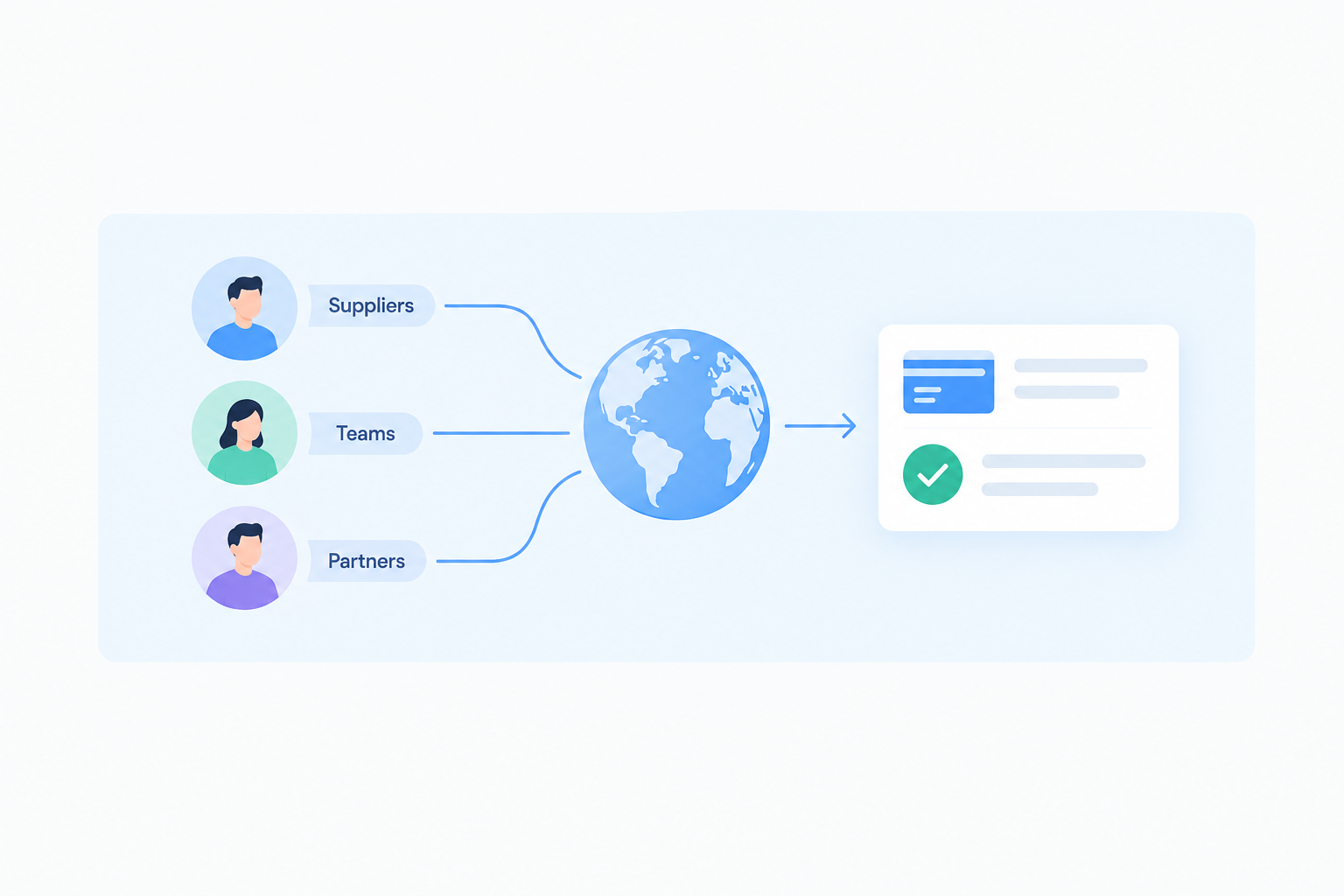
Start with the requirements of each global payee
Start by documenting what each payee needs before selecting a payment method. A global payout process can include suppliers, contractors, employees, distributors, agents, logistics partners, and other commercial counterparties. Each group may require different approval, documentation, currency, and payment-frequency rules.
Cross-border payments generally involve more complexity than domestic payments because multiple jurisdictions, payment systems, financial institutions, time zones, and compliance regimes may be involved. The BIS explains cross-border payment complexity in the context of these different systems and requirements.
The payment record should connect the following information:
| Requirement | What to record |
|---|---|
| Payee identity | Legal name and relevant business or beneficial-owner information |
| Commercial basis | Invoice, contract, purchase order, or other payment reference |
| Payment value | Amount, currency, due date, and payment purpose |
| Destination | Bank or wallet instructions and destination country |
| Charges | Sender-side fees, receiving fees, and charge allocation |
| Authorization | Approval owner, approval status, and release evidence |
| Reconciliation | Accounting reference, settlement record, and recipient confirmation where available |
Document requirements by corridor instead of assuming that one process works everywhere. A USD-to-EUR payment may follow different rules from a payment into CNY, AED, or another currency.
For example, a supplier invoice is not payment-ready until the beneficiary name, destination account details, invoice reference, currency, amount, due date, and approval status match the company’s records. Finance teams should be able to produce an approved checklist for each material corridor and payee category.
Choose the payment currency, route, and settlement expectation
Choose the currency and route based on what the recipient must receive, by what date, and at what total cost. Currency choice affects the amount received, foreign exchange exposure, conversion timing, and the possibility of intermediary or receiving-bank charges.
The World Bank outlines common remittance cost components, including a sending fee, an exchange-rate margin, and, in some cases, a receiving fee. These categories are useful prompts when comparing business payment options, although business pricing and corridor economics can differ.
Cross-border performance can vary because of local infrastructure, market liquidity, payment-system hours, compliance checks, and the number of intermediaries. The BIS identifies operational factors that can influence cross-border payment outcomes.
A payment policy should distinguish between:
•The amount debited from the sender.
•The amount the recipient is expected to receive.
•The currency the recipient receives.
•The party responsible for transfer charges.
•The expected settlement date.
Paying in a supplier’s requested currency may simplify the supplier’s cash management. Paying from an existing balance may reduce internal conversion steps. Neither approach is automatically better.
For an invoice denominated in CNY, compare the total amount debited, the exchange rate or conversion margin, stated fees, expected settlement date, and CNY amount the supplier should receive. The approver should see the source balance, conversion rate or quote, sender-side fees, recipient currency, delivery expectation, and charge allocation before release.
Compare payment options by corridor, cost, and control
Compare payment options using the same principal amount and the same recipient requirement. Traditional cross-border payments may use correspondent banking chains. Other models may use multicurrency systems or newer payment technologies. Each model can differ in speed, access, transparency, and settlement risk, as described in BIS research on payment models.
Do not judge an option by its headline fee alone. Include the foreign exchange margin, intermediary charges, receiving fees, funding cost, return or repair risk, expected settlement time, and manual reconciliation effort.
Evaluate the complete payment workflow rather than looking at a single headline fee. Consider foreign exchange, intermediary charges, funding requirements, expected settlement time, return or repair risk, and manual reconciliation effort where relevant.
| Option | Main points to assess |
|---|---|
| Bank or correspondent route | Intermediary fees, cutoff times, supported currencies, and possible manual repairs |
| Payment platform with banking network | Corridor access, supported currencies, settlement expectations, transparency, and reconciliation |
| Stablecoin-supported route | Conversion capability, required recipient currency, applicable controls, and treasury policy |
A banking network may help when a destination market is difficult to reach. The business should still confirm supported currencies, recipient requirements, cutoff times, and compliance dependencies for the specific corridor.
Stablecoin conversion may be relevant when a business holds stablecoins and needs to settle in a required fiat currency. The process still needs appropriate compliance, counterparty, treasury, and conversion controls.
The best route depends on the business priority. That priority may be recipient certainty, speed, cost, corridor access, or operational control. A finance manager should compare recipient value, settlement expectations, and exception handling for the same payment.
We support cross-border payments and money movement through Fuze Business, including banking network connectivity and access to supported corridors. Businesses can use Fuze Business for supplier and partner payments while continuing to use their existing accounting, treasury, and reconciliation systems where appropriate.
Build compliance, tax, and fraud controls into the payment workflow
Build compliance and fraud controls into vendor onboarding and payment release. Do not treat them as a final review added after the payment has been prepared.
FATF Recommendation 16 addresses payment transparency for cross-border and domestic payments or value transfers. Its payment transparency recommendations show why payment data and information-sharing expectations can shape operational requirements.
Organizations subject to U.S. jurisdiction, and certain foreign entities with U.S. connections, may also need a sanctions compliance program suited to their risks. OFAC guidance on sanctions compliance provides relevant context for organizations within its scope.
For U.S. withholding agents, the IRS explains that documentation such as Forms W-8 may help establish a foreign payee’s status and support a reduced rate or exemption where applicable. The correct treatment depends on the payment and payee, as outlined in the IRS instructions for Form W-8.
A basic control framework should include:
•Verify the payee identity and beneficiary details.
•Confirm relevant business or beneficial-owner information.
•Screen relevant parties against applicable sanctions requirements.
•Validate bank or wallet instructions independently.
•Collect applicable tax forms and documentation.
•Record the payment purpose and commercial reference.
•Separate payment preparation from approval.
•Apply dual approval to high-risk or high-value payments.
•Retain the invoice, approval, screening result, and settlement evidence.
Requirements are jurisdiction- and fact-specific. This checklist is not a substitute for legal, tax, sanctions, or regulatory advice.
For example, a U.S. company paying a foreign service provider may need to determine whether the payment is subject to U.S. withholding and whether valid foreign-status documentation is available. Finance should resolve that question before releasing the payment.
Design an on-time payment process for recurring global obligations
Start the payment process before the contractual due date. Time zones, local holidays, payment-system operating hours, intermediary processing, incomplete information, compliance reviews, and funding availability can all affect timing.
Recurring supplier and partner payments benefit from a corridor playbook. It should record standard currencies, cutoff times, required documents, escalation contacts, and expected settlement behavior.
A practical sequence is:
1.Receive the invoice or payment instruction.
2.Validate the beneficiary and commercial reference.
3.Confirm the currency and amount.
4.Check the balance and foreign exchange exposure.
5.Complete required approvals.
6.Complete screening and release the payment.
7.Monitor payment status.
8.Reconcile the settlement.
9.Document any exception and its resolution.
Set the internal release deadline earlier than the contractual due date. If a supplier must receive funds by Friday, allow time for the corridor’s operating hours, weekends, holidays, and possible compliance review.
Faster settlement does not remove the need for risk-based controls. OFAC guidance on instant payment systems states that payment speed should not discourage appropriate sanctions controls.
To reduce late payments, standardize beneficiary data, maintain corridor-specific cutoff and holiday calendars, pre-fund or confirm balances, and assign an owner for exceptions. A reliable process should report on-time delivery by corridor and explain late payments using reason codes such as missing data, funding, compliance review, bank rejection, or recipient-side issues.
Reconcile every payout and improve the global payment program
Reconcile every payout against its commercial, financial, and settlement records. The accounting record should connect to the invoice or contract, payment instruction, conversion or foreign exchange record, fees, settlement confirmation, and recipient acknowledgment where available.
We bring sending, receiving, converting, and transaction tracking into one unified account through Fuze Business, helping businesses maintain clearer visibility across cross-border payment workflows.
Track consistent metrics across currencies and corridors, including:
| Metric | What it helps measure |
|---|---|
| On-time payment rate | Whether payments reach recipients by the required date |
| Average settlement time | How long payments take by corridor |
| Total cost per corridor | Fees, conversion costs, and other payment expenses |
| Failed or returned payment rate | Payment reliability and data quality |
| Manual-touch rate | Operational effort required per payment |
| Exception aging | How long unresolved issues remain open |
| Unreconciled balance value | Financial items not yet matched or explained |
Define foreign exchange cost consistently. Finance teams should specify whether they measure it against a reference rate, quoted rate, or accounting rate.
At month-end, match each supplier payment to its invoice. Record the principal, conversion details, fees, settlement date, and any difference between expected and actual recipient value.
The process is working when finance can close the payment period without unexplained open items. The team should also be able to identify which corridors or payee groups create the highest cost, delay, or exception burden.
Use a unified platform to manage global supplier and partner payments
Global trade companies, finance managers, and supply chain managers may benefit from a more coordinated process when payments, collections, and currency conversion are fragmented across systems.
Fuze Business provides a unified platform for sending, receiving, and converting funds across borders. Our capabilities include access to difficult trade corridors, banking network connectivity, cross-border payments, enterprise-grade compliance, faster settlement, and currency and stablecoin conversion.
Fuze Business supports currencies including AED, CNY, and EUR, with coverage depending on the specific corridor, recipient, compliance process, and settlement requirements.
If your business manages recurring supplier payouts, distributed team payments, partner obligations, difficult corridors, or multiple currency needs, Fuze Business can support your international payment operations through a unified workflow.