
SEPA means the Single Euro Payments Area. It is a harmonised framework that helps electronic euro payments operate under common rules and standards across participating European countries and territories.
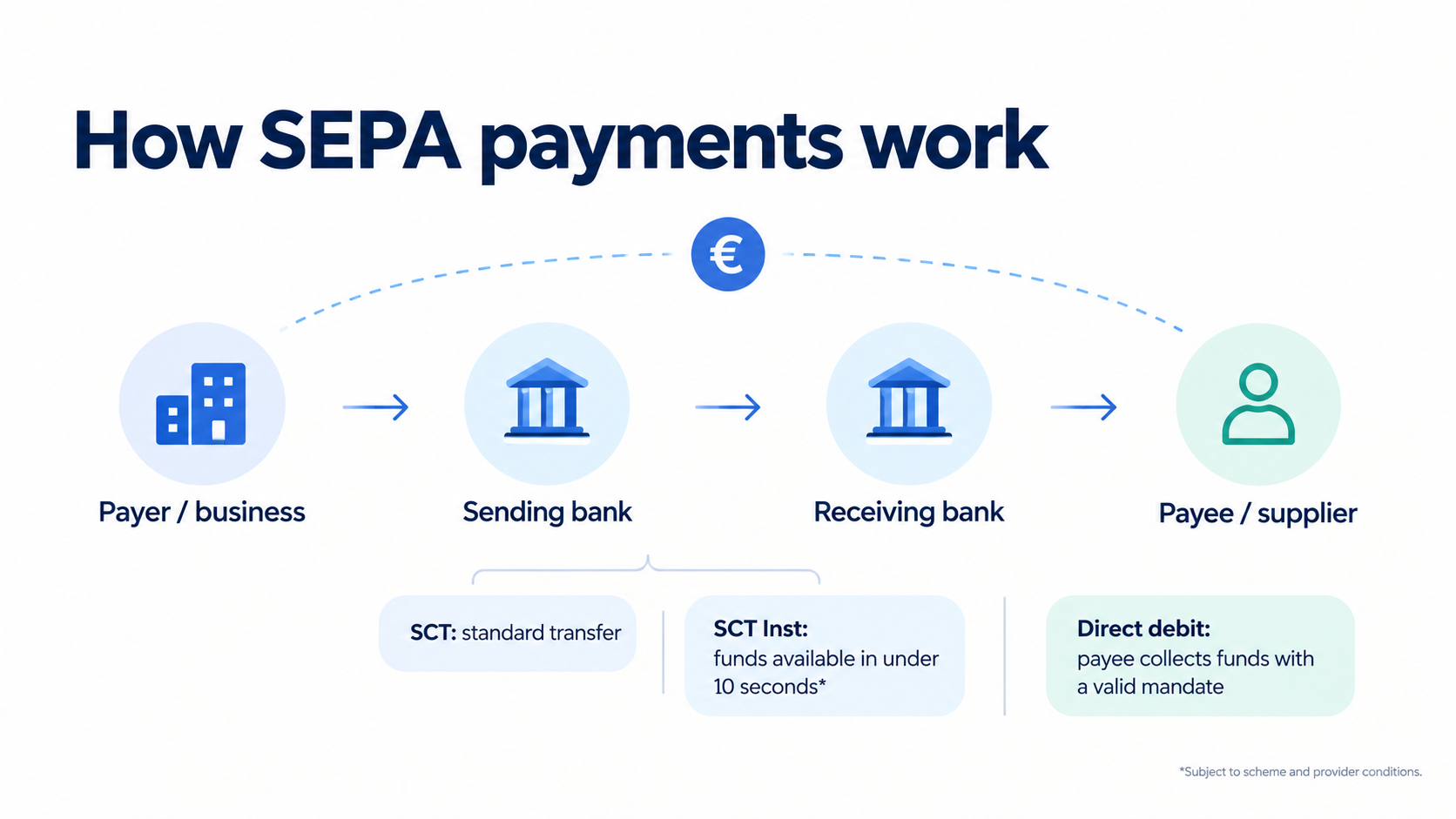
Before discussing how a payment moves, several terms matter. A payment service provider is the bank or regulated provider that sends, receives, or processes a payment. An International Bank Account Number (IBAN) identifies a payment account. A SEPA Credit Transfer (SCT) pushes funds from a payer to a beneficiary. A SEPA Instant Credit Transfer (SCT Inst) is designed to make funds available almost immediately. A SEPA Direct Debit (SDD) lets a payee collect funds after receiving the payer’s mandate or consent.
SEPA can include countries outside the European Union. However, a SEPA payment is generally denominated in euros and must meet the relevant scheme requirements. Availability, fees, cut-off times, compliance checks, and transaction limits can still depend on the providers involved.
This guide explains when SEPA suits finance managers, global trade companies, and supply chain teams. It also shows when a broader cross-border payment platform may be more appropriate. For a broader overview of international payment methods, costs, and settlement considerations, read our guide to cross-border payments.
What is SEPA?
SEPA is the rulebook and payments area that makes many euro payments across Europe work more like domestic payments.
The European Commission describes SEPA as covering credit transfers, direct debits, and card payments under common basic conditions. The European Payments Council’s geographical scope currently includes 41 countries and territories.
That scope is broader than the European Union. It includes the 27 EU Member States and additional European countries and territories. Participation in the geographical area does not mean every provider offers every SEPA product.
A SEPA payment also has a specific meaning. It describes how a euro payment is processed under an applicable scheme. It does not mean every international payment is a SEPA payment.
For example, a business may send euros from a participating country to an eligible beneficiary account. It may then use an SCT payment, subject to the provider’s requirements and the relevant scheme. The currency, account eligibility, and provider reachability must all be checked first.
How a SEPA credit transfer moves from payer to payee
A standard SEPA Credit Transfer starts when the payer instructs a payment service provider to send euros to the beneficiary’s account.
The flow usually works as follows:
1.The payer submits the beneficiary’s name, IBAN, euro amount, remittance information, and authorisation.
2.The payer’s provider validates the instruction and applies fraud, sanctions, identity, and account checks.
3.Clearing and settlement mechanisms, or intermediary providers, route the payment to the beneficiary’s provider.
4.The beneficiary’s provider credits the recipient’s payment account.
5.The payer and beneficiary reconcile the payment using the confirmation and remittance information.
The process relies on standardised data and payment messages based on ISO 20022 standards. The SCT rulebook and scheme requirements define important processing rules.
Under the standard SCT framework, execution is generally linked to one banking business day after the provider receives the instruction. This expectation depends on applicable law, banking-business-day conditions, and provider processing.
A payment submitted after a provider’s daily cut-off may count as received on the next banking business day. Weekends, holidays, incorrect account details, insufficient funds, compliance reviews, rejections, and recalls can also affect completion.
Therefore, one banking business day does not guarantee immediate availability at every provider.
SEPA payment types compared
SEPA schemes differ by payment direction, initiation method, and expected availability. The EPC payment schemes include SCT, SCT Inst, SDD Core, SDD Business-to-Business, and One-Leg-Out Instant Credit Transfer.
| Scheme | Direction and typical use | Speed expectation | Initiation method |
|---|---|---|---|
| SCT | Standard euro account-to-account transfer, such as supplier settlement or payroll | Generally linked to banking-business-day processing | Payer initiates and pushes funds |
| SCT Inst | Near-real-time euro transfer | Funds made available in less than ten seconds under scheme conditions | Payer initiates and pushes funds |
| SDD Core | One-off or recurring consumer and business collection | Depends on the collection and provider process | Payee initiates after a mandate |
| SDD B2B | Business-to-business collection | Depends on the collection and provider process | Payee initiates under business-specific requirements |
SCT Inst operates continuously, subject to permitted provider maintenance and exceptional processing conditions. Its execution requirements target availability in less than ten seconds.
Direct debit is not a faster version of a credit transfer. It uses a different payment direction and authorisation model. A credit transfer is pushed by the payer, while a direct debit is pulled by the payee under a valid mandate or consent arrangement.
Payroll and supplier settlement are usually credit-transfer use cases. Subscriptions and recurring collections are usually direct-debit use cases.
Where SEPA works and what businesses need to send a payment
The EPC currently lists 41 SEPA countries and territories. These include the 27 EU Member States, the United Kingdom, Iceland, Norway, Liechtenstein, Switzerland, Monaco, San Marino, Andorra, Vatican City or the Holy See, Montenegro, Albania, North Macedonia, Moldova, and Serbia.
The EPC’s country list shows geographical participation. It does not prove that every account, provider, currency, or payment product is available.
Businesses should check the scheme, currency, beneficiary account, and provider reachability. They should not rely on the country name alone.
Common payment inputs include:
•Beneficiary name
•Beneficiary IBAN
•Payment amount in euros
•Payment purpose or remittance information
•Payer authorisation
•Compliance information requested by the provider
A business sending another currency generally needs a different payment or conversion workflow. SEPA participation does not turn a non-euro payment into a SEPA payment.
The United Kingdom remains within the EPC’s listed geographical scope. However, a UK payment may still depend on provider onboarding, compliance checks, and account availability.
SEPA transfer costs, speed, and current payment rules
Qualifying cross-border electronic payments in euros should generally cost the same as corresponding domestic payments with the same provider. The EU fee-equality rule applies to the comparable domestic payment, not to every possible transaction.
This rule does not mean every SEPA transfer is free. Providers can set charges for domestic payments and apply other disclosed fees where permitted. Same price as a comparable domestic payment does not mean zero price.
Standard SCT timing is usually measured in banking business days. Cut-off times, weekends, holidays, compliance checks, provider processes, and incorrect payment data can change the outcome.
SCT Inst is designed to make funds available in less than ten seconds, 24 hours a day and on calendar days. This remains subject to scheme conditions, provider availability, maintenance, and exceptional processing rules. The SEPA Instant framework describes the service level.
The Instant Payments Regulation introduced staged obligations covering instant-payment receipt, sending, equal charges, and Verification of Payee. The applicable dates vary by provider type and by euro-area or non-euro-area status. The European Central Bank’s regulation overview explains these requirements.
Verification of Payee helps identify discrepancies between the account identifier and the intended payee name before a credit transfer begins. It can support payment accuracy, but it does not replace sanctions, fraud, identity, or account checks.
SEPA advantages, limitations, and alternatives for global payments
SEPA standardises many euro payment processes across participating countries. This can simplify supplier payments, payroll, recurring collections, and treasury operations.
Its main limitation is scope. SEPA is euro-focused and does not provide a universal solution for every currency, corridor, or settlement requirement. For practical ways to assess payment speed, costs, visibility, and settlement performance across different corridors, see our guide to optimizing cross-border transactions.
SEPA may be less suitable when a business needs:
•Non-euro settlement
•Multi-currency conversion
•Difficult trade corridors
•Payments across SEPA and non-SEPA destinations
•One workflow for global treasury operations
Direct debit can support recurring collections, but it requires the correct mandate, scheme, and account-servicing arrangements.
Businesses can also use domestic payment rails, SWIFT-based transfers, correspondent banking, regulated payment platforms, or stablecoin-enabled settlement. The right choice depends on currency, corridor, compliance, liquidity, counterparty, and operational requirements.
A company paying a euro-denominated supplier in France may use SCT. A business paying a non-euro supplier, or managing AED, CNY, and stablecoin conversion, may need a broader workflow.
SEPA is strong for euro payments when counterparties are reachable through a participating scheme. It is less complete as a standalone answer for global payment operations.
A practical SEPA checklist for finance and operations teams
Use this sequence before releasing a payment:
1.Confirm the currency: Verify that the payment is denominated in euros.
2.Confirm the corridor: Check the payer’s and beneficiary’s countries and accounts.
3.Select the scheme: Use SCT for standard transfers, SCT Inst for supported instant payments, or SDD for collections under a valid mandate.
4.Validate the beneficiary: Check the beneficiary name and IBAN using available account-validation or Verification of Payee controls.
5.Review compliance: Complete sanctions screening, fraud controls, customer due diligence, and transaction monitoring.
6.Check timing: Record the provider cut-off, banking-business-day assumptions, holidays, and expected settlement date.
7.Confirm settlement: Define which confirmation proves that the payment completed and how the transaction will be reconciled.
The SCT scheme rules and instant-payment requirements support this operational review.
The key decision sequence is: currency, corridor, scheme, beneficiary data, compliance review, cut-off, settlement confirmation, and reconciliation.
If the payment fails the currency or reachability test, stop treating it as a routine SEPA transfer. Route it through the appropriate global-payment workflow instead.
How Fuze Business supports global payments
SEPA simplifies euro payments across participating European countries and territories. Standard credit transfers, instant transfers, and direct debits support different payment needs within this regional framework.
Businesses operating across multiple markets may also need multi-currency conversion, access to difficult trade corridors, and coordinated cross-border settlements. These requirements extend beyond what SEPA alone is designed to support.
Fuze Business provides a unified platform for sending, receiving, and converting funds across global payment workflows. Its listed capabilities include banking network access, support for difficult trade corridors, AED, USD, EUR, and GBP, etc, stablecoin conversion, and enterprise-grade compliance.
For eligible transactions, stablecoin rails may help reduce settlement delays compared with traditional cross-border payment routes. Actual processing times and costs depend on the corridor, currency availability, liquidity, compliance checks, and payout arrangements.
For businesses managing payments across Europe, the Middle East, and other global markets, explore Fuze Business to learn how a broader cross-border payment platform can support multi-currency workflows beyond SEPA.