
Stablecoin wallet usage means measurable on-chain activity involving addresses that send, receive, or hold stablecoins. It is a useful adoption signal, but it is not a direct count of users.
Wallet statistics need context. Active-address methodology, payment-specific volumes, cross-border flows, balances, transaction complexity, and compliance all affect what the numbers mean. Stablecoins now support more than crypto trading. They are also used for business payments and cross-border settlement. However, the evidence does not support treating every transfer or address as a separate person or payment.
What stablecoin wallet usage statistics actually measure
A stablecoin address is a public blockchain address that sends or receives stablecoin transactions. Address-level data does not identify a unique person, company, or economic purpose. Visa’s stablecoin address dashboard separates active unique sending addresses, active unique receiving addresses, total active unique addresses, and average monthly active addresses by stablecoin and blockchain.
Stablecoin wallet usage is an on-chain activity measure not a direct census of users.
A wallet may control one address or several addresses. The same individual or business can therefore appear through multiple addresses. Hosted exchanges may also pool assets belonging to many customers into a smaller number of on-chain addresses. This makes address counts different from customer counts.
Wallet activity can represent several types of activity:
•Payments and business settlement
•Trading, lending, and arbitrage
•Liquidity provision
•Treasury movements
•Transfers between wallets controlled by the same entity
For this reason, active addresses, holders, transactions, payment flows, and unique users should remain separate metrics. A dashboard may report sending and receiving addresses separately. A business moving funds between its own wallets can increase activity without adding a customer or creating an external payment.
The BIS analysis of the monetary and financial system also supports caution around interpreting blockchain activity as direct economic use. The same address can transact repeatedly, while one user can control multiple addresses.
Stablecoin wallet adoption statistics and active addresses
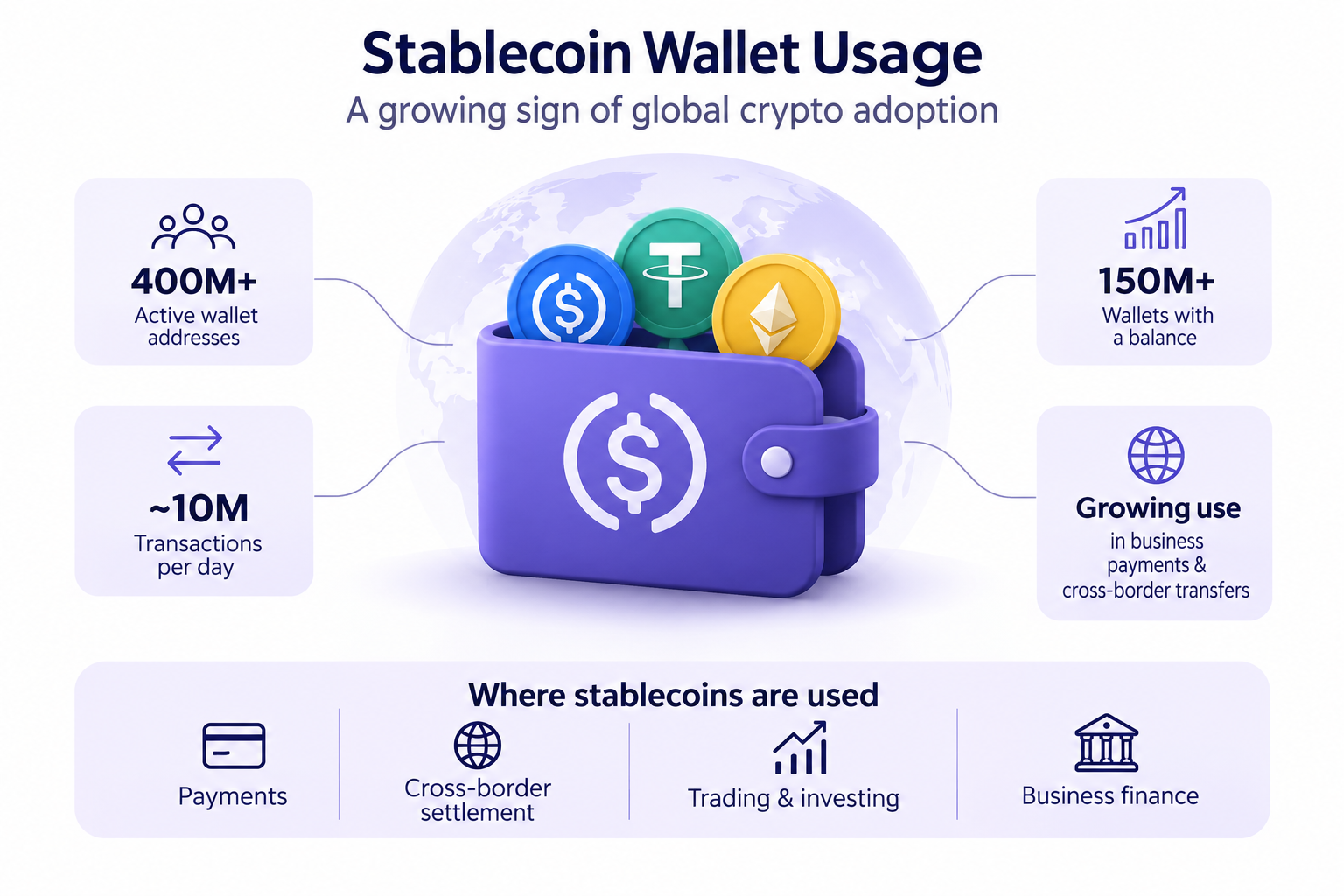
The latest displayed Visa dashboard snapshot reports 353.8 million active unique sending addresses, 417.0 million active unique receiving addresses, and 436.7 million total active unique addresses over its displayed last-12-month period. The exact dashboard timestamp should be checked because these figures can change.
| Metric | Reported value | Period or method | Interpretation limit |
|---|---|---|---|
| Active unique sending addresses | 353.8 million | Displayed last 12 months | Not a count of people |
| Active unique receiving addresses | 417.0 million | Displayed last 12 months | May include businesses and services |
| Total active unique addresses | 436.7 million | Displayed last 12 months | Address overlap and attribution matter |
| Daily addresses making a stablecoin transaction | Approximately 10 million | Artemis estimate | Not a count of daily users |
| Addresses with a nonzero stablecoin balance | More than 150 million | Artemis 2025 estimate | Measures balances, not active use |
The Visa dashboard includes major stablecoins and blockchains. These include USDT, USDC, Ethereum, Tron, BNB Chain, Polygon, Solana, Base, and Arbitrum.
Artemis estimated that approximately 10 million blockchain addresses make a stablecoin transaction on an average day. It also estimated that more than 150 million blockchain addresses held a nonzero stablecoin balance in 2025. These figures use a different methodology and should not be added to Visa’s address totals. The Artemis stablecoin payments report presents them as separate estimates.
Stablecoin adoption is large enough to measure in hundreds of millions of active addresses. However, address activity is not the same as unique-user adoption.
Balances provide another market signal. Chainalysis reported that stablecoin balances remained between $98 billion and $109 billion during its measured nine-month 2026 market drawdown. Stablecoins represented 22.5% of global measured crypto balances by June 2026, according to its global adoption analysis.
Why transaction volume is not the same as stablecoin payment adoption
A transfer count shows how often tokens moved. It does not necessarily show why they moved.
The BIS estimated annual stablecoin transaction volume at approximately $28 trillion in 2025. It also noted that the value becomes much lower after removing transactions between wallets owned by the same party. The BIS stablecoin transaction research therefore distinguishes headline volume from economic activity.
Transaction structure creates another measurement problem. The BIS analyzed more than 593 million event logs from 141 million Ethereum transactions involving USDT, USDC, and PYUSD in 2025. Roughly one-third of the analyzed stablecoin transactions generated multiple steps or event logs. Nearly 60% of transfer events occurred within complex transactions, according to the BIS working paper.
A single smart-contract transaction can emit multiple stablecoin transfer events. Counting each event as a separate payment can therefore overstate payment adoption.
Payment-specific research provides a narrower view. Artemis attributed $136 billion in stablecoin payments settled between January 2023 and August 2025. It estimated a $122 billion annualized payment run rate in August 2025. In its sample, business-to-business payments represented the largest category, with a $76 billion annualized run rate.
The most useful comparison separates:
•Gross on-chain volume
•Adjusted payment volume
•B2B payment volume
•Cross-border payment flows
•Same-owner transfers
•Trading and complex smart-contract activity
This distinction shows why stablecoin payment adoption can be growing even when a large share of total on-chain volume comes from trading, lending, arbitrage, liquidity provision, or internal transfers.
Cross-border flows are becoming a central adoption signal
Cross-border stablecoin activity is growing and provides a more practical adoption signal than wallet counts alone.
Chainalysis estimated that monthly cross-border stablecoin value increased from $11 billion in January 2025 to $24 billion in June 2026. Measured stablecoin value moving across borders rose 77.5%, from $124.2 billion to $220.3 billion. Its cross-border adoption analysis estimated an average cross-border payment size of approximately $3,000 during the measured period.
That average is consistent with supplier payments, remittances, and savings transfers. It does not describe only large institutional settlements.
Cross-border activity is concentrated in major corridors. The top quartile of corridors accounted for 96.1% of measured cross-border stablecoin value. Lower-volume and newly observed corridors also expanded, but from a smaller base. Turning this activity into practical business payments requires reliable stablecoin payments infrastructure, including suitable settlement, liquidity, and compliance capabilities.
Artemis identified B2B payments as the largest stablecoin payment category in its sample. This supports a focus on business settlement rather than wallet ownership alone. Potential use cases include:
•Supplier payments
•Cross-border payouts
•Trade settlement
•Treasury conversion
•Receiving funds from international customers
For businesses, the relevant metric is not simply how many wallets exist. It is whether the rail can move value reliably across the corridors the business actually uses.
BIS cautioned that stablecoins’ current real-economy use remains modest compared with headline transaction totals. Fees, spreads, liquidity, and on- and off-ramp costs can affect the practical result. The BIS annual economic report also highlights these limits.
For finance, treasury, payments, and supply-chain teams, adoption should be assessed through operating outcomes. These include settlement access, speed, corridor coverage, conversion availability, compliance review, and reconciliation requirements.
Market concentration and compliance shape wallet adoption quality
Stablecoin activity is concentrated in major dollar-linked assets, especially USDT and USDC. BIS, Chainalysis, and Artemis analyses all identify these assets as central to the market.
Artemis reported that USDT represented approximately 85% of stablecoin payment volume among its sampled firms. This is a sample-specific result, not a complete estimate of global stablecoin market share. The Artemis payment study should be read within that limitation.
BIS reported that approximately 98% of stablecoins were denominated in U.S. dollars. It also reported stablecoin market capitalization of approximately $320 billion at the end of May 2026. The market remained concentrated in two U.S. dollar-pegged coins, according to its market discussion.
Adoption quality depends on more than volume. Asset concentration, jurisdiction, counterparty screening, and the ability to connect on-chain value to compliant business workflows all matter. The digital asset infrastructure supporting these workflows is also important, particularly for connecting digital assets with institutional trading, liquidity, and payment operations.
Regulation also affects whether wallet activity can become usable business payment activity. BIS reported that, as of August 2025, 11 jurisdictions had finalized comprehensive cryptoasset frameworks. Five had finalized stablecoin frameworks, according to its regulatory implementation summary.
Public-wallet activity is pseudonymous. Enterprise use therefore requires attribution, screening, and transaction monitoring. A high-volume public-wallet metric does not by itself provide identifiable counterparties, a clear payment purpose, or a compliant fiat conversion route.
How finance and payments teams should interpret stablecoin wallet metrics
Finance teams should use a metric hierarchy instead of relying on one wallet statistic.
•Use active sending and receiving addresses to assess reach.
•Use balances to assess stored value.
•Use transaction counts to assess activity.
•Use adjusted payment volume to assess economic settlement.
•Use cross-border flows to assess corridor demand.
•Use repeat activity to assess ongoing usage.
Every comparison should record the observation period, blockchain coverage, stablecoins included, and attribution method. It should also state whether hosted-service addresses were identified, whether same-owner transfers were removed, and whether complex transactions were separated from simple payments.
Teams should distinguish growth from new addresses from growth caused by existing users transacting more often. These patterns have different implications for adoption.
Wallet statistics should also be compared with operational outcomes. A treasury manager can use address growth to understand market reach. The manager should then evaluate a specific corridor through settlement time, conversion, compliance, payout, and reconciliation requirements.
The key business question is whether stablecoins can be integrated into an account that supports sending, receiving, and converting fiat currencies and stablecoins. Fuze Business brings fiat and stablecoin movement into one business account, giving payments and treasury teams a practical way to assess stablecoin rails through real cross-border workflows.
How Fuze Business helps businesses make faster global payments
Stablecoin adoption metrics show growing activity across wallets, cross-border corridors, and B2B payment flows. The business value comes from turning that activity into reliable payments, payouts, conversion, and compliance workflows.
Faster settlement, practical corridor access, and fiat-to-stablecoin conversion matter more to operating teams than wallet counts alone. Using stablecoin rails, Fuze Business is designed to support faster global payments and quicker movement of value across supported workflows.
Fuze Business helps businesses send, receive, and convert fiat currencies and stablecoins from one account. Businesses can also use a currency converter to support currency conversion as part of their payment workflows. Its supplied capabilities include cross-border payments, cross-border payouts, difficult trade corridors, banking network access, instant currency and stablecoin conversion, USD, AED, EUR, GBP & more, support, and enterprise-grade compliance.
Explore Fuze Business for cross-border payments, stablecoin-to-fiat conversion, and global payout workflows.