
Finance managers, treasury managers, payments operations managers, global trade managers, and supply-chain managers need more than a low advertised transfer fee. They need reliable corridor coverage, clear pricing, payment tracking, local-rail access, implementation flexibility, and support for recurring business payments.
The platforms below are ranked by business usability rather than brand size. They are not identical. Some are multi-currency business accounts, some are embedded-payments infrastructure, and some use SWIFT only for selected currencies or destinations.
SWIFT payment platform comparison at a glance
| Platform | Coverage | SWIFT or wire cost signal | Tracking | Best fit | Main limitation |
|---|---|---|---|---|---|
| Wise Business | 160+ countries | Sending fees start from 0.23% on the US pricing page; USD SWIFT receiving is listed at $6.11 per payment | Transfer status and tracking tools | SMBs and mid-market businesses | SWIFT payments can take 1–6 working days, with possible correspondent deductions |
| Airwallex | 200+ countries and regions; 90+ currencies | Local payouts are positioned as faster and more cost-effective than SWIFT where available | Platform and payout visibility depend on product and corridor | Globally distributed businesses | Availability varies by entity, location, currency, and corridor |
| Currencycloud | 180+ countries; 37 currencies | SWIFT charges and intermediary-bank fees may apply; pricing is generally quote-based | Payment tracking, notifications, and SWIFT workflows | Fintechs, platforms, and API-led businesses | May require commercial onboarding and integration work |
| Stripe Global Payouts | 160+ countries | Stripe lists a $25 SWIFT wire fee and currency conversion from 0.5% in the displayed pricing context | API and dashboard payout workflows | Marketplaces and Stripe users | More payout-oriented than a universal treasury account |
| Revolut Business | International SWIFT transfers | Fees vary by plan, currency, destination, and route; OUR and SHA options are available | Transfer status and fee details are shown in applicable workflows | Businesses wanting a digital business account | Intermediary and beneficiary-bank charges may still apply |
| Payoneer | 190+ countries and territories; 70+ currencies | Fees depend on locations, payment method, and currencies | Transaction-specific visibility | Marketplaces, contractors, and global service businesses | May not match a traditional corporate SWIFT treasury workflow |
Fees and availability depend on region, currency, account, and corridor. Verify a live quote before choosing a provider.
For example, a US business paying a supplier in China should compare the visible transfer fee, FX conversion, correspondent deductions, recipient-credit certainty, and availability of a local payout rail. These factors can matter more than the advertised wire fee.
How we evaluated SWIFT payment platforms
SWIFT is a financial messaging network and payment workflow, not a single retail payment app. A platform may use SWIFT for some routes and local clearing rails for others. The SWIFT payments network connects banks and financial institutions, while SWIFT gpi supports tracking and payment status across participating institutions.
The ranking uses five priorities:
•Coverage: Supported countries, currencies, difficult corridors, and access to local rails.
•Total cost: Transfer fees, FX pricing, correspondent charges, and the amount the recipient ultimately receives.
•Tracking: Transfer status, estimated delivery, UETR support, payment confirmations, and exception visibility.
•Implementation: Self-serve accounts, APIs, batch payments, recurring payments, and embedded workflows.
•Business controls: Beneficiary validation, compliance workflows, reporting, reconciliation, and operational support where documented.
The ranking focuses on practical value for recurring international business payments. A platform supporting 200 countries is not automatically better than one supporting fewer markets. A specific AED, CNY, or USD corridor may be cheaper and more reliable through a local rail than through several correspondent banks.
1. Wise Business
Wise Business is a strong option for businesses prioritizing transparent pricing, multi-currency payments, and self-serve international transfers.
Wise Business supports payments to teams and suppliers in more than 160 countries. It also provides multi-currency balances, bulk payments, accounting integrations, approvals, and transfer tracking.
Features: Businesses can manage multiple currencies, send supplier and contractor payments, use bulk payment tools, connect accounting systems, and monitor transfer status.
Pricing: US business pricing lists a one-time $31 setup fee and sending fees from 0.23%, depending on the currency. Selected SWIFT receiving fees are listed separately, including $6.11 for USD, £2.16 for GBP, and €2.39 for EUR. Wise also explains that USD SWIFT costs vary by destination.
Limitation: Wise states that SWIFT transfers usually take 1–6 working days. Correspondent banks may deduct additional charges. Coverage and fees also vary by currency and destination.
Best for: SMBs and mid-market businesses paying suppliers, contractors, or invoices across established corridors.
Wise is the pricing-transparency pick, but it is not automatically the lowest-cost option for every route. Before comparing fees, verify whether the payment uses a local rail or SWIFT. A business sending USD outside the United States should review both the Wise fee and any destination-specific SWIFT or correspondent fee.
2. Airwallex
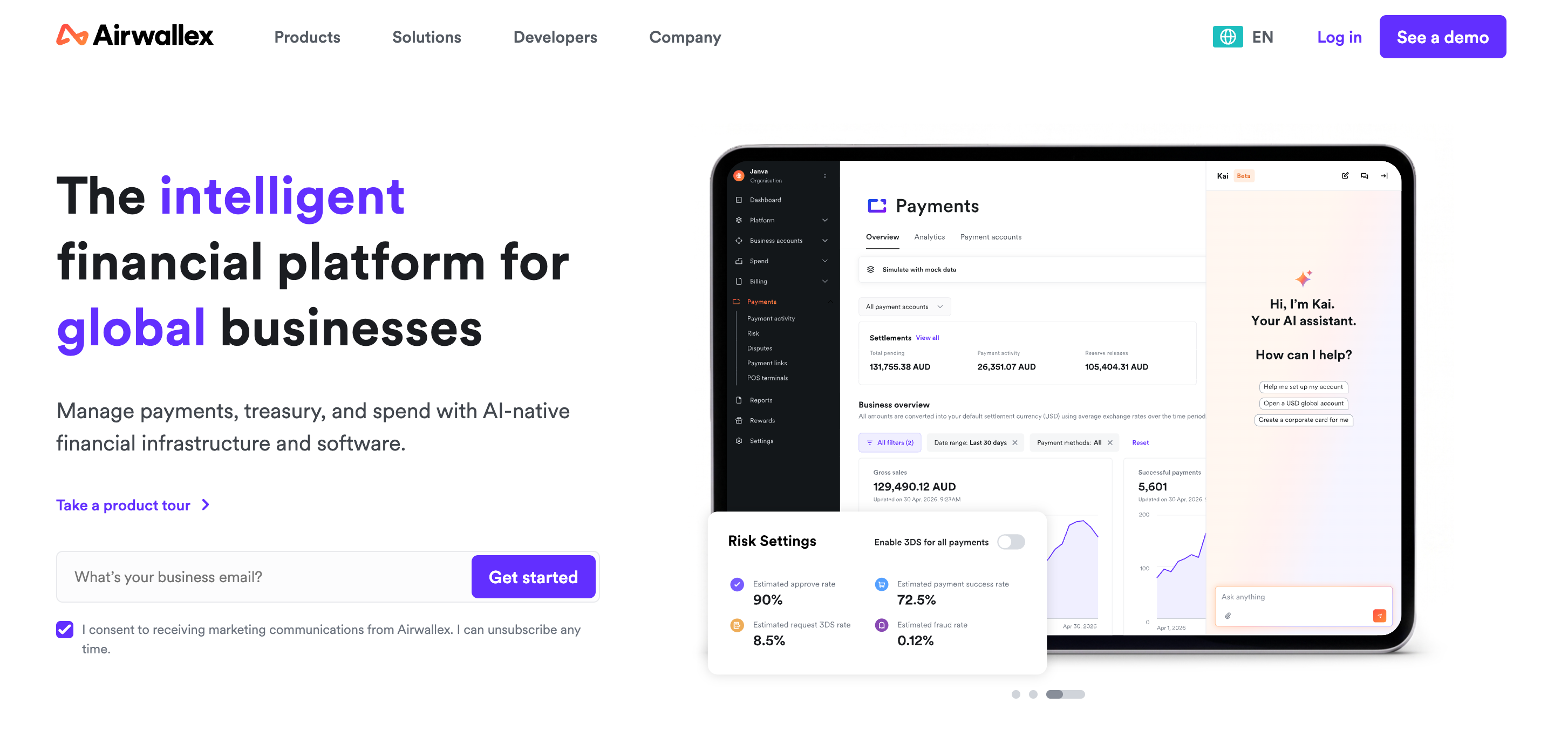
Airwallex suits globally distributed companies that want local accounts, local payout rails, and SWIFT coverage in one platform.
Airwallex documents local and SWIFT payouts to more than 200 countries and regions and more than 90 currencies. It also documents local clearing connections in more than 120 countries and regions.
Features: Businesses can use local accounts, local payout methods, SWIFT payouts, and Global Accounts. For selected account locations and currencies, Global Accounts can support both local receiving methods and SWIFT receiving.
Pricing: Airwallex states that transfer, FX, payment-processing, and plan fees can apply. Its public pricing does not provide one universal SWIFT transfer price for every corridor.
Limitation: Availability depends on the onboarding entity, customer location, currency, account type, and corridor. The provider’s coverage tables include market-specific restrictions.
Best for: Businesses managing multiple entities, currencies, suppliers, and collection accounts across regions.
The main advantage is the local-rail option. Businesses can use SWIFT where necessary while avoiding it where a domestic rail is available. Account eligibility, supported currencies, and entity-specific availability should be confirmed before implementation.
For example, a business receiving USD or GBP should check whether the payment qualifies for local account functionality or must arrive through SWIFT. That distinction can affect both speed and cost.
3. Currencycloud
Currencycloud is a strong choice for fintechs, platforms, and businesses needing API-based payment infrastructure with SWIFT tracking.
Currencycloud supports payments in 37 currencies across more than 180 countries. Its materials describe API and dashboard initiation, beneficiary creation, local and SWIFT rails, payment tracking, automated notifications, reporting, and real-time beneficiary validation.
Features: The platform combines local payment rails, SWIFT payments, APIs, dashboards, beneficiary management, payment tracking, notifications, and reporting.
Pricing: Currencycloud states that SWIFT transactions incur a charge. Intermediary banks may also add handling fees or commissions. Public pricing is generally quote-based rather than a single universal schedule.
Limitation: The platform model may require commercial onboarding and integration work. It is less like a simple consumer-style account-opening flow.
Best for: B2B payment providers, marketplaces, fintechs, and larger operating teams embedding international payments into a product or workflow.
Currencycloud is most compelling when a business needs local rails, SWIFT, APIs, tracking, and control over fee handling. During sales qualification, confirm supported corridors, settlement timing, compliance responsibilities, and integration scope.
A platform paying beneficiaries in more than 180 countries can use local rails where available and reserve SWIFT for destinations without local payout options.
4. Stripe Global Payouts
Stripe Global Payouts fits platforms and businesses already using Stripe APIs for international payout workflows.
Stripe states that Global Payouts can pay recipients in more than 160 countries through local bank transfers, international wires, debit cards, or stablecoins. The product supports no-code tools and APIs.
Features: Global Payouts can support supplier payouts, marketplace payments, refunds, reimbursements, and similar use cases. Businesses can compare API-based orchestration with separate bank integrations.
Pricing: Stripe’s pricing page lists a $25 SWIFT wire fee and currency conversion starting at 0.5% in the displayed Global Payouts pricing context. Local-rail pricing varies by destination.
Limitation: Global Payouts is more payout-oriented than a universal treasury account. Product availability, underwriting, and corridor support should be confirmed for the intended use case.
Best for: Marketplaces, fintechs, software platforms, and companies already operating within the Stripe ecosystem.
Stripe is most compelling when payout orchestration and API integration matter more than standalone SWIFT account functionality. Compare SWIFT-wire pricing separately from local-bank-transfer and stablecoin pricing.
A marketplace paying recipients across several countries should confirm whether each destination uses a local rail, international wire, or stablecoin route.
5. Revolut Business
Revolut Business suits companies wanting a digital business account with international transfers and clear OUR-versus-SHA choices.
Revolut Business documentation describes international SWIFT transfers. It also explains the difference between OUR and SHA fee arrangements. With OUR, the sender pays fees upfront so the recipient is intended to receive the full amount. With SHA, fees are split and the beneficiary may receive less.
Features: Businesses can initiate international SWIFT transfers, choose how fees are allocated, and review applicable charges before completing a transfer.
Pricing: SWIFT pricing depends on the account plan, currency, destination, and route. Revolut states that intermediary and beneficiary banks may charge additional fees. Current fees are shown before completion or in the app.
Limitation: There is no single universal rate. Transfer timing, availability, and allowances vary by country and plan.
Best for: Businesses that value a digital banking interface and need occasional or recurring international bank transfers with control over fee allocation.
OUR versus SHA is an important decision for supplier payments. If a contract requires the supplier to receive exactly USD 50,000, compare an OUR transfer with a SHA transfer that could deliver less after intermediary deductions.
Do not treat Revolut’s displayed transfer fee as the complete landed cost. Include correspondent and beneficiary-bank charges in the comparison.
6. Payoneer
Payoneer is useful for businesses receiving and sending funds across broad sets of countries and currencies, especially in platform and freelancer ecosystems.
Payoneer states that it supports cross-border payments across more than 190 countries and territories and more than 70 currencies. Its services include receiving accounts, sending, withdrawals, currency management, and cards.
Features: Businesses can receive funds, send payments, withdraw balances, manage currencies, and use payment cards where available.
Pricing: Exact fees depend on sender and recipient locations, payment method, and currencies. Payoneer states that applicable fees are shown before confirmation. Its pricing examples include up to 1% for receiving through a non-local-currency receiving account and up to 3.99% plus $0.49 for certain card-funded receipts.
Limitation: Public pricing is transaction-specific. The available payment method or receiving-account structure may differ from a traditional corporate SWIFT treasury workflow.
Best for: Global service businesses, marketplaces, contractors, and companies collecting or paying across many markets.
Payoneer is best positioned around broad account and marketplace coverage, not as the cheapest SWIFT option. Before comparing fees, identify whether the transaction is a bank transfer, receiving-account credit, card-funded payment, or another method.
A business receiving funds from several marketplaces should calculate receiving-account fees, withdrawal costs, FX conversion, and the destination-bank payout method together.
What businesses should know about SWIFT fees, coverage and tracking
SWIFT provides financial messaging and infrastructure. The actual movement of funds can involve correspondent banks, local clearing systems, and beneficiary institutions. Its network-level figures include more than 200 countries and territories, more than 4 billion accounts, and more than 150 currencies, but these figures do not guarantee that every platform supports every corridor.
SWIFT gpi supports end-to-end payment tracking, fee visibility, payment status, and beneficiary-credit confirmation for participating institutions and services. A UETR is a unique end-to-end transaction reference used to trace a payment through the chain.
Published transfer prices can be incomplete. A quoted fee may exclude FX spreads, intermediary deductions, beneficiary-bank charges, repair fees, or the cost of choosing OUR instead of SHA.
Before sending a payment, confirm:
•The route and currency.
•The expected delivery estimate.
•The UETR or other tracking reference.
•The fee option.
•The beneficiary details.
•The amount the recipient is expected to receive.
Two providers can both advertise international USD payments while one uses a local payout rail and the other uses several correspondent banks. The visible transfer fee alone will not show the difference.
How Fuze Business helps with faster global payments
The best platform depends on the corridor, currency, compliance process, intermediary banks, and settlement rail. Local rails can reduce cost and improve speed where available. SWIFT remains valuable for broad bank connectivity but can involve several institutions and fee layers.
Businesses seeking another model can use Fuze Business to send, receive, and convert fiat currencies and stablecoins from one account. It supports cross-border payments, cross-border payouts, currency conversion, access to difficult trade corridors, AED, USD, EUR, GBP and banking network access.
Fuze Business is intended to be faster and quicker than traditional SWIFT-based workflows by using stablecoin rails rather than relying only on correspondent-banking processes. Actual performance should be validated by corridor, including compliance, settlement timing, recipient acceptance, and total landed cost.
Explore Fuze Business for cross-border payments.