
International business payments often involve several banks, currencies, payment systems, and compliance checks. Understanding the process helps finance, treasury, payments operations, trade, and supply-chain teams manage timing and exceptions.
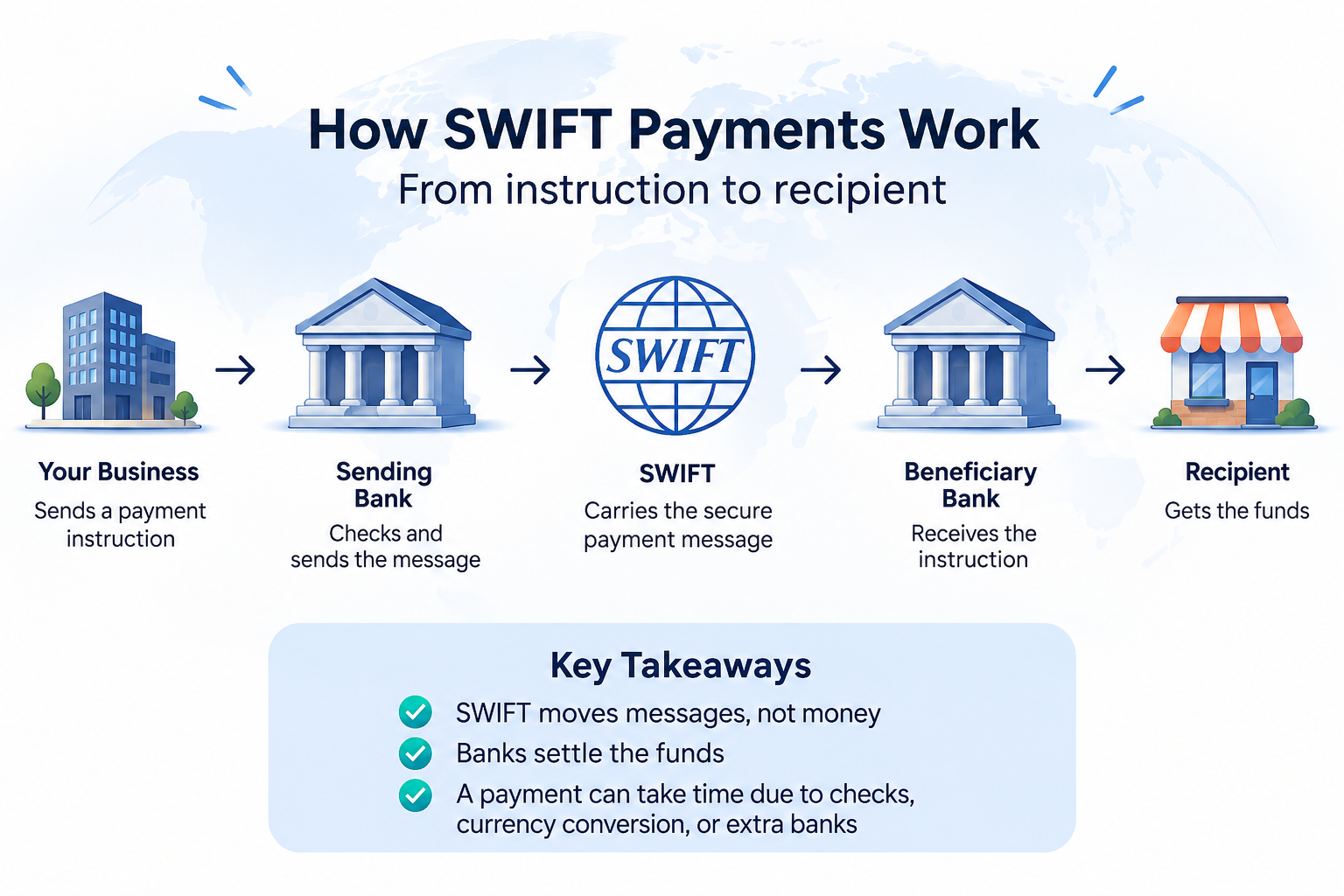
SWIFT is a secure financial messaging system. It helps financial institutions exchange payment instructions, but it does not hold or transfer the underlying funds. The banks and other institutions involved execute the payment through accounts, payment systems, foreign-exchange arrangements, and settlement relationships.
This distinction explains why a SWIFT message can be delivered before the beneficiary receives usable funds. The message, account debits and credits, currency conversion, compliance reviews, and final account credit are separate events.
What SWIFT is and what it does not do
SWIFT carries the instruction; the banks carry out the payment. It is not a bank, payment account, or settlement asset. SWIFT describes its role as providing secure messaging services for financial institutions.
SWIFT began in 1973, and its messaging service went live in 1977. It launched with 518 connected institutions from 22 countries. Today, SWIFT describes a community of more than 11,000 banking, securities, market-infrastructure, and corporate users across more than 200 countries and territories.
A SWIFT payment therefore means that a payment instruction is sent through SWIFT messaging. It does not mean that SWIFT itself moves money between the parties.
For example, a business might instruct its bank to pay an overseas supplier. The bank can send a SWIFT message to the supplier’s bank or to one or more correspondent banks. The underlying balances are then debited and credited through banking relationships and settlement systems.
A SWIFT message can authorize or describe a transfer without being the transfer itself. The answer to “Does SWIFT move money?” is no: SWIFT provides the messaging infrastructure.
The banks, identifiers and accounts behind a SWIFT payment
A business payment usually involves an originating bank, one or more correspondent banks, and a beneficiary bank. Each participant performs a different function.
The originating bank receives the business’s instruction. It checks the payment, debits or earmarks funds under its procedures, and sends the relevant payment message.
A correspondent bank provides account and payment services for a bank based abroad. It may be needed when the originating and beneficiary banks lack a direct relationship in the required currency or payment system. Several correspondent banks can form a payment chain.
The beneficiary bank receives the instruction, applies its own account and compliance checks, and credits the recipient when settlement and release conditions are met. Payment-system guidance from the BIS describes the wider payment arrangements that support these transfers.
| Participant or term | Role in the payment |
|---|---|
| Originating bank | Starts the instruction, performs checks, and sends the payment message |
| Correspondent bank | Provides intermediary account access and payment services |
| Beneficiary bank | Receives the instruction and credits the recipient |
| BIC | Identifies and addresses an institution for payment routing |
| Nostro account | An account held by one bank with another bank, usually in a foreign currency |
| Vostro account | The same correspondent account viewed by the bank holding the account |
A Business Identifier Code (BIC) is an ISO 9362 identifier used to identify and address institutions. A standard BIC has eight characters, with an optional three-character branch identifier. The extended form therefore has 11 characters. SWIFT’s BIC standard explains its identification and addressing purpose.
A BIC is not the same as a bank account number. It also does not automatically prove that an organisation connects to SWIFT or can send and receive SWIFT financial messages. SWIFT’s BIC guidance distinguishes the identifier from network participation.
Correspondent banking is the account-and-settlement layer around the message. The banks use nostro and vostro relationships to hold and settle funds in relevant currencies.
How a business SWIFT payment moves from instruction to settlement
A business payment moves through several operational milestones. The sequence is:
1.Initiate: The business provides the beneficiary’s legal name, account information, bank identifier, amount, currency, purpose, and required supporting documents.
2.Validate: The originating institution checks the instruction, customer information, transaction details, sanctions requirements, and available funds.
3.Message: The originating institution sends a structured financial message to the next institution in the route.
4.Route: Correspondent institutions identify the payment path, apply their checks, and pass the instruction onward where necessary.
5.Settle: Institutions debit and credit correspondent accounts through relevant banking and domestic or regional payment systems.
6.Release: The beneficiary bank completes its checks and releases the payment to the recipient’s account.
7.Reconcile: The business matches payment records with bank confirmations, statements, invoices, and beneficiary confirmation.
The message can identify the beneficiary bank, intermediary institutions, currency, amount, and parties to the transaction. Payment infrastructure guidance helps explain why the message and settlement layers operate separately.
For a USD supplier payment, the sender’s bank might route instructions through a correspondent holding USD liquidity. The beneficiary bank then completes local checks and credits the supplier.
A payment can be delayed after the message is sent. Foreign-exchange conversion, account entries, sanctions screening, local processing, and beneficiary-bank release may happen at different times.
SWIFT states that 90% of cross-border payments now reach the beneficiary bank in under an hour. This is a network-level figure. It does not necessarily mean that the beneficiary’s account is credited within an hour.
Finance teams should distinguish at least three timestamps:
•Message sent
•Funds settled between institutions
•Beneficiary account credited
The ISO 20022 standards support richer, more structured payment data. Better data can improve processing, but it does not eliminate settlement or release steps.
Why SWIFT business payments can cost more or take longer
Cross-border payments are usually more complex than domestic payments. They can involve multiple institutions, jurisdictions, currencies, operating hours, payment systems, and compliance regimes.
A missing direct relationship can add intermediary banks to the route. Each additional institution creates another processing point. It can also introduce separate fees, checks, cutoffs, and operational dependencies.
Correspondent banks may charge fees or apply foreign-exchange spreads. They may also deduct amounts under the payment route’s terms. The outcome depends on the institutions, currency, corridor, and payment instructions.
Missing or inconsistent information can cause manual review, payment repair, rejection, or delay. A correct BIC does not correct an incorrect beneficiary account number. The BIC identifies the institution, while the account details direct the credit.
Financial institutions perform sanctions, anti-money-laundering, fraud, customer, and transaction checks. SWIFT explains its sanctions position and states that it does not control the legitimacy of underlying financial transactions.
Before releasing a payment, verify:
•Beneficiary legal name and account details
•BIC and any intermediary-bank requirements
•Currency, amount, and payment purpose
•Invoice and supporting information
•Fee treatment and expected deductions
•Cutoff times, holidays, and required compliance documents
The cheapest route is not always the fastest route. The fastest message is not always the fastest final credit.
SWIFT’s ISO 20022 transition is intended to support richer, structured payment data. SWIFT states that several legacy MT reporting messages were not withdrawn in November 2025. However, they are deprecated and no longer maintained, so institutions are advised to move to ISO 20022 equivalents. SWIFT’s ISO 20022 information provides the relevant migration context.
SWIFT correspondent banking compared with stablecoin-enabled payment rails
SWIFT correspondent banking combines financial messaging with bank accounts, intermediary institutions, foreign-exchange processes, and local settlement systems.
Stablecoin-enabled rails use digital assets designed to track a reference value. A complete business payment can still require compliance checks, liquidity, conversion, banking access, and local payout capability.
| Operational area | SWIFT correspondent banking | Stablecoin-enabled payment rails |
|---|---|---|
| Core function | Financial messaging connected to bank settlement relationships | Digital-asset movement or settlement connected to conversion and payout arrangements |
| Typical participants | Banks, correspondent banks, payment systems, and beneficiary institutions | Regulated provider, business, wallet or account, liquidity provider, banking partner, and recipient-side payout route |
| Main question | Which banks and accounts will route and settle the payment? | Which asset, network, regulated entity, off-ramp, and local payout route will complete it? |
| Main controls | Beneficiary verification, compliance, reconciliation, and corridor checks | Beneficiary verification, compliance, reconciliation, liquidity, conversion, and corridor checks |
| Key constraint | Intermediary availability, bank cutoffs, fees, and settlement relationships | Asset support, network access, liquidity, regulated conversion, and local payout capability |
For eligible corridors, Fuze Business uses regulated stablecoin rails to support same-day settlement, offering an alternative to traditional correspondent banking routes that can take multiple business days. Actual settlement times depend on the corridor and payment workflow.
The key distinction is that blockchain transfer speed is not the same as end-to-end payment time. A supplier payment may still require compliance checks, stablecoin-to-fiat conversion, liquidity, and a local bank payout before funds are available to the recipient.
When comparing the two approaches, businesses should assess the full payment journey, including total cost, time to beneficiary credit, corridor availability, and payment tracking, rather than comparing blockchain confirmation times with bank transfer estimates alone.
How businesses can make SWIFT payment operations more reliable
Reliable payment operations depend on accurate data, clear status tracking, and defined exception ownership. Businesses should use a controlled beneficiary master record and verify bank details through trusted processes before releasing funds.
They should also provide complete originator, beneficiary, purpose, invoice, and payment-reference information. Structured information can reduce manual intervention and payment repair.
Before approval, the treasury or payments team should confirm the route, currency, fee arrangement, intermediary requirements, cutoff times, holidays, expected value date, and exception owner.
Payment status should be tracked by event rather than by one broad label. Useful statuses include instruction accepted, message sent, intermediary processing, funds settled, beneficiary bank received, and beneficiary credited.
Businesses should reconcile outgoing payment records against bank confirmations, account statements, beneficiary acknowledgements, and invoice or shipment records. Rejected, returned, held, and delayed payments should have escalation procedures across treasury, accounts payable, the bank, and the beneficiary.
A practical control list should cover:
•Data accuracy: Beneficiary details, BIC, amount, currency, purpose, and invoice information are complete.
•Status visibility: Each payment milestone is recorded separately.
•Reconciliation: Bank records and beneficiary confirmation match the payment instruction.
•Exception ownership: A named team or person manages rejected, returned, held, or delayed payments.
SWIFT’s risk and compliance resources support the need for structured controls around payment operations. ISO 20022 migration should also be treated as an operational data-quality project, not only a message-format change.
How Fuze Business helps with faster global payments
SWIFT helps banks communicate payment instructions. Settlement depends on the institutions, accounts, currencies, and payment systems behind the route.Traditional payments can also involve correspondent banks, foreign-exchange conversion, compliance checks, and local settlement.Businesses seeking a different operating model can evaluate platforms that connect banking and stablecoin rails.The right choice depends on corridor, currency, compliance, liquidity, and recipient requirements.
Fuze Business’s stablecoin rails support faster settlement and that its platform settles same-day in stated workflows. Final timing remains dependent on corridor, eligibility, liquidity, compliance, conversion, and the recipient’s payout route.
Explore Fuze Business for faster global payments using banking and stablecoin rails and assess supported corridors, assets, compliance requirements, and payment needs.