
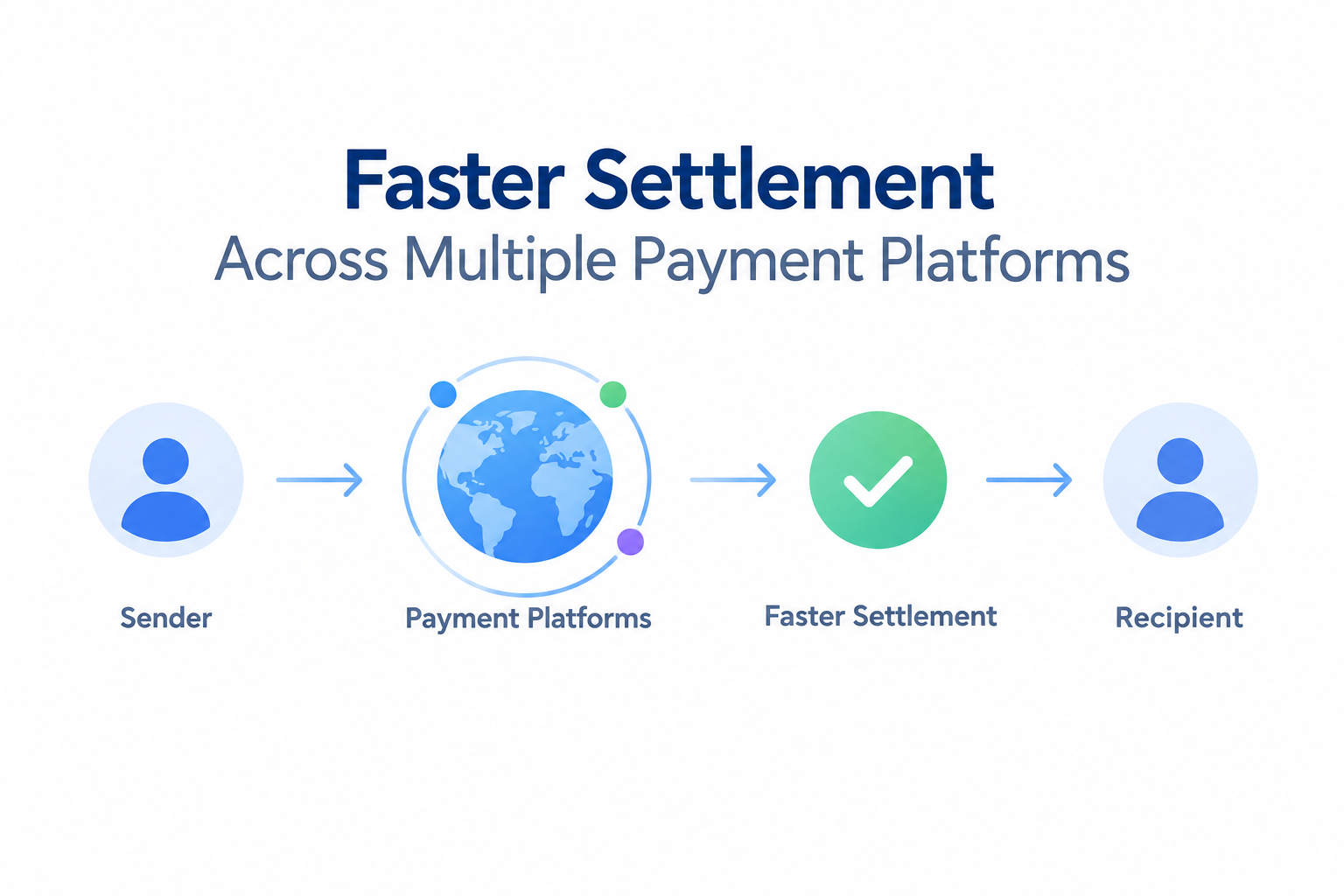
Faster settlement is an operating process, not a single platform setting. It depends on the payment rail, currency, corridor, participant access, compliance checks, cutoffs, liquidity, and exception handling.
Payment initiation is the point when an approved instruction is submitted. Clearing covers the exchange, validation, and processing of payment information. Settlement is when the payment obligation is completed. Settlement finality is the point after which the transfer is no longer revocable under the applicable system rules.
This guide is for finance managers, global trade companies, and supply chain managers coordinating payments across banks, instant-payment systems, correspondent networks, and digital-asset rails. Confirm availability, eligibility, limits, fees, regulatory requirements, and settlement timing for every corridor before implementation.
Define the settlement target and baseline your current payment flows
Faster settlement means reducing the elapsed time between an approved payment instruction and final, usable funds at the beneficiary. It does not simply mean sending the instruction faster.
The BIS Principles for Financial Market Infrastructures state that financial market infrastructures should provide clear and certain final settlement. Where appropriate, settlement should occur during the day or in real time to reduce settlement risk.
Do not treat “instant,” “same day,” “available,” “processed,” and “final” as interchangeable labels. Ask each provider to define the event and timestamp represented by its status.
Baseline these events for every material payment flow:
1.Payment initiation.
2.Provider acceptance.
3.Compliance review.
4.Intermediary processing.
5.Beneficiary credit.
6.Final settlement.
A payment marked “completed” by the sending platform may not yet be credited or final at the receiving institution. Keep it outside the fastest-settlement KPI until the receiving-side event is confirmed.
Measure results by corridor, currency, platform, payment size, business day, weekend, holiday, and exception status. Use median and 95th-percentile end-to-end settlement times instead of relying on one overall average.
Your baseline is usable when the team can identify the largest delay stage for each material corridor.
Map cutoffs, operating windows, liquidity, and access requirements by platform
Payment platforms differ in operating hours, settlement models, participant eligibility, funding requirements, transaction limits, and holiday calendars. The fastest theoretical route may not be available for the sender or beneficiary.
For example, FedNow operating hours support continuous instant-payment messaging, including weekends and Federal Reserve holidays. Its funds-transfer business-day rollover occurs at approximately 7:01 p.m. Eastern Time. TIPS operates in central bank money on a 24/7/365 basis. SEPA Instant Credit Transfer can make euro funds available within seconds when the relevant institutions and transaction conditions support the service.
Access is not automatic. The sender, receiver, service provider, or correspondent may need direct or indirect access. Confirm FedNow participant eligibility and equivalent access requirements for every destination rail.
Build a corridor matrix covering:
•Currency and source account.
•Beneficiary account and destination platform.
•Available primary and fallback rails.
•Local cutoff and holiday handling.
•Funding model and liquidity requirement.
•Expected settlement event.
•Fees, limits, and compliance requirements.
•Named escalation owner.
Use a batch or scheduled rail when timing is predictable and cost or reach matters more than immediate availability. Use a high-value or gross-settlement rail when finality and value are priorities. Use an instant rail only when both sides are reachable and the payment passes its limits, compliance, and validation checks.
Select the fastest eligible route, not the fastest theoretical route. Before production use, every high-value corridor should have a documented primary route, fallback route, liquidity requirement, cutoff calendar, and escalation owner.
Standardize payment data and pre-validate every instruction
Complete, structured payment data reduces manual repairs, investigations, and avoidable processing delays. Fragmented formats can cause data truncation, inconsistent messages, and slower straight-through processing.
The BIS and CPMI ISO 20022 work identifies structured and consistent payment data as a way to improve interoperability, speed, cost, transparency, and automated processing.
Required information varies by jurisdiction, rail, provider, and transaction type. Missing originator, beneficiary, account, address, purpose, or remittance data can create a review queue.
Pre-validation should check:
1.Beneficiary identity and account details.
2.Currency, amount, and transaction limits.
3.Required purpose and reference fields.
4.Sanctions-screening inputs.
5.Available balance and liquidity.
6.Destination-rail eligibility.
7.Required compliance information.
Reject or route an instruction for repair before submission when the beneficiary name, account identifier, currency, or mandatory purpose data does not meet the destination platform’s rules.
In the European Union, the Instant Payments Regulation includes verification-of-payee requirements for euro credit transfers. It also includes periodic sanctions-screening obligations for providers offering instant credit transfers. Applicability depends on the relevant institution and implementation timeline, so confirm the requirements for each operating model.
Track the straight-through-processing rate and the percentage of payments rejected before submission, repaired after submission, or held for investigation. Improve these measures without weakening required controls.
Route each payment through the fastest eligible settlement path
Faster settlement usually comes from reducing handoffs, selecting suitable operating hours, using reachable counterparties, and preventing manual intervention.
Instant-payment systems can operate around the clock. Actual availability still depends on participant reachability, transaction rules, risk controls, liquidity, and successful processing.
Cross-border interoperability can use a single access point, bilateral links, a hub-and-spoke arrangement, or a common platform. The right model depends on your corridors, volumes, technical resources, and risk requirements. The BIS interoperability work and Nexus model provide relevant reference points for connecting payment systems.
| Attribute | Batch or scheduled rail | High-value or gross-settlement rail | Instant rail | Stablecoin-enabled route |
|---|---|---|---|---|
| Settlement mode | Scheduled or batched processing | Individual settlement, often with strong finality controls | Near-real-time payment processing | Digital-asset transfer with conversion or local-currency payout |
| Typical availability | Predictable business windows | Defined operating windows and participant rules | Potentially continuous | Depends on the network, provider, corridor, and conversion process |
| Access dependency | Account and network participation | Direct or eligible intermediary access | Reachable sender and beneficiary institutions | Approved business, provider, custody, and beneficiary arrangements |
| Liquidity dependency | Funding by processing window | Sufficient prefunding or available balance | Immediate balance or funding availability | Digital-asset liquidity and local-currency payout liquidity |
| Data requirements | Rail-specific payment and reference data | Detailed payment and beneficiary information | Complete data for validation and compliance | Payment, wallet, beneficiary, conversion, and compliance data |
| Reversibility and finality | Depends on the system rules | Finality is a central consideration | Confirm the system’s finality and return rules | Confirm ledger finality, custody controls, conversion, and payout rules |
| Fallback trigger | Missed window or rejected batch | Participant or funding issue | Reachability, limit, compliance, or service-level failure | Conversion, custody, compliance, or payout failure |
Pre-funding or maintaining sufficient balances can prevent payments from waiting for liquidity. Treasury teams should define exposure limits, replenishment triggers, and reconciliation controls.
Stablecoin rails may provide an alternative movement path in some business models and corridors. Use them only after approving the regulatory, counterparty, custody, conversion, settlement, accounting, and compliance model.
A practical routing sequence is:
Primary rail → eligibility check → compliance check → liquidity check → release → confirmation → fallback if the service-level threshold is missed.
If an instant route is unavailable because the beneficiary institution is unreachable, move to an approved fallback only when the currency, compliance status, fees, and delivery expectation remain acceptable.
Test one successful primary-route payment, one controlled fallback, one rejected payment, and one delayed payment. Each scenario should produce an auditable status and reconciliation record.
Fuze Business describes a platform focused on cross-border payments and difficult trade corridors, supported by banking and currency-conversion capabilities. Confirm availability for the specific corridor before relying on any route.
Monitor settlement performance and resolve exceptions before they become delays
A route is not operationally faster if teams cannot see its status, identify the failure point, reconcile balances, or contact the responsible provider.
Monitor status transitions rather than only final outcomes. Useful states include submitted, accepted, pending review, released, sent, received, credited, settled, rejected, returned, and under investigation.
Create service-level thresholds by corridor and payment type. Alert teams to stale statuses, missing acknowledgements, liquidity shortfalls, compliance holds, beneficiary-detail mismatches, and cutoff misses.
A practical KPI set includes:
•End-to-end settlement time.
•Funds-availability time.
•95th-percentile settlement time.
•Straight-through-processing rate.
•Exception and return rates.
•Fallback rate.
•Reconciliation age.
•Liquidity utilization.
Reconcile provider statements, internal ledgers, bank balances, and beneficiary confirmations with a shared payment identifier and timestamp standard. Review failed and delayed transactions by root cause instead of handling every exception manually.
A daily exception report can group unresolved payments by missing data, compliance review, insufficient liquidity, platform outage, beneficiary-bank rejection, cutoff miss, and reconciliation mismatch.
If no expected status arrives by the corridor threshold, pause duplicate submission. Verify whether funds moved, then escalate through the documented provider path. The dashboard should show the owner, next action, expected resolution time, and whether duplicate payment must be prevented.
Use Fuze Business for faster global payment settlement
Faster global payments require coordinated sending, receiving, conversion, routing, compliance, tracking, and reconciliation across platforms and currencies.
Fuze Business is a unified platform for sending, receiving, and converting funds across key and emerging corridors. Its capabilities include cross-border payments, access to difficult trade corridors, a banking network, currency and stablecoin conversion, real-time transaction monitoring, and enterprise-grade compliance.
The platform has faster settlement through its banking network and stablecoin rails. Actual timing still depends on the selected corridor, currency, counterparties, controls, and transaction conditions.
Explore how Fuze Business can help your team send, receive, convert, track, and reconcile cross-border payments.