

Faster settlement marks a shift from delayed, batch-based payment processing toward near-real-time availability of funds. Instant-payment systems, stronger interoperability, broader non-bank participation, and improved settlement infrastructure are driving this change.
Adoption is real but uneven. Domestic instant-payment networks are scaling quickly, while cross-border payments still face multiple intermediaries, foreign-exchange conversion, compliance checks, fragmented infrastructure, and inconsistent data. By 2026, faster settlement is becoming a competitive expectation. However, the strongest benchmark is not speed alone. It is the combination of speed, reach, compliance, currency access, transparency, and reliable execution across payment corridors.
What faster settlement means in modern payments
Faster settlement is the movement from delayed payment processing toward rapid, dependable availability of funds. Fast-payment systems are designed to make money available to recipients immediately or near real time, rather than waiting for conventional batch-processing cycles.
The BIS description of fast payments identifies near-real-time transfers between end users as a core feature. It also highlights system design, governance, participation, use cases, and cross-border connections as important adoption factors.
Instant payment, payment processing, and final settlement are related but not interchangeable terms. Payment initiation may happen immediately, while processing, funds availability, and final settlement occur at different stages.
This difference matters most for international payments. A domestic instant-payment transfer may make funds available within seconds. Cross-border payments may still require FX conversion, compliance checks, intermediary banks, operating-hour coordination, or local-rail processing.
Cross-border payments can involve multiple institutions, currencies, legal frameworks, compliance regimes, and settlement assets. As a result, faster payment initiation does not automatically mean every international transaction settles instantly.
The 2026 adoption benchmarks show faster settlement moving into the mainstream
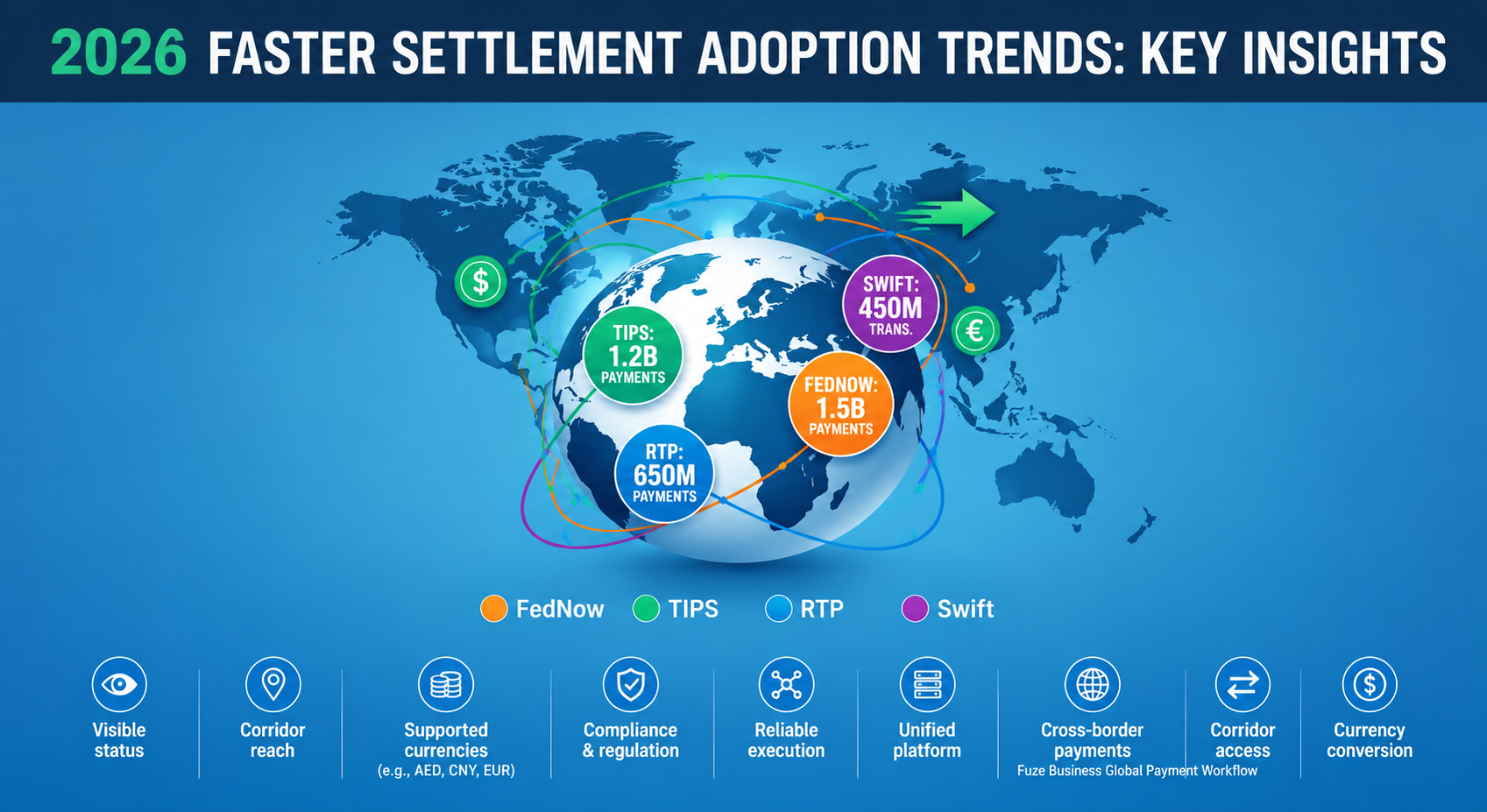
The latest figures show strong growth in instant-payment infrastructure and usage. However, the metrics measure different networks and stages of the payment journey.
| Network or measure | Period | Transactions or result | Transaction value or growth | Adoption signal | Measurement caveat |
|---|---|---|---|---|---|
| RTP Network | 2025 | 447,207,091 transactions | $1.454 trillion | Significant year-over-year growth | Measures one U.S. instant-payment network |
| FedNow | 2025 | 8,413,402 settled payments | $853.4 billion | Strong growth from 2024 | Measures a separate U.S. network |
| RTP Network participation | Q1 2025 | 100 million transactions | $163 billion | More than 950 participating financial institutions | Quarterly participation and volume measure |
| TIPS | 2025 | Transaction volume grew 82.5% | Not specified | European instant-payment activity expanded | Measures a European settlement platform |
| Swift cross-border payments | Q1 2025 | 75% reached the beneficiary institution within 10 minutes | Not specified | Faster cross-border delivery across sampled payments | Does not mean universal end-recipient availability |
The RTP annual statistics show growth from 342,638,985 transactions worth $246.4 billion in 2024 to 447,207,091 transactions worth $1.454 trillion in 2025.
FedNow also expanded. Federal Reserve Financial Services data reports 8,413,402 settled payments worth $853.4 billion in 2025. In 2024, the service recorded 1,505,250 payments worth $38.2 billion.
Participation is expanding as well. The Clearing House reported that more than 950 financial institutions participated in RTP during the first quarter of 2025. The network processed 100 million transactions worth $163 billion during that quarter.
Europe shows a similar infrastructure trend. The ECB reported that TIPS transaction volumes grew 82.5% in 2025. The increase was linked partly to new European instant-payment rules and the addition of the Danish krone.
Cross-border delivery is improving, but the measurement is different. Swift reported 75% of sampled payments across the top 40 countries on its network reached the beneficiary institution within 10 minutes in the first quarter of 2025.
These figures are not directly comparable. RTP and FedNow measure separate U.S. networks. TIPS measures a European settlement platform. Swift measures delivery to the beneficiary institution, not necessarily final availability to the recipient.
The direction of travel is clear: instant-payment infrastructure is scaling, but the metrics still measure different stages of the payment journey.
Why adoption is accelerating and why settlement remains uneven
Faster settlement adoption accelerates when payment networks are widely accessible, support practical use cases, and connect across borders. It slows when payment systems, currencies, compliance processes, or legal requirements cannot work together.
BIS research found stronger adoption where central banks play an active ownership role, non-bank payment providers can participate, systems support more use cases, and cross-border connections are available. This shows that speed is a network outcome, not merely a product feature.
Regulation is also increasing market pressure. The European Union’s Instant Payments Regulation requires relevant payment service providers to offer instant euro credit transfers. It also addresses comparable charges, payee verification, and sanctions-screening processes.
The implementation timetable introduced receiving instant payments for euro-area member states from January 9, 2025. Sending instant payments followed from October 9, 2025. Later deadlines apply to non-euro-area states and eligible non-bank institutions.
Cross-border settlement remains harder because a payment may pass through several systems. Each system can introduce its own operating hours, compliance controls, data requirements, liquidity needs, and settlement procedures.
FX conversion adds another dependency. A business paying a supplier across currencies needs rapid payment execution and synchronized currency conversion. Delays can arise if either process requires separate providers or manual intervention.
Payment-versus-payment arrangements can help reduce FX settlement risk. However, BIS research on payment-versus-payment adoption identifies barriers such as weak incentives, technical access challenges, and differences between national legal frameworks.
A payment can be fast on one rail and still slow end to end. The corridor, currency conversion, compliance process, or intermediary network may introduce delay.
Cross-border benchmarks reveal a gap between faster infrastructure and end-user outcomes
Cross-border payment infrastructure is improving, but end-user outcomes remain uneven. The FSB’s 2025 progress report said global progress toward the G20 cross-border-payment targets remained limited from an end-user perspective.
The G20 cross-border-payment targets aim for 75% of cross-border retail payments to make funds available within one hour by the end of 2027. The remaining payments should be available within one business day.
Current business-payment performance shows why this target remains challenging. The 2025 FSB monitoring materials reported that more than two-thirds of person-to-person payments settled within one business day. Business-to-business and business-to-person use cases had less than 45% settled within one business day.
The same materials reported that, among providers transparent about cost, 62.9% were also transparent about payment speed in 2025. This indicates that speed information is still not consistently available alongside pricing information.
Cost remains another gap. The World Bank remittance data reported a global average remittance cost of 6.36% as of August 18, 2025. That remains above the G20 and UN goal of reducing average remittance costs toward 3%.
The FSB targets also emphasize transparency. Providers should disclose total transaction cost, FX charges, expected delivery time, payment status, and terms of service.
The industry is moving faster, but not evenly. Person-to-person performance is generally stronger than business cross-border use cases. For global companies, corridor coverage, FX execution, compliance, and operational certainty matter as much as payment-rail speed.
What faster settlement adoption means for finance and supply-chain teams
For businesses, faster settlement affects liquidity timing, supplier relationships, treasury operations, cross-border commerce, and customer expectations. A faster payment can reduce waiting time, but only when the entire workflow operates reliably.
The FSB’s cross-border payment framework identifies access, cost, speed, and transparency as core challenges. These factors support a multidimensional benchmark rather than a speed-only score.
Businesses should evaluate faster settlement providers across several criteria:
•Funds-availability time and payment-status visibility
•Corridor reach and banking-network access
•Supported currencies and FX-conversion speed
•Compliance and sanctions-screening handling
•Total cost and FX charges
•Interoperability with relevant payment systems
•Operational reliability and reconciliation support
Businesses can also evaluate a global payment platform based on corridor reach, banking connectivity, supported currencies, FX conversion, settlement timing, compliance controls, and transaction visibility.
BIS research also links stronger fast-payment adoption with broader participation, more use cases, and more cross-border connections. Businesses should therefore assess network reach, not only advertised transfer speed.
Different teams will prioritize different outcomes. Finance managers may focus on liquidity timing and reconciliation. Global trade companies may prioritize difficult corridors and currency access. Supply-chain managers may focus on predictable supplier payments.
For example, a global trade company can compare providers based on whether they support the required AED, CNY, or EUR flow. It should also assess whether the provider can support the relevant corridor and compliance requirements.
The best benchmark asks how quickly funds arrive, how many corridors are reachable, how currencies are handled, and how confidently transactions pass compliance controls.
How Fuze Business helps with faster global payments
Faster settlement is becoming a business requirement, but cross-border execution still depends on reach, currencies, compliance, and network connectivity.
Fuze Business is built for global cross-border payment workflows. Its unified platform for sending, receiving, and converting funds is designed to simplify global payment operations.
Supplied Fuze Business capabilities include cross-border payments, access to difficult trade corridors, banking-network access, faster settlement, and enterprise-grade compliance. The platform also supports AED, CNY, and EUR, GBP & more, alongside instant currency and stablecoin conversion.
For finance managers, global trade companies, and supply-chain teams, the practical next step is to assess whether their workflows combine speed, currency access, corridor reach, compliance, and reliable execution.
Explore how Fuze Business supports faster global payments through one platform for sending, receiving, and converting funds.