

Moving between fiat currencies, stablecoins, and payment rails requires more than selecting an exchange rate. Businesses must compare rates, fees, settlement requirements, and compliance constraints across the available tools.
The correct workflow depends on the source asset, destination currency, payment corridor, transaction purpose, recipient requirements, and settlement window. This guide is for finance managers, global trade companies, and supply chain managers managing cross-border payments.
Fuze Business sends, receives, and converts funds across supported cross-border payment workflows. Availability depends on the corridor, asset, jurisdiction, and account eligibility.
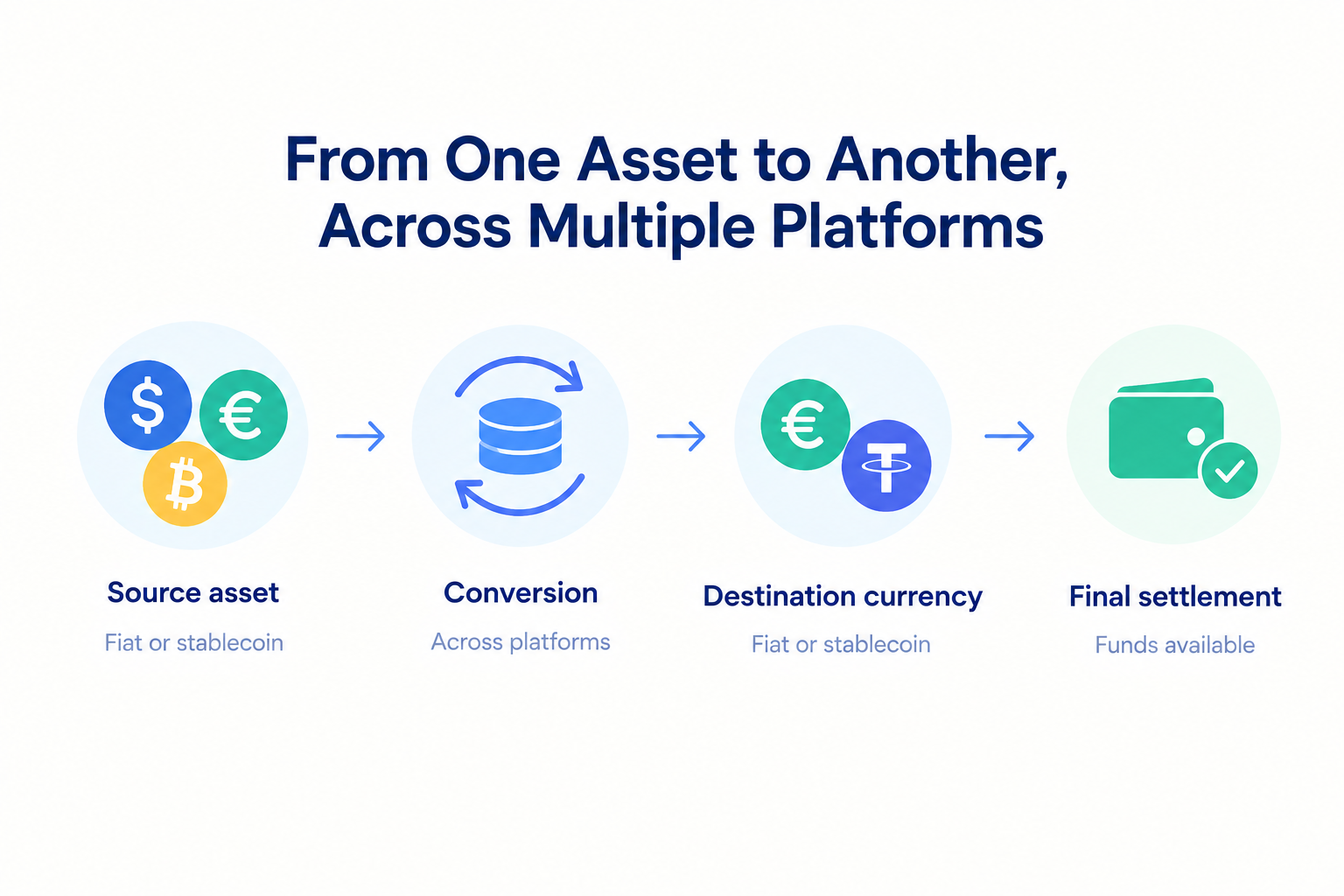
Define the source asset, destination currency, and payment purpose
Start by documenting the complete conversion request. Identify the source asset, destination currency, amount, beneficiary, payment purpose, corridor, and required settlement window.
Currency conversion and stablecoin conversion are not identical. Fiat-to-fiat conversion changes one sovereign currency into another. Stablecoin conversion may involve converting a digital asset into fiat or another supported asset.
Stablecoins are cryptoassets designed to maintain a stable value relative to a specified asset or basket. However, the term does not guarantee stable value or identical legal treatment in every jurisdiction. Confirm the treatment of the specific asset and jurisdiction before proceeding.
Cross-border payments may require foreign-exchange conversion, banking-network or intermediary access, compliance checks, and settlement confirmation. The recipient’s required currency may matter more than the currency held by the sender.
For example, a supplier invoice payable in EUR is not ready for payment until you confirm the funding asset, recipient currency, beneficiary details, payment corridor, and required settlement date.
Use this starting checklist:
•Source asset and amount
•Destination currency
•Beneficiary or recipient requirement
•Payment purpose
•Payment corridor
•Required settlement deadline
The request is defined when each item is documented and approved.
Map the tools, payment rails, and corridor requirements
Multi-platform conversion may involve bank accounts, foreign-exchange services, payment providers, stablecoin-enabled rails, and banking networks. A provider’s geographic presence does not prove support for the exact currency, asset, recipient, jurisdiction, or transaction type you need.
Stablecoin on-ramps and off-ramps connect stablecoins with sovereign currencies. Exchanges, custodial wallets, payment service providers, and other intermediaries may provide these functions. Cross-border payment arrangements can also involve different settlement and access requirements.
Stablecoin use does not remove sanctions, anti-money-laundering, licensing, tax, accounting, or local foreign-exchange obligations. Confirm those requirements before selecting a route.
For each shortlisted tool or rail, document the following:
| Comparison point | What to confirm |
|---|---|
| Source assets | Whether the tool supports the asset you hold |
| Destination currencies | Whether it can deliver the currency the recipient requires |
| Corridor fit | Whether it supports the sending and receiving jurisdictions |
| Compliance process | Required onboarding, verification, and documentation |
| Quoted rate | Rate used for the specific transaction |
| Fees | Displayed, intermediary, network, funding, and withdrawal charges |
| Settlement expectation | Expected timing and conditions |
| Business-account suitability | Account eligibility and operational controls |
For a payment involving AED, CNY, or EUR, confirm that the selected platform supports the required currency and corridor before transferring funds.
Choose the tool that meets the legal, currency, corridor, and settlement requirement. The lowest headline fee is not always the best route.
Fuze Business supports cross-border payments, difficult trade corridors, banking-network access, instant currency and stablecoin conversion, USD, AED, EUR, GBP & more, alongside enterprise-grade compliance and faster settlement. Review our global payments capabilities against your specific requirements.
Compare the quoted rate, fees, and settlement outcome
The effective conversion cost is broader than the displayed transaction fee. It can include the exchange-rate spread, network or intermediary charges, funding costs, withdrawal costs, and recipient-side deductions.
Review every quote against the amount the recipient is expected to receive. Do not compare platforms using only the amount paid by the sender.
Stablecoin-to-fiat conversion may have different costs and timing from fiat-to-fiat conversion. The route may include an on-ramp, off-ramp, intermediary, or separate blockchain settlement step.
Compare tools using the same source amount, destination currency, beneficiary, and settlement deadline. Record the expected recipient amount before choosing a route.
The selected quote should show:
•Quoted exchange rate
•Displayed and disclosed fees
•Expected recipient amount
•Settlement expectation
•Compliance or onboarding requirements
The comparison is complete when you have recorded the rate, every disclosed fee, expected recipient amount, and expected settlement outcome. The cheapest headline fee is not necessarily the lowest total cost.
Execute the conversion through the selected platform
Complete the provider’s required business onboarding and compliance checks before sending funds. This may include account verification or know-your-business information.
Before authorization, confirm the source asset, destination currency, amount, beneficiary, payment purpose, and quoted terms. For stablecoin workflows, also verify the asset, wallet or account destination, network or rail, jurisdictional eligibility, and recipient-currency requirement.
A stablecoin arrangement supports a payment workflow only where it is legally permitted and operationally supported.
Use this sequence:
1.Verify the business account and required compliance information.
2.Add funds from the approved bank account or wallet.
3.Review the conversion quote and expected recipient amount.
4.Confirm the beneficiary and payment purpose.
5.Authorize the conversion.
6.Save the transaction reference and confirmation.
Our onboarding flow includes creating an account, submitting KYB details, adding funds from a preferred bank account or wallet, and then sending, receiving, or converting through the unified account. Confirm current onboarding requirements and account eligibility before starting.
A business holding stablecoins should first confirm whether the selected route can convert or settle those assets into the supplier’s required fiat currency.
The conversion is complete when the platform accepts the transaction, displays a confirmation or reference, and shows the selected source asset, destination currency, amount, and settlement route.
Validate settlement and reconcile the completed transaction
A conversion is operationally complete when the expected destination asset or currency is available to the intended recipient or account. The transaction must also match the company’s records.
Reconciliation should capture the source amount, conversion rate, fees, destination amount, transaction reference, beneficiary, payment purpose, settlement date, and approval record.
Finance teams should retain supporting records required by their internal controls, tax process, accounting policy, and applicable compliance obligations. Access to a trade corridor should also be validated against the specific transaction.
If the received amount, settlement timing, or transaction status differs from the quote, pause further activity. Escalate through the provider’s support or resolution process.
Use this reconciliation checklist:
•Match the transaction reference.
•Confirm the recipient amount.
•Record the rate and fees.
•Confirm the settlement date.
•Store approval and compliance evidence.
Do not scale a route until a controlled test confirms the expected currency, cost, settlement timing, and documentation. The transaction passes when the destination currency has settled, receipt is confirmed where applicable, and the accounting entry reconciles without unexplained variance.
Use Fuze Business to manage cross-border conversion and payments
Cross-border conversion is easier to manage when sending, receiving, and converting funds are coordinated within one business payment workflow.
Fuze Business is built for finance managers, global trade companies, and supply chain managers that need cross-border payments, access to difficult trade corridors, banking-network access, instant currency and stablecoin conversion, USD, AED, GBP, EUR & more, enterprise-grade compliance, and faster settlement.
Our platform centers on simplifying global cross-border payments through one unified platform for sending, receiving, and converting funds. Suitability depends on the business’s corridor, source asset, destination currency, jurisdiction, account eligibility, compliance requirements, and settlement window.
Explore Fuze Business for supported payment and conversion needs.