
Instant currency and stablecoin conversion is becoming a practical layer in global payments. However, adoption should not be measured by blockchain transaction volume alone. The more useful measures are usable payment flows, settlement performance, corridor coverage, compliance readiness, and conversion access.
Instant currency conversion means rapidly exchanging one fiat currency for another within a payment or treasury workflow. Stablecoin conversion involves exchanging fiat currency for a stablecoin, exchanging a stablecoin back into fiat, or moving between stablecoins. Hybrid bank-plus-digital-asset models combine these capabilities with bank accounts, payment providers, local payout rails, exchanges, custodians, and compliance controls.
This article explains the 2026 market benchmarks, institutional workflows, adoption barriers, and business considerations for finance managers, global trade companies, and supply chain managers.
What instant currency and stablecoin conversion means in global payments
Instant conversion is best understood as a payment capability, not simply a token swap. It describes how quickly value can move between currencies within a broader payment or treasury process.
The underlying provider, corridor, banking rail, liquidity position, and compliance checks determine whether the full transaction settles quickly. A fast conversion screen does not mean that beneficiary payout, redemption, or reconciliation is also immediate.
Stablecoins are crypto tokens designed to maintain a stable value relative to a specified asset or currency. Most major stablecoins are denominated in U.S. dollars, according to the IMF’s stablecoin analysis.
Stablecoins may serve as settlement instruments, liquidity bridges, stores of value, or on- and off-ramps. However, stablecoin transaction volume can include trading, arbitrage, rebalancing, and other activity. That activity does not automatically represent commercial payment adoption.
Businesses generally consider three conversion paths:
•Fiat-to-fiat: Directly converting one national currency into another.
•Fiat-to-stablecoin-to-fiat: Using a stablecoin as a bridge between the source and destination currencies.
•Stablecoin-to-stablecoin: Converting between digital assets that track different currencies or references.
An institutional workflow may combine bank money with digital assets rather than replace the banking system. The BIS discussion of stablecoin arrangements describes a broader payment environment involving issuers, service providers, wallets, financial institutions, and settlement systems.
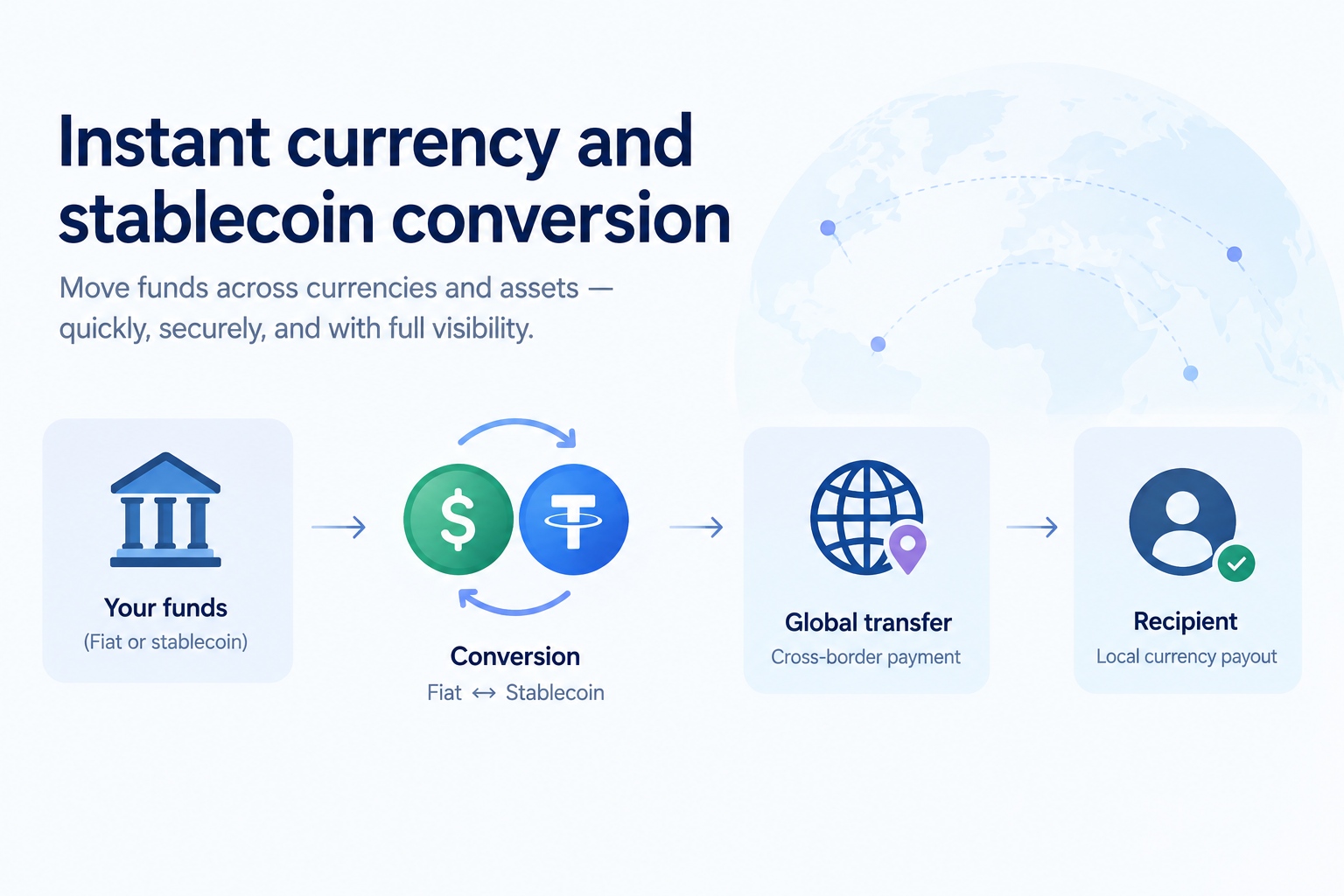
For example, a company paying an overseas supplier could convert available funds into a settlement asset. It could then move value across borders and convert it into the recipient’s required currency. The exact timing depends on corridor access, liquidity, screening, and payout infrastructure.
Stablecoin infrastructure has grown quickly, but stablecoins are not yet the dominant global cross-border rail. Market capitalization and trading volume show infrastructure growth. They do not measure completed commercial payments by themselves.
An IMF analysis of stablecoins reported market capitalization of approximately $300 billion in 2026. The market had nearly tripled between 2021 and 2025. This is a market snapshot, not a direct measure of payment adoption.
The IMF also reported that USDT and USDC trading volume reached approximately $23 trillion in 2024. That represented a 90% increase from 2023. Much of this activity remained connected to crypto-asset trading and liquidity management.
The IMF estimated approximately $1.5 trillion in stablecoin cross-border payment flows. It compared that figure with an approximately one-quadrillion-dollar global cross-border traditional and crypto payment market for 2024. These figures describe different types of activity and should not be treated as equivalent measures.
A separate FSB estimate of cross-border payment activity put stablecoin cross-border payment volume below 0.2% of total cross-border payments in 2025 under some measures.
Regional usage is also uneven. Asia and the Pacific lead by absolute activity in IMF analysis. Africa, the Middle East, and Latin America stand out when stablecoin activity is measured relative to GDP.
The useful description is rapid infrastructure growth with early commercial-payment penetration. Both conditions can be true at the same time. The more useful question is not how much stablecoin volume exists, but how much supports repeatable, compliant business payments.
How institutions move between fiat currencies and stablecoins
Institutions typically manage conversion as a sequence of operational steps. The goal is to move value into the right currency, corridor, and settlement endpoint.
A typical workflow includes:
•Sourcing funds from a bank account, payment balance, or other approved funding source.
•Completing compliance, sanctions, fraud, and counterparty checks.
•Converting into the selected fiat currency or stablecoin.
•Transferring or settling the value.
•Converting again if the recipient requires another currency.
•Completing local payout and treasury reconciliation.
The main decision points include the required currency, counterparty location, available liquidity, settlement timing, redemption access, payout access, transaction monitoring, and accounting treatment.
Stablecoins can act as a bridge between currency zones. They may be useful where correspondent-banking access is costly, slow, or limited. They are not a universal replacement for bank money or established payment infrastructure.
IMF research on stablecoin activity identifies emerging-market and developing-economy corridors as prominent in stablecoin cross-border activity. This differs from the concentration pattern of traditional cross-border flows in advanced economies.
A hybrid model can connect stablecoin infrastructure with bank money, local payout systems, and foreign-exchange services. This approach treats stablecoins as one part of the payment workflow rather than a standalone rail.
For example, a global trade company receiving funds in EUR and paying a supplier in CNY could compare direct fiat conversion with a stablecoin bridge. It would then assess liquidity, compliance, settlement, and payout conditions for the selected corridor.
Fuze Business is a platform positioned around this type of workflow. Its listed capabilities include sending, receiving, and converting funds, instant currency and stablecoin conversion, cross-border payments, faster settlement, AED, CNY, and EUR support, access to difficult trade corridors, and a banking network. These capabilities should be assessed against the company’s actual routes and requirements.
The frictions that still limit instant conversion adoption
Instant on-chain movement does not automatically produce instant, compliant local-currency settlement. Adoption remains shaped by regulation, liquidity, redemption, interoperability, compliance, data requirements, and local payout access.
The FSB’s October 2025 peer review found progress in crypto-asset regulation. It also identified significant gaps and inconsistencies in implementation for global stablecoin arrangements.
Compliance is therefore a core adoption condition. Relevant risks include money laundering, sanctions evasion, fraud, consumer protection, operational resilience, capital flows, and currency substitution.
Liquidity and redemption are corridor-specific. A stablecoin may be liquid in one market but difficult to convert into local currency in another. The recipient may also lack a suitable banking or payout route.
Fragmentation across blockchains and stablecoin networks can raise transaction costs. It can also make interoperability more difficult. The BIS assessment of stablecoin arrangements highlights the importance of examining the full arrangement rather than only the token transfer.
Cross-border payments also involve data-transfer, privacy, sanctions, AML/CFT, and reporting requirements. These obligations can create friction even when the underlying technology operates quickly. The FSB’s cross-border payments data recommendations address the need for greater alignment and interoperability across data frameworks.
Traditional instant-payment systems, tokenized deposits, and improved bank infrastructure remain competing or complementary approaches. Stablecoins are not the only route to faster settlement, as reflected in FSB remarks on stablecoins and payments.
A payment can move quickly on a blockchain yet remain operationally incomplete. This may happen when the recipient cannot redeem the asset, a compliance review pauses the transfer, or the destination corridor lacks a suitable payout route.
Benchmarks businesses should use to evaluate conversion providers
Businesses should compare the whole payment journey, not just the speed of the conversion screen. A useful evaluation covers speed, total cost, corridor reach, currency and stablecoin availability, compliance controls, and operational visibility.
The main benchmarks are:
•Speed: Compare quoted conversion speed with end-to-end payment completion time.
•Total cost: Review the FX rate, conversion spread, transaction fees, payout fees, and other charges.
•Corridor reach: Check whether the provider supports the routes used in practice, including difficult trade corridors.
•Currency access: Confirm the required fiat currencies and stablecoins are available.
•Compliance controls: Assess screening, transaction monitoring, regulatory coverage, and escalation procedures.
•Operational visibility: Review tracking, exception handling, beneficiary availability, reporting, and reconciliation.
End-to-end completion may include screening, liquidity checks, banking-network processing, local payout, and reconciliation. A provider’s quoted conversion speed should therefore be measured separately from the time required for usable funds to reach the beneficiary.
Companies should measure corridor performance rather than rely on a global average. The FSB’s cross-border payments work emphasizes the importance of improving payment speed, cost, transparency, and access across different markets.
Useful settlement measures include time to beneficiary availability, exception-handling time, failed-payment rate, conversion spread, fees, and reconciliation effort. Numerical targets should come from provider data or the company’s own transaction history.
Enterprise-grade compliance and regulatory coverage are also adoption enablers. This is especially important while stablecoin regulation remains inconsistent across jurisdictions, as shown by the FSB implementation review.
A finance manager can compare two providers using the same corridor and payment amount. The test should record the quoted FX rate, fees, screening time, settlement time, beneficiary availability, exception handling, and reconciliation output. Teams should also confirm support for currencies such as AED, CNY, and EUR where those currencies are part of the workflow.
How Fuze Business helps with global payments
Instant conversion is most valuable when it connects currency access, stablecoin conversion, cross-border payment execution, settlement, and local-corridor requirements in one workflow. The next phase of adoption will be measured by reliable corridors, compliant execution, and faster access to usable funds, not by transaction volume alone.
Fuze Business is a unified way to send, receive, and convert funds. Its listed capabilities include cross-border payments, faster settlement, access to difficult trade corridors, a banking network, enterprise-grade compliance, and instant currency and stablecoin conversion.
The platform lists support for AED, USD, EUR, GBP and more. Finance managers, global trade companies, and supply chain teams should assess whether these capabilities align with their actual payment routes, conversion needs, payout requirements, and compliance workflows.
Explore how Fuze Business can support faster, more seamless cross-border payment workflows.