
Finance managers, global trade companies, and supply chain teams often need to move money across currencies and jurisdictions. They may hold traditional currencies, stablecoins, or both.
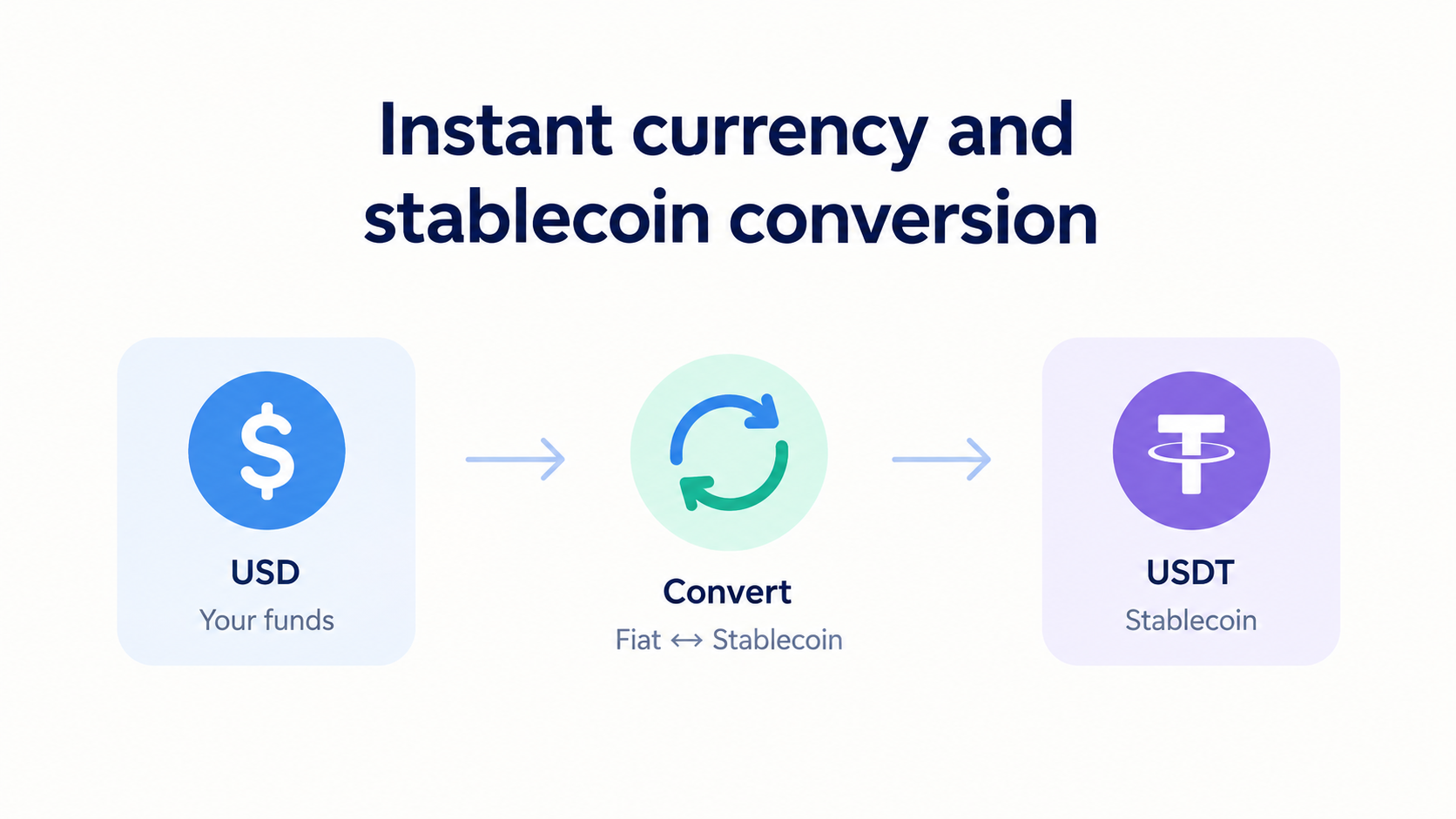
The first step is understanding the terms. Currency conversion changes the denomination of funds. Stablecoin conversion changes between fiat money and a digital asset designed to track a reference value.
A practical payment may involve several separate stages. These include conversion, payment initiation, compliance review, clearing, settlement, beneficiary credit, and reconciliation. Therefore, “instant” usually describes an intended conversion experience. It does not guarantee that every payment, compliance review, corridor, or beneficiary credit will complete instantly.
Define instant currency conversion, stablecoins, and off-ramps
Currency conversion exchanges one fiat currency for another. For example, a business might convert USD to EUR or AED to CNY. The applicable exchange rate, spread, and fees determine the amount received.
A stablecoin is a cryptoasset designed to maintain a stable value against a specified asset or basket of assets. However, the label does not guarantee that the asset will always remain stable. Global stablecoin guidance highlights the importance of risks, governance, and oversight.
Stablecoins can serve as digital settlement or holding instruments. An off-ramp converts stablecoins into fiat currency or makes fiat funds available to a recipient. An on-ramp generally describes the reverse process: moving fiat funds into a digital asset.
The phrase “instant currency and stablecoin conversion” is best treated as a product or workflow description. It is not a universally defined financial or legal term. Payment providers can use it to describe fast quoting and execution within supported conditions.
| Term | Meaning |
|---|---|
| Fiat currency | Government-issued money, such as USD, EUR, AED, or CNY |
| Stablecoin | A digital asset designed to track a reference value |
| Conversion | Exchanging one currency or asset for another |
| On-ramp | Moving fiat funds into a digital asset |
| Off-ramp | Converting a digital asset into fiat funds or a fiat payout |
| Settlement | Completing the transfer of value between parties |
| Beneficiary credit | Making funds available to the intended recipient |
| Reconciliation | Matching payment records with financial accounts and transaction references |
For example, a business holding USDC that needs to pay a supplier in CNY may need two steps. It may first convert USDC into fiat or another supported asset. It may then use a cross-border payment or local settlement route to deliver CNY.
The conversion result and the supplier’s access to funds are different outcomes. A payment is not fully complete until the business can confirm the relevant settlement and beneficiary-credit status.
Trace how a currency or stablecoin conversion works from funding to settlement
A typical workflow moves through several stages:
Fund → quote → verify → convert → route → settle → confirm → reconcile
The business first funds an account or wallet. It then selects the source asset and destination currency. The provider generates a quote showing the exchange rate and applicable charges.
Before execution, the provider may complete eligibility, know-your-business, sanctions, or transaction-monitoring checks. Once approved, the conversion takes place. The resulting funds then move through the selected payment or settlement route.
The quote may include several cost components:
•Exchange rate and spread
•Provider transaction fees
•Network or blockchain charges
•Banking or intermediary fees
•Withdrawal or payout costs
The business should assess the total cost before confirming the transaction. A low visible transaction fee does not always mean a lower delivered cost.
Settlement speed depends on the currency pair, corridor, funding method, counterparty, operating hours, compliance review, data quality, and recipient-bank availability. Cross-border payment workflows can also involve different banking and payout stages.
A transaction marked “sent” or “converted” does not necessarily mean the recipient can use the funds. It also does not prove that the payment has been reconciled. Payment settlement speed should therefore be assessed by milestone.
For a stablecoin-funded supplier payment, record the following:
•Source asset and network
•Destination currency
•Quoted rate and total fees
•Beneficiary details
•Expected settlement window
•Payment and reconciliation references
The process is complete only when the business can identify both the conversion result and the final recipient-credit status.
Compare direct fiat conversion with stablecoin-assisted conversion
Direct fiat conversion is often the simpler option when the payer and recipient currencies are supported. It may also suit businesses with established banking connectivity and predictable settlement requirements.
A stablecoin-assisted route may suit a business that already holds stablecoins. It may also help when a digital settlement rail supports a difficult corridor or provides an operational path into the recipient’s required currency.
However, stablecoin routes introduce additional questions. These include asset support, wallet and network compatibility, liquidity, redemption arrangements, regulatory treatment, accounting, and off-ramp availability.
| Route | Best-fit starting position | Main steps | Cost questions | Operational risks | Validation test |
|---|---|---|---|---|---|
| Direct fiat | Both currencies and the banking route are available | Convert fiat, route payment, settle, reconcile | Compare spread, banking charges, intermediary costs, and payout fees | Bank delays, corridor limits, returned payments | Confirm destination currency and recipient-credit process |
| Stablecoin-assisted | Stablecoins are already held or provide a supported settlement route | Transfer or hold stablecoin, convert, route payment, settle, reconcile | Compare spread, network fees, conversion fees, and payout costs | Asset support, liquidity, redemption, compliance, and off-ramp limits | Confirm supported asset, network, destination currency, and final payout |
| Decision rule | The route meets legal, currency, delivery, and reconciliation requirements | Document every milestone | Compare the total delivered amount | Review exceptions and settlement risk | Test a representative payment before scaling |
Fuze Business supports currency and stablecoin conversion, banking-network connectivity, access to difficult trade corridors, cross-border payments, and enterprise-grade compliance among its capabilities. Availability remains dependent on the corridor and the business’s eligibility. Businesses can explore its global payment capabilities to assess how Fuze Business can support their specific payment and settlement needs.
Compare a USD-to-EUR bank route with a USDC-to-EUR route using the same payment amount. Keep the recipient requirement, settlement window, and reconciliation standard consistent.
Choose the route with a documented total-cost estimate and a confirmed recipient-currency outcome. Do not choose only on the lowest visible fee.
Evaluate the benefits and limitations of instant conversion for business payments
The practical benefit is not speed alone. It is a more visible and manageable payment workflow.
Potential benefits include fewer manual conversion steps, clearer visibility into rates and fees, faster movement between supported assets, and simpler treasury operations. A unified workflow can also help teams track payment status and transaction records.
Stablecoin settlement may connect payment flows across jurisdictions. It does not remove the need for compliance controls, supported corridors, liquidity, or a suitable recipient payout method.
Stablecoins also carry risks. These can relate to reserve assets, redemption, governance, market liquidity, operational resilience, and regulatory treatment. Stablecoin risk considerations should form part of the provider and asset review.
Instant conversion does not mean instant finality, universal availability, or zero settlement risk. Actual performance should be measured with operational metrics, such as:
•Recipient availability
•Payments settled within the target window
•Exception and repair rates
•Time from settlement to reconciliation
A finance team should be able to compare the quoted rate, visible fees, destination currency, payment status, and reconciliation record for one completed transaction. The benefit is validated only when the payment can be traced from funding to final reconciliation.
Use a practical checklist to select a currency and stablecoin conversion provider
A provider should support the assets, currencies, jurisdictions, corridors, and payout methods required by the business. It should also provide enough information to assess cost, compliance, and settlement.
Use this checklist before selecting a provider:
1.Confirm coverage: Check supported source assets, destination currencies, stablecoins, jurisdictions, corridors, counterparties, and payout methods.
2.Review pricing: Ask when the quote is locked, how the rate is set, and which fees apply. Confirm whether network, banking, withdrawal, or intermediary charges are separate.
3.Assess compliance: Review KYB, sanctions screening, transaction monitoring, licensing, custody or wallet arrangements, redemption processes, and recordkeeping requirements.
4.Define controls: Set beneficiary-verification rules, approval thresholds, transaction-status procedures, exception handling, returned-payment processes, and reconciliation requirements.
5.Run representative tests: Test a recurring supplier payment, a foreign-currency payment, a permitted stablecoin-funded payment, and a delayed or returned-payment scenario.
The core question is simple: can the provider move the required asset through the required corridor, under the required compliance process, within the required settlement window?
A provider-selection review passes when finance can produce a written answer for the source asset, recipient currency, corridor, total cost, compliance owner, expected settlement milestone, and reconciliation reference.
How Fuze Business helps with global payments and currency conversion
Fuze Business is a unified platform for sending, receiving, and converting funds across cross-border payment workflows. The platform brings currency and stablecoin conversion, cross-border payments, banking-network connectivity, and access to difficult trade corridors into one business payment workflow.
Fuze Business supports currencies including AED, USD, EUR, GBP, and more. The platform also provides enterprise-grade compliance and faster settlement capabilities for business payment workflows. Coverage and availability depend on the specific currency, asset, jurisdiction, and corridor.
Businesses can view the FX rate and applicable fees before confirming a payment. Fuze Business also supports currency and stablecoin conversion as part of the broader payment workflow, including stablecoin-funded payments and settlement in the required currency where supported.
A finance manager with stablecoin holdings and a supplier payable in a supported fiat currency can evaluate Fuze Business by confirming:
•Required corridor and destination currency
•Supported asset and payment method
•Compliance and eligibility requirements
•Quoted costs and applicable fees
•Settlement process and reconciliation evidence
Fuze Business brings sending, receiving, conversion, and cross-border payment workflows together in one platform. Coverage, settlement timing, pricing, eligibility, and compliance treatment should be confirmed for the specific payment use case.