

Businesses use global payments to pay suppliers, collect funds, manage international trade, and convert currencies or stablecoins. These activities require more than a domestic transfer.
Cross-border payments may involve multiple institutions, currencies, jurisdictions, time zones, compliance checks, and settlement processes. This makes the operating model more complex than moving money within one country.
This guide explains how the system works, reviews the main capability categories, examines benefits and trade-offs, and provides a provider-evaluation checklist.
What global payments include: money movement across currencies, countries, and payment systems
A global payments capability is the set of systems and processes used to send, receive, convert, settle, and monitor funds across borders.
Global payments include transactions where parties, accounts, or payment systems are located in different countries or economic jurisdictions. They can involve several payment infrastructures, financial institutions, currencies, and regulatory regimes. The BIS identifies four key dimensions for assessing cross-border payments: cost, speed, access, and transparency.
These payments support international trade, business operations, remittances, economic activity, and financial inclusion. They also combine several related capabilities that should not be treated as one process:
•Payment initiation: instructing a provider or financial institution to send funds.
•Currency conversion: exchanging one currency or stablecoin for another.
•Settlement: completing the transfer between participating institutions.
•Reconciliation: matching payment records with invoices, accounts, or other business data.
•Compliance: applying required identity, sanctions, anti-money-laundering, and other controls.
A domestic payment usually stays within one country or domestic payment system. A cross-border payment involves parties, accounts, or payment systems across countries. Settlement is the point at which the transfer is completed between participating institutions.
For example, a business might pay an overseas supplier in the supplier’s required currency. The business could fund that payment with another currency or stablecoin. The transaction then requires a defined corridor, a conversion step, a settlement method, and applicable compliance checks.
How a global payment works from initiation to settlement
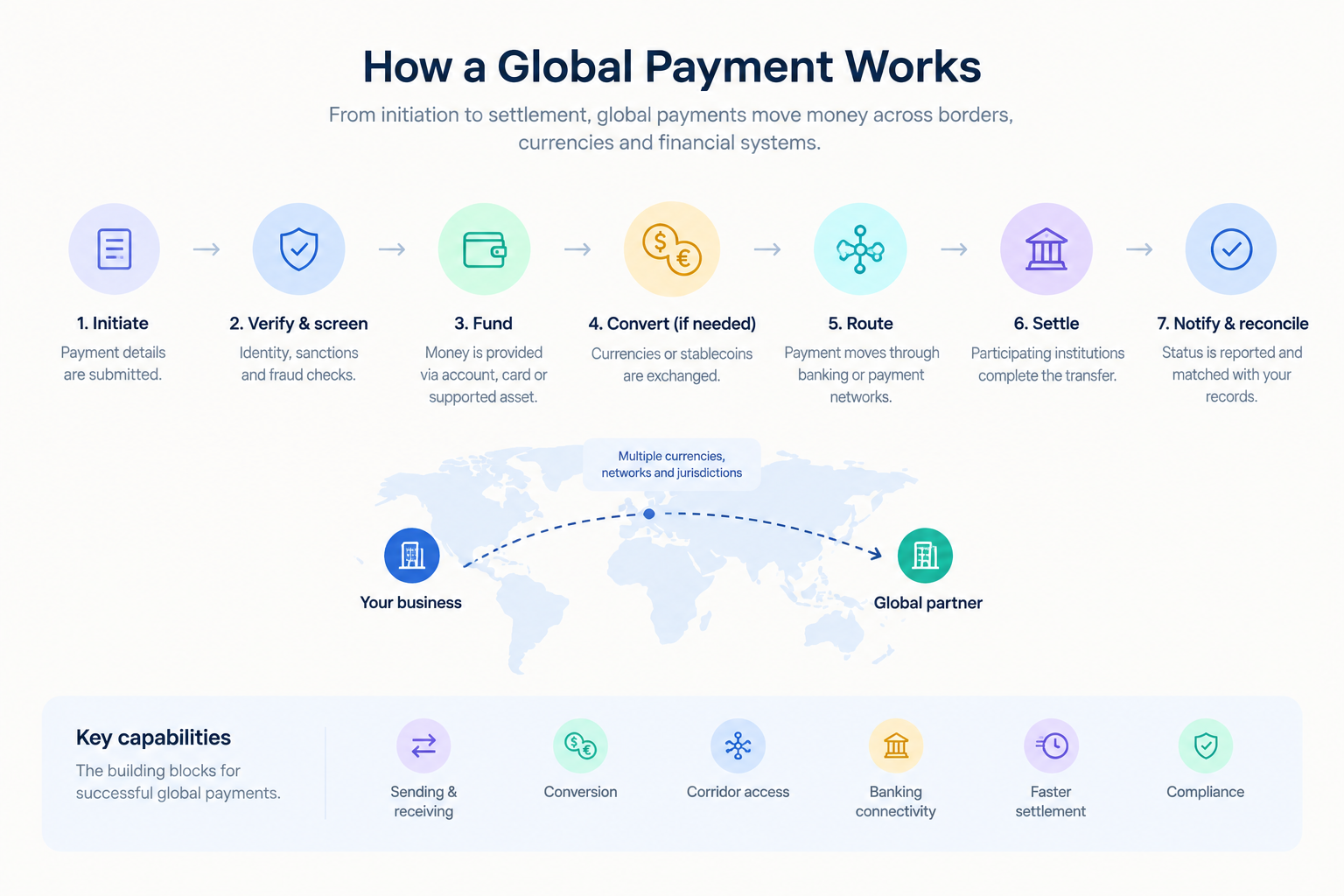
A typical global payment moves through several stages, from cross-border execution to settlement. The exact sequence depends on the currency, corridor, provider, payment network, and regulatory requirements.
The core process is:
1.Initiate: The payer submits the payment instruction and beneficiary details.
2.Verify and screen: The provider checks identity, payment information, sanctions, fraud indicators, and other applicable requirements.
3.Fund: The payer provides the required funds through an account, payment method, or supported asset.
4.Convert if required: The provider exchanges currencies or stablecoins when the funding and payment currencies differ.
5.Route: The payment moves through relevant banking or payment networks.
6.Settle: Participating institutions complete the transfer.
7.Notify and reconcile: The provider reports the status, while the business matches the payment with its internal records.
Correspondent banking chains have historically connected institutions across jurisdictions. They can also add intermediaries, costs, processing time, and reconciliation work. Newer payment arrangements may reduce some of this complexity, but results depend on the participating institutions and jurisdictions.
Foreign-exchange conversion and foreign-currency liquidity are separate considerations from the transfer itself. A provider may be able to route a payment but still face limits on currency availability or funding.
Cross-border payments can also require repeated or coordinated checks. Countries apply different sanctions, anti-money-laundering, counter-terrorist-financing, and other regulatory requirements. Faster settlement does not remove applicable compliance checks.
A payment may be delayed by incomplete beneficiary data, compliance review, insufficient liquidity, a non-operating local payment system, currency conversion, or settlement failure. Structured payment data and interoperability can reduce manual work and improve traceability, but implementation conditions still matter.
Global payments capability taxonomy: sending, receiving, conversion, corridors, and control
A provider comparison should connect each capability to a specific business task. The following framework covers the seven core areas.
| Capability | What it enables | Operational question | Business outcome |
|---|---|---|---|
| Sending | Paying suppliers, employees, partners, or customers across borders | Can the provider send through the required corridor and currency? | More ways to complete international obligations |
| Receiving | Collecting funds from international customers or counterparties | Can the provider support inbound payments and reconciliation? | Better support for international revenue |
| Currency and stablecoin conversion | Exchanging assets during funding, payment, or treasury workflows | Which currencies or stablecoins are supported, and when are rates and charges disclosed? | Greater funding and payment flexibility |
| Corridor access | Reaching payment routes that may be difficult through conventional banking infrastructure | Are the required countries, counterparties, and routes available? | Access to more markets and trading relationships |
| Banking network | Connecting activity to banking relationships and settlement pathways | Which banking and settlement connections support the payment? | More reliable payment routing |
| Faster settlement | Reducing the time between initiation and completion | What conditions affect the stated settlement time? | Improved cash-flow coordination |
| Enterprise-grade compliance | Applying controls for processing across relevant markets | What screening, monitoring, audit, and escalation controls apply? | More structured risk and regulatory management |
Fuze Business can illustrate this unified model. Its supplied capability list includes cross-border payments, banking network connectivity, access to difficult trade corridors, AED, CNY, EUR, instant currency and stablecoin conversion, faster settlement, and enterprise-grade compliance.
These capabilities still require specific evaluation. A provider comparison is complete only when each item maps to a task, such as paying a supplier, receiving an export payment, converting AED or CNY, or managing a difficult trade corridor.
Fuze Business provides one example of this capability model, combining cross-border payments, banking-network connectivity, currency and stablecoin conversion, settlement, tracking, and compliance capabilities across supported corridors. These capabilities can be evaluated against the specific currencies, corridors, settlement requirements, and compliance needs of a business.
Key benefits and persistent challenges of global payments
Global payments can reduce operational friction, expand market access, improve payment coordination, and support international trade. The Financial Stability Board’s policy objective is to make cross-border payments faster, cheaper, more transparent, and more inclusive.
The main benefits include:
•Faster movement of funds: Shorter settlement times can improve cash-flow planning.
•Broader access: Businesses can work with suppliers, customers, and counterparties in more markets.
•Conversion flexibility: Currency and stablecoin conversion can support different funding and payment needs.
•Better visibility: Structured status information can improve tracking and reconciliation.
•Lower operational friction: Unified workflows can reduce manual coordination across providers and accounts.
However, cross-border payments remain generally more costly, slower, less accessible, and less transparent than domestic payments. The BIS describes these continuing challenges across different payment technologies and arrangements.
Costs may include stated fees, foreign-exchange margins, intermediary charges, and recipient-side charges. Delays or uncertainty can result from long transaction chains, limited interoperability, different technical standards, incomplete payment information, regulatory variation, and foreign-currency liquidity constraints.
Speed and access also require careful qualification. A faster payment claim may depend on the corridor, currency, funding method, compliance review, operating hours, and settlement conditions.
The World Bank’s Q3 2025 data reported a global average remittance cost of 6.36%. This is a specific remittance benchmark, not a universal price for business payments.
| Potential benefit | Related constraint |
|---|---|
| Faster settlement | Compliance review or operating hours may add time |
| Broader access | Coverage depends on corridor availability |
| Conversion flexibility | Foreign-exchange exposure and charges may apply |
| Easier coordination | Integration and data-quality requirements remain |
| Greater transparency | Visibility depends on the provider and payment network |
The value of a global payments platform is not only moving money. It is reducing the operational friction around moving money while preserving appropriate controls.
Compliance, payment data, and standards in cross-border transactions
Compliance affects what information a payment requires, how it is screened, and whether it can proceed. Requirements may include anti-money-laundering, counter-terrorist-financing, sanctions, fraud-prevention, consumer-protection, data, and licensing obligations.
The exact obligations depend on the jurisdictions and services involved. Businesses should distinguish three concepts:
1.Payment information: Data required to identify the payer, beneficiary, and transaction.
2.Screening and monitoring: Checks applied to the transaction, parties, and activity.
3.Authorization and oversight: The provider’s regulatory permissions, responsibilities, and supervision.
The Financial Action Task Force agreed revised Recommendation 16 changes in June 2025. The changes aim to improve information accompanying cross-border payments and clarify responsibilities across ordering, intermediary, and beneficiary institutions. The FATF materials describe the implementation timeline, with countries expected to be ready by the end of 2030.
This is a future implementation checkpoint. It does not mean every jurisdiction has already adopted the changes.
ISO 20022 is a global standard for structured financial information. It supports richer payment data, automation, and more consistent processing. Swift reported that the coexistence period between MT and ISO 20022 payment instruction messages for cross-border payments ended in November 2025, with further migration milestones continuing in 2026. Its ISO 20022 information provides the relevant standards context.
Enterprise-grade compliance should be evaluated as an operating capability. It is not a guarantee that every transaction will be approved or completed without review.
A practical assessment should cover required payer and beneficiary data, screening workflows, transaction-monitoring responsibilities, exception handling, audit trails, data retention, jurisdictional coverage, and escalation processes. Compliance supports safe and lawful processing, but it can also create review time or payment restrictions.
How to evaluate a global payments provider for business use
Start with the business’s actual payment corridors, currencies, counterparties, transaction sizes, settlement expectations, and compliance obligations. Then test whether the provider supports the complete workflow.
Use this decision framework:
1.Corridor fit: Confirm that the provider supports the countries, counterparties, and routes required.
2.Currency fit: Verify support for operating currencies and any required stablecoins.
3.Send and receive coverage: Check whether the business can make outbound payments and collect inbound funds.
4.Conversion fit: Understand supported assets, exchange-rate timing, liquidity, and charges.
5.Settlement expectations: Confirm expected timing and the conditions that could change it.
6.Compliance and data controls: Review screening, monitoring, records, authorization, and escalation processes.
7.Operational visibility: Assess payment status, exception handling, notifications, and reconciliation.
8.Commercial review: Compare fees, foreign-exchange costs, intermediary charges, and other pricing conditions.
General geographic coverage is not the same as access to a difficult trade corridor. Availability can vary by currency, counterparty, regulatory condition, and banking connectivity.
A provider should also explain when the exchange rate and charges are disclosed. This helps the business assess the total cost rather than only the visible transaction fee.
The evaluation is actionable when a finance manager can answer one question: Can this provider move the required currency through the required corridor, under the required compliance process, within the required settlement window?
How Fuze Business helps with global payments
For businesses managing payments across countries and currencies, Fuze Business brings several global payments capabilities into one platform. Businesses can use a unified account to send, receive, convert, and track funds across supported payment corridors and manage each cross-border transaction from a single platform.
Fuze Business supports cross-border payments, banking-network connectivity, currency and stablecoin conversion, settlement, and transaction tracking, helping businesses coordinate payment and treasury workflows through a single platform.
The platform also provides transparent pricing, with the applicable exchange rate and fees shown before payment confirmation. Depending on the corridor and payment method, businesses can access different settlement options, including stablecoin-powered settlement.
For finance teams, visibility and control are also important. Fuze Business provides transaction status, balance reconciliation, and alerts through a unified dashboard, while compliance controls are built into the onboarding and payment workflow.
As with any global payments provider, availability and settlement times depend on the specific currency, corridor, funding method, counterparty, and applicable regulatory requirements. Businesses should evaluate these factors against their own payment needs before selecting a provider.