

Intermediary banks are a normal part of cross-border banking. Their involvement does not automatically mean that a payment has failed or is unsafe.
A typical international wire can involve three parties: the ordering bank, the intermediary or correspondent bank, and the beneficiary bank. The ordering bank sends the payment instruction. The intermediary bank helps route or settle it. The beneficiary bank receives the funds and credits the recipient’s account.
Several intermediary institutions may be involved when the sending and beneficiary banks lack a direct relationship. This is common in complex corridors, including some MENA and South Asia routes. For example, an AED-to-INR or AED-to-PKR payment may require additional routing before the destination bank can process the local-currency leg.
Businesses should assess more than the initial transfer fee. The practical decision includes total delivered cost, settlement timing, payment visibility, corridor access, compliance requirements, and the risk of deductions.
Before sending a payment, the sender should have the beneficiary’s legal name, account or IBAN details where applicable, bank identifier, destination currency, payment purpose, and required compliance information.
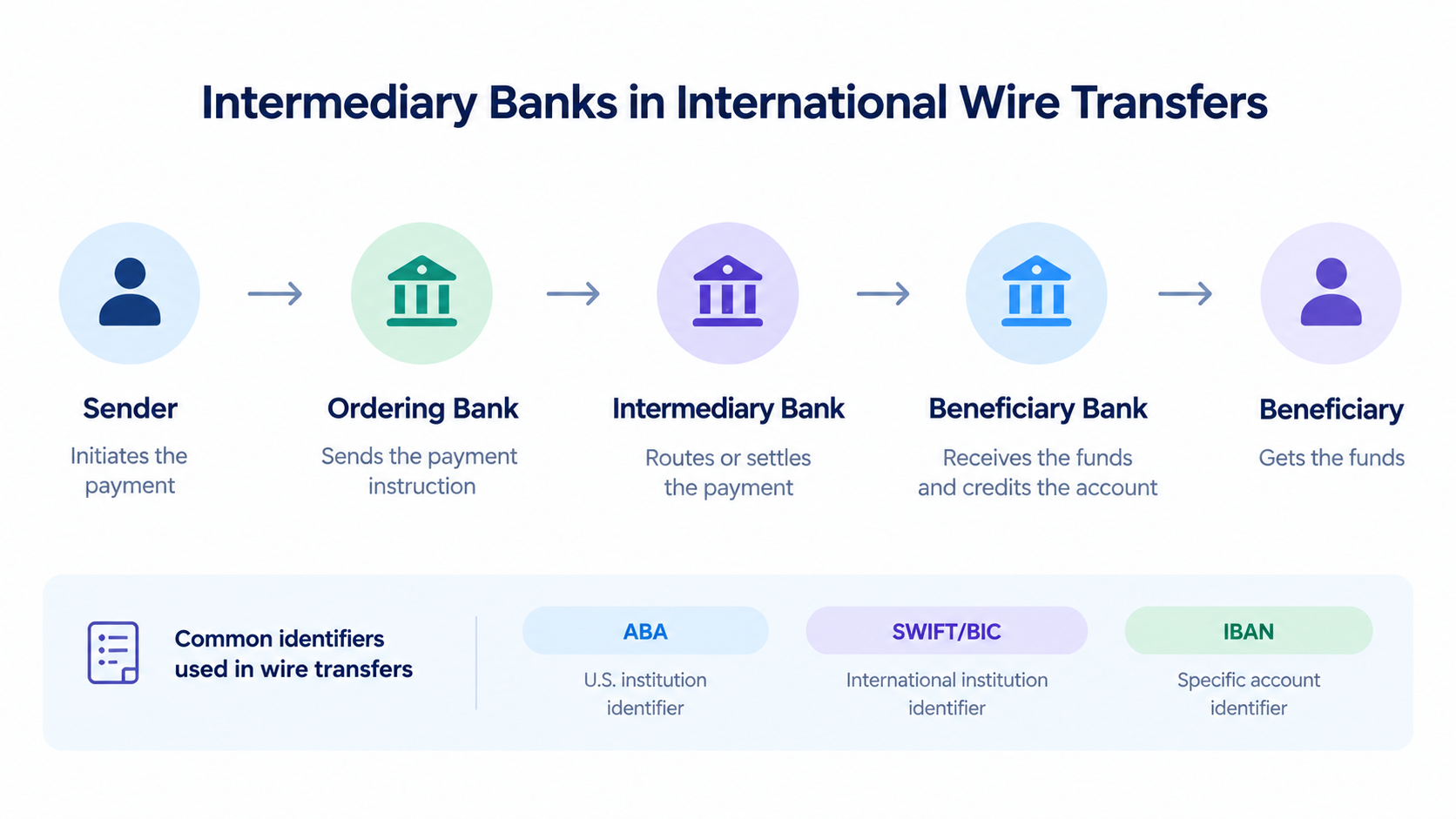
What an intermediary bank does in an international wire transfer
An intermediary bank is the bridge used when two banks cannot settle a payment directly. It helps transmit instructions, access a payment system, or settle funds between institutions.
A correspondent bank provides banking and payment services to another bank through an established correspondent relationship. This may include access to a currency, payment system, or destination market where the respondent bank lacks a direct presence.
The terms intermediary bank and correspondent bank overlap in everyday payment discussions. They describe different roles, however. An intermediary bank is positioned between the sending and beneficiary banks in a payment route. A correspondent bank is the institution providing services through a correspondent relationship.
The beneficiary bank is the institution that ultimately processes the payment and credits the recipient’s account. The route may include one or more institutions before that final credit occurs.
The basic payment map is:
Ordering customer → ordering bank → intermediary or correspondent bank(s) → beneficiary bank → beneficiary customer
In a typical cross-border payment, banks update account balances between institutions. Physical cash does not move across borders. The payment instruction travels through banking and payment relationships, while settlement occurs through accounts held between financial institutions. The correspondent banking framework supports this model.
Additional hops may be required when the originating and receiving banks do not maintain a direct bilateral relationship. Currency requirements, local payment access, and corridor-specific arrangements can also create another step.
For an AED-to-INR supplier payment, the sender’s bank may use one or more correspondent relationships. The Indian beneficiary bank then receives and credits the INR leg. A useful validation signal is whether the payment instruction identifies a usable route and whether the beneficiary bank confirms receipt or credit.
How the correspondent-banking chain moves funds from sender to beneficiary
The payment journey normally includes initiation, compliance screening, sanctions checks, routing, foreign-exchange conversion, interbank settlement, beneficiary-bank processing, account credit, and reconciliation.
SWIFT primarily carries standardized payment messages. It does not itself move the underlying funds. Settlement occurs through accounts and payment relationships maintained by financial institutions. This distinction matters because a message can move quickly while settlement and account credit take longer.
A bank may route a payment through a third-country institution when it lacks the required relationship or currency access in the destination market. Each additional institution can introduce another operating window, compliance review, cut-off time, or fee.
| Stage | Institution involved | What can delay it | Evidence to request |
|---|---|---|---|
| Initiation | Ordering bank | Incorrect payment data or missing documents | Payment confirmation |
| Screening | Ordering or intermediary bank | Sanctions, compliance, or purpose review | Hold or review status |
| Routing | Intermediary or correspondent bank | Missing relationship, cut-off, or repair | Routing details and intermediary BIC |
| Conversion | Relevant banking or payment institution | FX availability, liquidity, or conversion review | Currency and exchange-rate details |
| Settlement | Banks holding the relevant accounts | Operating hours, liquidity, weekends, or holidays | Value date and settlement status |
| Beneficiary processing | Beneficiary bank | Local checks or incorrect account details | Credit confirmation or rejection reason |
| Reconciliation | Sending business and beneficiary | Missing fee or receipt information | MT103, UETR, and beneficiary credit |
Time zones, public holidays, liquidity arrangements, and repeated compliance checks can extend the time between instruction and final credit. A longer chain also creates more points where a payment can be held, rejected, repaired, converted, or charged.
A payment that leaves the sender’s bank but remains pending at an intermediary has not necessarily failed. The operational question is which institution currently holds it. The team should then establish whether it is awaiting compliance review, repair, liquidity, or onward routing.
How intermediary-bank fees work with OUR, SHA, and BEN charges
International-wire pricing can include several separate costs. These may include the sender bank’s outgoing fee, intermediary deductions, beneficiary-bank fees, foreign-exchange spread, and repair or investigation costs.
The three common charge instructions are:
| Charge code | General meaning | Potential result |
|---|---|---|
| OUR | The ordering customer is instructed to bear transaction charges | The sender aims to cover the relevant charges |
| SHA | Charges are shared under applicable payment rules | The sender and beneficiary may each pay charges |
| BEN | The beneficiary bears transaction charges | Deductions may reduce the amount received |
The charge code does not guarantee the same commercial result in every corridor. Local market practice, bank agreements, currency, payment method, and fee schedules can affect the final amount.
Under common MT103 practice, intermediary fees may be deducted from the payment amount. This can cause the beneficiary to receive less than the original instruction. A business should therefore distinguish three figures: the amount sent, the amount debited from the sender, and the amount credited to the beneficiary.
For example, a sender may instruct a payment of USD 10,000. If an intermediary deducts USD 25 under a shared or beneficiary-borne arrangement, the beneficiary may receive USD 9,975 before any additional receiving-bank charge.
The cheapest fee at initiation is not always the lowest total cost. Deductions can reduce the supplier’s receipt and create reconciliation work. For a USD 10,000 invoice, the finance team should record the sender debit, intermediary deductions, and beneficiary credit separately.
A payment process passes the fee-control check only when the instruction and beneficiary-side receipt reconcile to the agreed commercial amount.
Why international wires are delayed or arrive short and how to trace them
International wires can be delayed by inaccurate beneficiary data, missing purpose information, sanctions screening, cut-off times, insufficient liquidity, currency conversion, weekends, holidays, or unexpected routing.
A payment may also arrive short. Common causes include intermediary deductions, beneficiary-bank fees, foreign-exchange conversion, and the selected OUR, SHA, or BEN instruction.
The MT103 is a customer-credit-transfer message commonly used as evidence of the payment instruction and its routing details. The sender should request a copy from its bank where available.
The Unique End-to-End Transaction Reference, or UETR, supports payment tracking across participating institutions. SWIFT gpi uses the UETR to improve status visibility and payment traceability.
A practical trace request should include:
•MT103 copy
•UETR
•Value date
•Currency and amount
•Beneficiary account details
•Intermediary BIC
•Current payment status
•Rejection or hold reason
•Fee fields
•Expected beneficiary credit
When investigating a delayed payment, ask whether it has left the ordering bank. Then ask which bank last acknowledged it. The bank should clarify whether the payment is pending, rejected, returned, credited, or transferred outside the SWIFT network.
Start with the last confirmed institution rather than repeatedly resubmitting the same payment. Resubmission can create duplicate-payment risks and does not explain where the original funds remain.
An MT103 alone does not resolve a payment. Resolution requires confirmed beneficiary credit, a documented rejection or return, or a clear status showing where the funds remain.
Traditional correspondent wires versus connected banking and stablecoin-rail approaches
Traditional correspondent banking offers broad reach through established bank relationships. It may also involve multiple hops, separate operating windows, layered compliance checks, foreign-exchange conversion, and less predictable deductions.
Direct or connected banking routes can reduce the number of institutions involved. This depends on the provider’s corridor access, currency capability, liquidity, compliance coverage, and payout arrangements.
Stablecoin-rail approaches offer another possible settlement path. Their suitability depends on supported currencies, conversion capability, regulatory permissions, counterparty acceptance, liquidity, and the final local-currency payout route. Businesses evaluating this model should understand how stablecoin payments infrastructure supports settlement, conversion, compliance, and payout across the intended payment corridor.
| Approach | Operating model | Main considerations |
|---|---|---|
| Traditional correspondent wire | Multiple bank relationships | Broad but corridor-dependent reach; potential stacked fees and deductions; timing affected by hops and cut-offs; tracking usually depends on bank-provided MT103 or gpi data |
| Banking-network route | Connected banking access | Depends on supported corridors and currencies; pricing may be more visible; fewer operational handoffs may simplify settlement |
| Stablecoin-enabled settlement | Stablecoin transfer plus conversion and payout | Depends on supported assets, jurisdictions, liquidity, and compliance; may reduce reliance on sequential correspondent legs; requires controls for conversion, compliance, and final beneficiary credit |
Fuze Business brings sending, receiving, and converting funds into a unified cross-border payment workflow, with access to difficult trade corridors, banking networks, currency and stablecoin conversion, faster settlement, and enterprise-grade compliance.
Its operating model uses regulated stablecoin rails to support same-day settlement, reducing reliance on multi-day correspondent-banking chains where supported. Actual settlement times depend on the corridor, payout method, and compliance checks.
For MENA-to-South Asia payments, businesses can compare traditional correspondent-banking routes with alternative payment paths by evaluating supported currencies, conversion steps, beneficiary payout methods, intermediary deductions, and settlement confirmation.
The key criteria are the final amount received, end-to-end settlement time, corridor coverage, compliance requirements, payment tracking, reconciliation, settlement finality, and available fallback routes.
How finance teams can reduce intermediary-bank cost and delay
Finance teams can reduce avoidable problems by validating payment data before release and documenting the full payment route.
Before sending a payment, verify the beneficiary’s legal name, account or IBAN details, bank identifier, destination currency, payment purpose, and required supporting documents.
Ask the sending bank whether the route is direct or uses one or more intermediaries. Confirm which charging code applies and whether the beneficiary is expected to receive the gross or net amount.
The quoted foreign-exchange rate should also be checked. Confirm whether it includes the full conversion cost and whether additional receiving-bank or intermediary charges may apply. Businesses can use a currency converter to estimate the amount in the recipient’s currency before confirming the final exchange rate and fees with their payment provider.
Retain the payment confirmation, MT103, UETR, invoice reference, fee breakdown, and beneficiary credit confirmation. These records support reconciliation and make investigations more efficient.
For recurring corridors, compare providers using delivered cost and confirmed settlement time. Do not rely only on the advertised initiation fee.
A useful procurement scorecard should include:
•Corridor and currency pair
•Number of expected hops
•Charge model
•Foreign-exchange spread
•Expected settlement window
•Tracking method
•Compliance requirements
•Refund or repair process
•Reconciliation data
Reject a route from the shortlist if the provider cannot explain who may deduct fees or how the payment can be traced.
The process is operationally controlled when the team can forecast the beneficiary’s net receipt, retrieve transaction status using the available reference, and reconcile the payment without manual bank-by-bank investigation.
How Fuze Business helps businesses make global payments faster
Traditional correspondent-banking chains provide international reach but can introduce additional intermediaries, fees, cut-off times, settlement delays, and reconciliation work. Connected banking networks and stablecoin-enabled settlement offer alternative ways to streamline cross-border payment workflows where supported.
Fuze Business brings sending, receiving, and converting funds into a unified cross-border payment platform. Its capabilities include access to difficult trade corridors, banking-network connectivity, support for AED, GBP, USD, EUR & more, currency and stablecoin conversion, and enterprise-grade compliance.
Fuze Business uses regulated stablecoin rails to support same-day settlement in applicable payment flows, reducing reliance on multi-day correspondent-banking chains. Actual settlement times depend on the corridor, currency, liquidity, compliance reviews, beneficiary payout method, and product availability.
For businesses dealing with intermediary fees, multiple banking hops, and unpredictable settlement times, Fuze Business offers a unified way to send, receive, and convert funds across supported markets, helping simplify global payment operations.