

For finance managers, global trade companies, and supply-chain teams, the difference between a telegraphic transfer and a wire transfer is mainly terminology. A telegraphic transfer (TT) commonly means an international bank payment. Wire transfer is more common in the United States and can include domestic wires.
The exact label does not identify the payment route. Required fields, fees, processing time, and available rails depend on the originating bank, destination country, currency, correspondent route, compliance review, and beneficiary bank. SWIFT/BIC details, intermediary banks, charge codes, foreign-exchange conversion, and recipient availability also affect the outcome.
Stablecoin-enabled payment routes offer another option for some cross-border use cases. However, businesses should compare the complete path to usable funds, not only the initial transfer step.
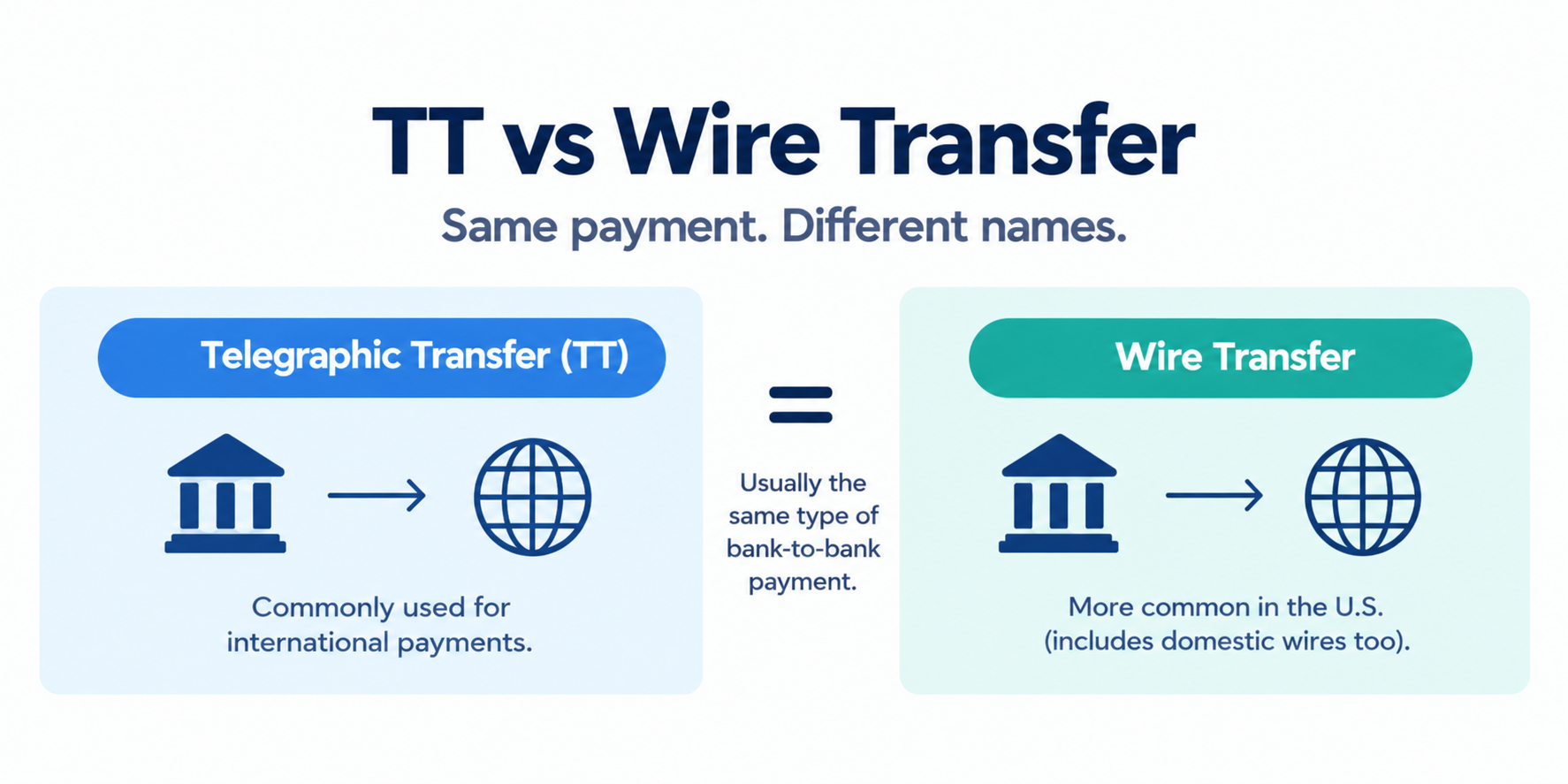
TT and wire transfer usually describe the same bank payment
A wire transfer is an electronic movement of money from one bank account to another. It can be domestic or international, as explained by the Consumer Financial Protection Bureau.
In international and trade-banking contexts, banks may call the same type of payment a telegraphic transfer. ANZ describes international payments as also known as cross-border payments or telegraphic transfers. HSBC describes a TT as an electronic method mainly used for overseas wire transactions.
“Telegraphic transfer” is more common in some international markets. “Wire transfer” is more common in U.S. banking. The terminology alone does not identify the exact payment rail, settlement method, or delivery time.
For example, a supplier in China may request payment by T/T. A U.S. bank may describe the same instruction as an international wire. The buyer should confirm the bank’s required payment form and beneficiary details instead of choosing based on the label.
The terminology test passes when the sender’s bank confirms the payment type, destination currency, delivery route, and required beneficiary instructions.
How an international TT or wire transfer moves from sender to recipient
An international payment can pass through several institutions before the recipient can use the funds. The typical sequence is:
1.Sender instruction: The sender submits payment details to a bank or payment provider.
2.Sending bank: The institution validates the instruction, screens the payment, and begins processing.
3.Correspondent or intermediary route: One or more banks may handle the payment before it reaches the destination.
4.Beneficiary bank: The recipient’s bank receives and processes the payment.
5.Recipient credit: The bank posts the funds to the beneficiary account.
6.Reconciliation: The sender and recipient match the payment to their internal records.
International payments may use correspondent or intermediary banks, as outlined in this telegraphic transfer guide. SWIFT is commonly used for financial messaging and bank identification. However, the messaging network and the movement or settlement of funds are related, but different, components. For a broader view of the cross-border payment process, including routing, conversion, settlement, and reconciliation, see our guide to cross-border transactions.
The end-to-end process may include payment initiation, screening, FX conversion, clearing, settlement, beneficiary credit, and reconciliation. A payment marked “sent” is not necessarily available for the recipient to use.
For example, a USD payment to a EUR account may require screening, currency conversion, intermediary processing, and beneficiary-bank posting. The recipient may not see usable EUR until those steps are complete.
The important milestone is not only when the payment is sent. It is when the recipient can use and reconcile the funds. Treat the transfer as complete when the beneficiary bank confirms credit and the sender can match the transaction to its internal reference.
Check these details before sending a TT instruction
Use the beneficiary bank’s official incoming-payment instructions. Generic online templates may omit fields required for a specific country, currency, or route.
Confirm the following details before releasing the payment:
•Beneficiary’s legal name
•Account number or IBAN, where applicable
•Beneficiary bank name and address
•Destination country and currency
•SWIFT/BIC
•Payment amount and purpose
•Intermediary or correspondent-bank details
•“For further credit” information, if supplied
•Charge instruction
•Exchange-rate basis and expected delivered amount
•Transfer fee and possible intermediary deductions
•Cut-off time and estimated delivery window
•Return or repair process
A BIC, commonly called a SWIFT code, identifies a financial institution for international addressing and messaging. The exact identifier requirements depend on the bank, country, currency, and route. Some payments also require an intermediary bank’s name, BIC, account details, or further-credit instructions.
Charge codes also affect the recipient’s final amount. OUR generally assigns transaction charges to the payer. BEN assigns them to the beneficiary. SHA shares charges between sender and recipient.
For example, a supplier may request USD 50,000 with charges marked SHA. The buyer should confirm whether intermediary deductions could reduce the supplier’s received amount. The buyer should also confirm whether the supplier requires a guaranteed net amount.
Do not release the payment until the bank or provider accepts all mandatory fields without an exception. The charge code should also match the commercial agreement.
Compare TT and wire transfers by fees, speed, FX, and delivery risk
Calling a payment a TT instead of a wire does not create a universal fee or speed advantage. The underlying route and provider terms matter more than the label.
| Comparison factor | TT | Wire transfer |
|---|---|---|
| Label used | Usually an international payment term | Broader term for domestic or international payments |
| Core meaning | Electronic bank-to-bank transfer | Electronic bank-to-bank transfer |
| Potential fees | Sending-bank fee, intermediary deductions, beneficiary-bank fee, and FX spread | Sending-bank fee, intermediary deductions, beneficiary-bank fee, and FX spread |
| Timing dependencies | Currency, country, cut-offs, compliance, intermediaries, and recipient posting | Currency, country, cut-offs, compliance, intermediaries, and recipient posting |
| Information needed | Beneficiary, account or IBAN, SWIFT/BIC, currency, purpose, and charge details | Beneficiary, account or IBAN, routing details, currency, purpose, and charge details |
| Best comparison question | When can the recipient use the funds, and what amount will arrive? | When can the recipient use the funds, and what amount will arrive? |
Costs can include an originating-bank fee, intermediary-bank deductions, beneficiary-bank fees, and the FX spread. The SWIFT payment explains why payment instructions and charge handling require careful review. Businesses should also assess the exchange-rate impact of currency conversion when calculating the total amount the beneficiary will receive.
Delivery time varies with operating hours, cut-off times, compliance checks, data quality, liquidity, intermediary processing, and local posting cycles. Traditional correspondent-banking routes can involve multiple handoffs. Each handoff can create another point where a payment waits or requires repair.
A useful comparison measures time to recipient availability, total delivered cost, exchange-rate transparency, corridor reach, compliance, tracking, failure handling, and reconciliation. Initiation speed alone is not enough.
For the same EUR supplier payment, one route may use a bank wire with an intermediary. Another may use a provider route with pre-agreed FX. Select the route based on the supplier’s received amount and availability time, not the advertised send time.
A route passes the comparison when the team can document the expected total cost, recipient-credit window, required currency, intermediary exposure, and exception-handling path.
Understand when stablecoin rails can support faster global payments
Stablecoins may provide an alternative settlement path for some cross-border use cases. Their speed still depends on the complete route, not only the digital asset transfer.
BIS analysis identifies potential speed benefits when stablecoins reduce structural frictions across payment-service-provider and payment-system networks. It also notes related policy, risk, and financial-system considerations.
A stablecoin-enabled payment may still require compliance screening, liquidity, FX conversion, off-ramp or bank delivery, beneficiary validation, and reconciliation. Stablecoin rails can reduce reliance on traditional correspondent-banking chains where suitable. They do not remove corridor, compliance, conversion, or final-delivery requirements. Businesses evaluating stablecoin-enabled payment routes should verify corridor availability, conversion requirements, compliance, and final beneficiary delivery before selecting a provider.
For example, a company may hold a supported stablecoin while its supplier requires local-currency bank credit. The route must include conversion and final bank delivery. Blockchain settlement alone does not complete the supplier payment.
Fuze Business combines banking-network access, stablecoin rails, currency and stablecoin conversion, cross-border payments, access to difficult trade corridors, enterprise-grade compliance, and faster settlement. Its platform can settle same-day over regulated stablecoin rails instead of multi-day correspondent-banking chains.
Use a stablecoin-enabled route only when the corridor, recipient currency or wallet destination, compliance treatment, liquidity, conversion process, and reconciliation record are confirmed.
How Fuze Business helps with faster global payments
Faster global payments depend on reducing avoidable handoffs while maintaining compliance, conversion, and reliable recipient delivery. Stablecoin rails may provide another route where traditional correspondent banking creates delays.
Fuze Business is a unified platform for sending, receiving, and converting funds across borders. Its stated capabilities include cross-border payments, banking-network connectivity, difficult trade-corridor access, currency and stablecoin conversion, enterprise-grade compliance, and faster settlement.
The platform combines banking connectivity with stablecoin rails rather than treating every payment as a conventional correspondent-bank wire. This can help businesses evaluate and manage the complete payment workflow in supported corridors.
Availability, timing, currency support, compliance review, liquidity, and final delivery remain dependent on the specific transaction and corridor. A finance manager should confirm the required corridor, currency flow, conversion path, compliance requirements, and recipient delivery method before onboarding or routing a payment. Explore Fuze Business for faster global payments through banking-network access and stablecoin rails.