
Choosing between a wire transfer and Automated Clearing House (ACH) payment depends on the vendor’s location, required currency, urgency, transaction value, and reconciliation needs. You should also consider fees, settlement uncertainty, and the vendor’s payment requirements.
ACH is an electronic money-transfer network that connects bank and credit-union accounts. A wire transfer is a bank-account payment sent through a wire service or banking network instead of the ACH Network.
ACH is primarily a U.S. network. International ACH arrangements exist, but they depend on specific gateways, jurisdictions, formats, and service availability. A payment is not truly “faster” just because it is initiated quickly. Measure the time until funds are available to the recipient and the payment can be reconciled.
For businesses managing cross-border payments, currency conversion, difficult trade corridors, and settlement timing, Fuze Business is one relevant example.
What ACH means for business vendor payments
ACH connects bank and credit-union accounts for electronic account-to-account payments. Businesses commonly use it for supplier invoices, recurring payments, payroll, and scheduled vendor runs. The ACH Network reaches nearly every U.S. bank and credit-union account and settles payments four times per business day, according to Nacha’s ACH overview.
Standard ACH commonly settles in one to two business days. Same Day ACH can settle within hours when the payment, provider, cutoff time, amount, and business-day schedule qualify. As of the research date, the Same Day ACH limit is $1 million per payment. Nacha says that limit is scheduled to increase to $10 million on September 17, 2027.
ACH is generally a practical choice for:
•Domestic U.S. vendors
•Scheduled invoice runs
•Recurring supplier payments
•Cost-sensitive workflows
ACH payments can also be returned when the account lacks sufficient funds. A payment initiation therefore does not always mean the vendor has received final funds.
For example, a U.S. company paying a domestic supplier can evaluate standard ACH first when it has verified U.S. account and routing details. It should choose Same Day ACH only when the payment qualifies and same-day availability is necessary.
What a wire transfer means for business vendor payments
A wire transfer sends funds through a wire-transfer service or banking network rather than the ACH Network. Fedwire is a U.S. real-time gross-settlement service for high-value and time-critical payments. Accepted payments settle with finality between participating institutions under the service’s framework, as explained by the Federal Reserve’s Fedwire service.
A wire may be appropriate when:
•The vendor requires bank-native settlement
•The payment is urgent
•The transaction value is high
•The destination is international
•The payment needs stronger settlement finality than a typical ACH credit
Wire timing varies by bank and corridor. Cutoff times, sender fees, receiving fees, intermediary charges, foreign-exchange conversion, compliance screening, and beneficiary-credit timing can all affect the result.
For international wires, the sender’s “sent” timestamp is not necessarily the recipient’s available-funds timestamp. The payment may still pass through correspondent banks, foreign-exchange conversion, compliance checks, local clearing, and beneficiary-credit steps.
A wire is not automatically instantaneous at the vendor’s bank. Measure the full path through routing, screening, conversion, settlement, and beneficiary credit.
For a time-critical supplier invoice, confirm the receiving bank’s cutoff, required correspondent-bank details, fee allocation, expected beneficiary-credit time, and the point at which the payment is considered final.
Why standard ACH has limited use for international vendor payments
ACH is generally positioned as a cost-efficient option for domestic account-to-account payments. Wires can add sender fees, receiving fees, correspondent-bank deductions, and foreign-exchange costs.
Speed also depends on the payment path. Standard ACH commonly takes one to two business days. Same Day ACH can settle within hours when eligible. Fedwire supports same-day real-time gross settlement for participating institutions, but international beneficiary credit may still take longer.
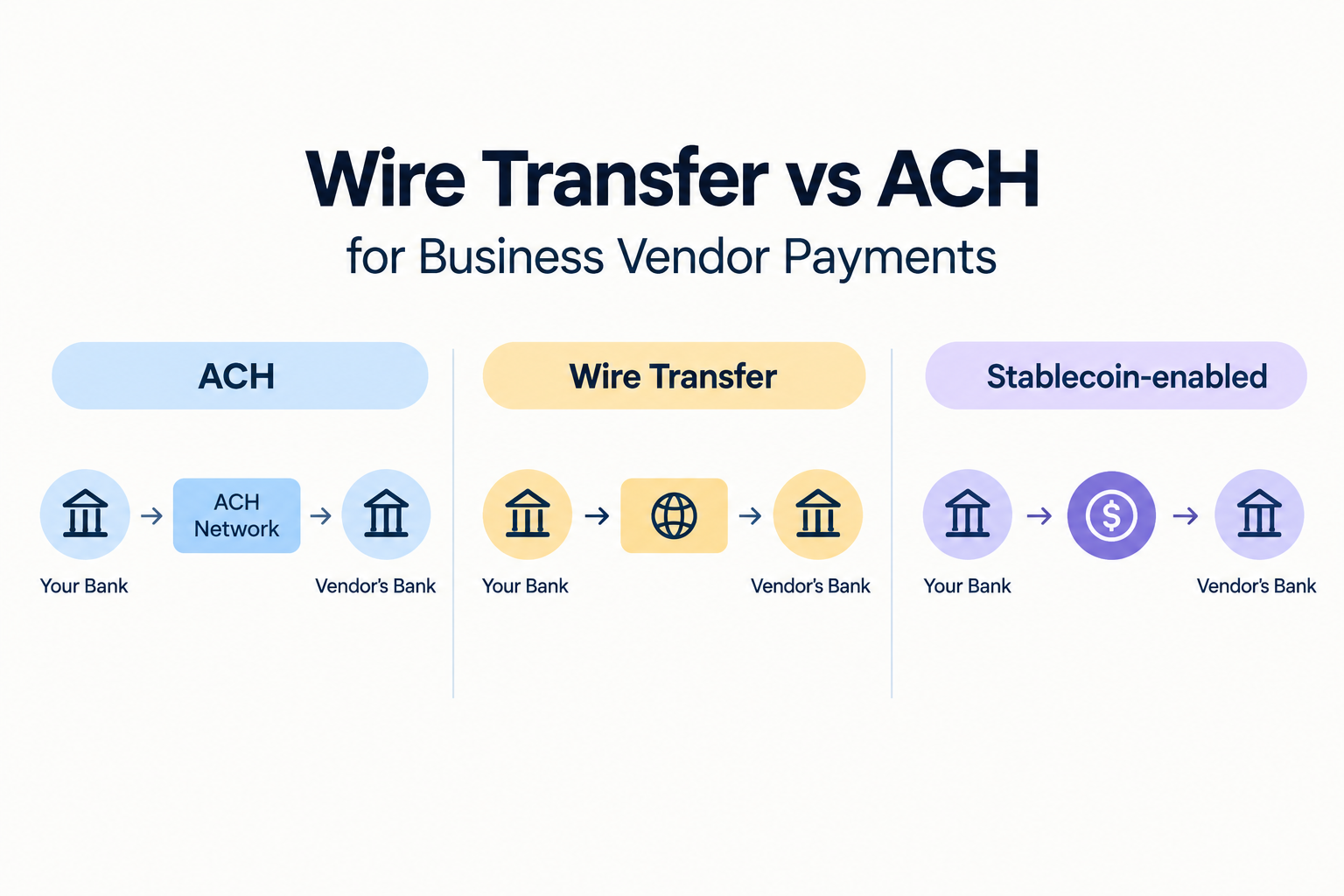
| Factor | ACH | Wire | Stablecoin-enabled cross-border settlement |
|---|---|---|---|
| Typical scope | U.S. domestic account-to-account payments | Domestic and international bank payments | Supported corridors and eligible counterparties |
| Typical use | Recurring invoices and routine vendor runs | Urgent, high-value, or bank-required payments | Cross-border payments where fiat and digital-asset conversion are acceptable |
| Speed | Standard one to two business days; Same Day ACH when eligible | May be same day domestically; international credit varies | Corridor- and workflow-dependent; may reduce correspondent-bank steps |
| Main cost consideration | Usually cost-efficient for domestic payments | Sender, receiver, intermediary, and FX charges may apply | Conversion, payout, compliance, and provider costs may apply |
| Finality and risk | Entries may be returned under applicable rules | Accepted Fedwire payments are designed for final settlement | Depends on the asset, provider, conversion, payout, and recipient process |
| Information required | Routing and account details, plus payment addenda | Beneficiary, bank, intermediary, address, purpose, and currency details may be required | Funding, asset, conversion, compliance, payout, and recipient details |
| Reconciliation | May carry invoice or remittance information | Intermediary deductions and reference differences can require manual matching | Requires matching funding, conversion, payout, and accounting records |
ACH has its strongest reach across U.S. bank accounts. Wires are more common for international bank payments, although the available route depends on the destination country, currency, and provider.
Select ACH when the vendor is domestic, the payment is routine, and minimizing cost matters more than immediate finality. Select a wire when the vendor requires bank-native settlement or the payment is urgent and high-value. Consider another cross-border rail when correspondent-bank delays are the main constraint.
Why standard ACH has limited use for international vendor payments
The core ACH Network is designed around U.S. financial-institution accounts. A U.S. ACH payment therefore cannot automatically reach a foreign vendor’s local bank account.
International ACH transactions and gateway services do exist. The Federal Reserve’s International ACH Transaction framework applies to payments entering or leaving the United States. It also includes additional data and screening requirements, as described in the international ACH transaction guidance.
International ACH availability is corridor-specific. It depends on the originating provider, gateway, destination market, participating institutions, payment format, currency path, and compliance data.
The Federal Reserve has also announced that FedGlobal ACH payments will be discontinued by year-end 2026. The service is no longer accepting new signups.
Before promising an overseas vendor an ACH payment, verify:
•The destination country and receiving institution
•The supported currency and gateway
•IAT or other format requirements
•Required compliance information
•Settlement timing and return procedures
•The vendor’s ability to receive and reconcile the payment
Do not classify a payment as international ACH merely because it starts from a U.S. business account. Verify the actual gateway and destination settlement path first. For a broader overview of international payment routes, settlement, and currency considerations, read our guide to cross-border payments.
Where stablecoin settlement fits in cross-border vendor payments
Stablecoin settlement is not a universal replacement for ACH or wires. Its suitability depends on the asset, jurisdiction, corridor, counterparty, compliance process, conversion path, and recipient’s required currency.
A stablecoin-enabled workflow may reduce reliance on traditional correspondent-banking chains when the provider, corridor, and recipient requirements support that route. The relevant question is not whether stablecoins are always faster. It is whether the supported route removes avoidable banking steps while meeting currency, compliance, and reconciliation requirements.
The full timing test should include:
1.Funding
2.Compliance screening
3.Conversion
4.Stablecoin settlement
5.Fiat payout
6.Beneficiary availability
7.Reconciliation
A stablecoin’s label does not guarantee identical price stability or legal treatment in every jurisdiction. Businesses should verify the specific asset and applicable rules.
Fuze Business is a unified platform for sending, receiving, and converting funds. It provides access to difficult trade corridors, banking-network connectivity, currency and stablecoin conversion, enterprise-grade compliance, and faster settlement.
For example, a finance team with stablecoins on hand and a vendor requiring fiat can test whether the route supports stablecoin funding, conversion into the required currency, compliant payout, confirmed recipient credit, and a matching accounting record before scaling.
How to choose the right rail for each vendor payment
Start with the vendor’s location and required settlement currency. These determine whether domestic ACH, a domestic wire, an international wire, or another cross-border route is technically available.
Then compare the full cost. Include foreign-exchange spreads, sender and receiver charges, intermediary deductions, funding costs, conversion costs, and payout fees. Before selecting a route, use our currency converter to compare the currencies involved in the payment.
Next, compare recipient availability rather than only payment initiation time. Document the expected time to beneficiary credit and the expected time to reconciliation.
Use this decision sequence:
1.Identify the vendor’s country and currency.
2.Confirm the vendor’s accepted payment methods.
3.Set the required arrival time and payment value.
4.Estimate the complete cost, including FX and intermediary charges.
5.Check cutoffs, compliance data, beneficiary details, and screening responsibilities.
6.Confirm the return, exception-handling, and reconciliation process.
7.Choose the least complex rail that meets the requirements.
A domestic U.S. vendor with a routine invoice usually supports evaluating ACH first. An urgent or high-value payment with a bank-native requirement usually supports evaluating a wire. A cross-border vendor in a difficult corridor may justify evaluating a stablecoin-enabled option when conversion, compliance, payout, and reconciliation requirements are supported.
A payment decision passes when the team can record the vendor’s country, destination currency, required arrival time, total estimated cost, rail-specific cutoff, compliance requirements, confirmation method, and reconciliation reference before release.
Use Fuze Business to pursue faster global vendor payments
ACH generally suits routine domestic U.S. vendor payments. Wires suit bank-native, urgent, high-value, or international payments. Cross-border teams should evaluate stablecoin-enabled settlement when it meets currency, compliance, corridor, payout, and reconciliation requirements.
Fuze Business combines cross-border payments, banking-network connectivity, access to difficult trade corridors, currency and stablecoin conversion, enterprise-grade compliance, and faster settlement. Its stablecoin rails may reduce reliance on multi-day correspondent-banking chains in supported routes.
If your business needs faster global payments across supported corridors, explore Fuze Business for a unified way to send, receive, convert, and manage cross-border funds.