
A wire transfer is an electronic transfer between bank accounts. Domestic and international wires are different use cases, with different processing steps and delivery risks.
There is no single universal wire-transfer time. The payment rail, currencies, sending and receiving institutions, intermediary banks, cut-off times, weekends, holidays, sanctions screening, beneficiary details, and receiving-bank posting policies all affect delivery.
A domestic wire may arrive the same business day. An international wire may take longer because it can pass through intermediary banks and local clearing systems. This guide also explains whether wire transfers are instant and how international wire-transfer cut-off times affect delivery.
Traditional wires remain useful when bank reach and established controls matter. Alternative rails may be worth evaluating when predictable settlement and difficult corridors are more important.
How long does a wire transfer usually take?
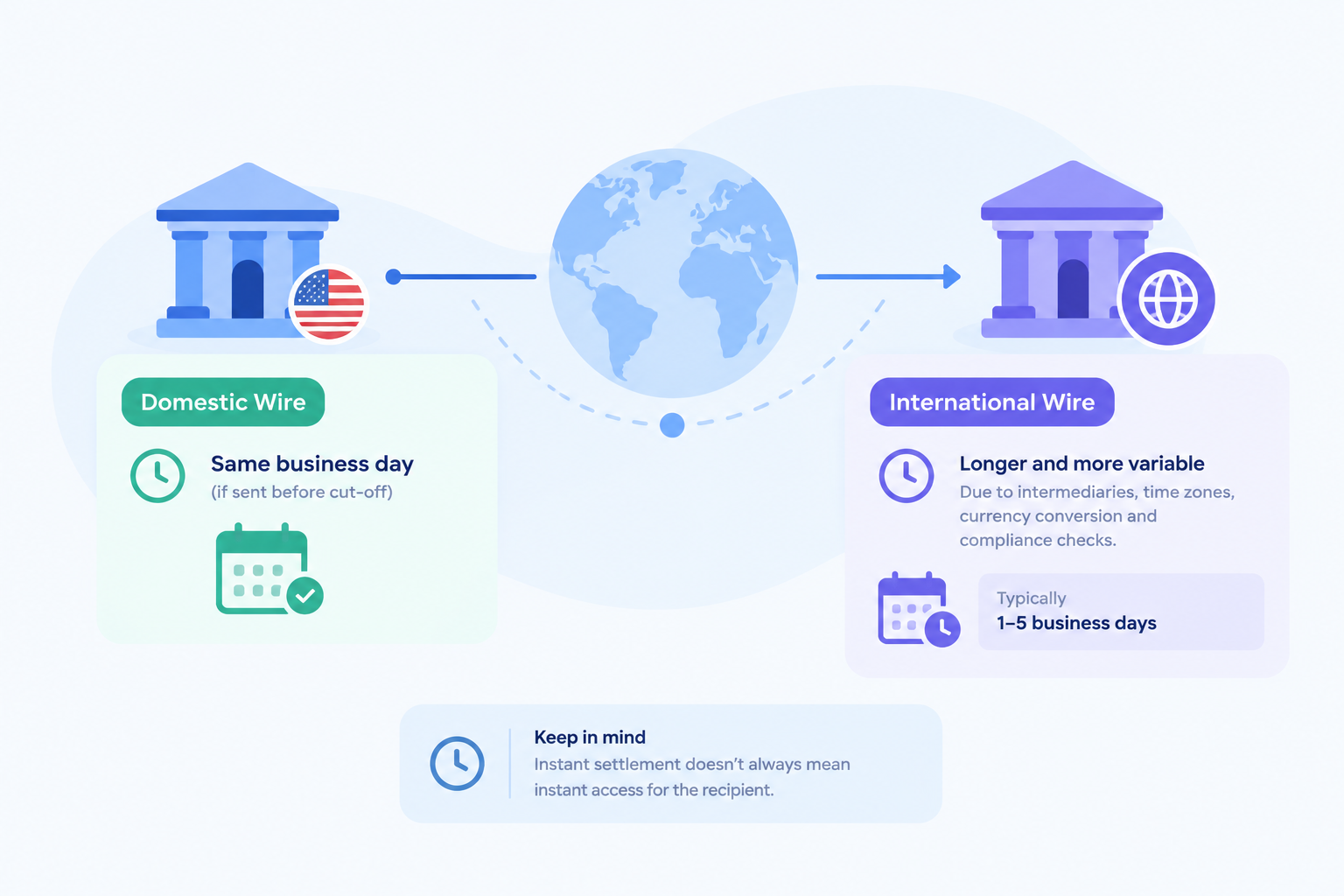
A domestic wire may arrive the same business day when the sending bank accepts it before its cut-off. The receiving bank must still process and credit the funds.
A wire transfer moves money electronically between bank accounts. The CFPB distinguishes domestic and international transfers because the route, institutions, and compliance requirements can differ.
Fedwire is a real-time gross-settlement service for participating institutions. Payments are processed individually and generally receive same-day value when sent during the applicable operating window, according to the Federal Reserve’s Fedwire overview.
However, interbank settlement is not the same as usable funds. A receiving bank may apply its own screening, posting, or account-crediting process.
| Transfer type | Typical planning outcome | What can change the result |
|---|---|---|
| Domestic wire | Often same business day if accepted before cut-off | Bank processing and receiving-account availability |
| International wire | Longer and more variable than a domestic wire | Intermediaries, currency conversion, local clearing, and compliance review |
For international payments, the destination bank may receive the payment message before the beneficiary account is credited. SWIFT reports that 90% of cross-border payments sent over its network reach the destination bank within an hour, while local regulation and domestic processing can delay final customer credit. The SWIFT processing update explains this distinction.
Consumer remittance rules also require covered providers to disclose when funds will be available to the recipient. This reinforces that sending a transfer and making funds available are separate milestones under consumer transfer rules.
For example, a U.S. bank may send a Fedwire payment during its operating window. The recipient’s bank may still screen the payment or wait for its posting cycle. The transfer is complete for the business only when the recipient can use the funds.
Are wire transfers instant?
Wire transfers are not universally instant. Some payment rails settle transactions in real time, but the recipient may not receive usable funds immediately.
Real-time gross settlement means payment instructions are settled individually and continuously during a system’s operating window. It does not guarantee 24/7 consumer access or immediate beneficiary crediting.
| Rail or system | Availability or settlement model | Main limitation |
|---|---|---|
| Fedwire | Real-time settlement during its operating window | Business days, bank cut-offs, and recipient posting still apply |
| UAE Funds Transfer System | Continuous real-time processing under system rules | Cross-border payments may use other routes |
| India RTGS | Available 24x7x365 and processes transactions continuously | The receiving route and bank process still matter |
| Pakistan Raast | Instant domestic payments | Currently limited to local transfers, not international transactions |
The Federal Reserve describes Fedwire’s operating model. The UAE Funds Transfer System is an RTGS system in which instructions are processed and settled continuously under its rules, as explained by the Central Bank of the UAE.
India’s RTGS system is available 24x7x365. The Reserve Bank of India also explains that NEFT transactions are processed in batches rather than continuously in its RTGS and NEFT guidance.
Pakistan’s Raast is an instant domestic payment system. The State Bank of Pakistan states that it is currently intended for local transfers, as outlined in its Raast frequently asked questions.
The practical rule is simple: instant settlement is not the same as instant availability. A payment can use a real-time domestic rail and still wait for foreign-exchange conversion, an intermediary, sanctions screening, or the recipient bank’s posting cycle.
How international wire-transfer cut-off times change the delivery date
There is no universal international wire cut-off time. The relevant cut-off depends on the sending bank, currency, channel, destination, time zone, business calendar, and payment type.
A bank’s cut-off determines whether it treats a payment as received on the current business day or the next one. Cut-offs vary by institution and payment route.
Fedwire’s published third-party transfer deadline is 6:45 p.m. Eastern Time under the Federal Reserve’s current overview. A commercial bank may set an earlier customer cut-off, so businesses should confirm the bank’s own deadline using the Federal Reserve operating information.
Weekends and designated holidays can push processing to the next available business day on systems that do not operate every day. International payments can also cross several time zones and operating calendars.
Before sending a wire, ask:
•What is the bank’s customer cut-off time?
•Which time zone applies?
•What date will the recipient bank treat as the value or availability date?
Submitting a payment before the sending bank’s cut-off helps. It does not guarantee same-day final credit.
For example, a transfer submitted after a bank’s Friday cut-off may not enter the relevant processing queue until Monday or the next banking day. The online banking system may accept the instruction immediately, but acceptance is not the same as processing.
Bank-level cut-offs should be confirmed directly. General deposit and processing guidance from the CFPB does not replace the sending bank’s specific schedule.
In Pakistan, PRISM and RTGS operating schedules include specific weekday and Saturday windows. Current customer cut-offs should be confirmed with the bank rather than inferred from older system notices, including the State Bank of Pakistan payment-system information.
What determines whether a wire arrives today or later?
The most useful timing measure is end-to-end time to usable funds. Message delivery and interbank settlement do not always show when the beneficiary can spend the money.
Check the rail, cut-off, calendar, data quality, intermediaries, compliance review, currency, and recipient posting policy in that order.
The main factors are:
•Payment rail: Operating hours and settlement design affect when processing can begin.
•Cut-off and calendar: Late submissions, weekends, holidays, and time zones can move processing to the next business day.
•Intermediary banks: International wires may pass through correspondent institutions before reaching the beneficiary bank.
•Beneficiary data: Incorrect or incomplete account details can trigger manual repair, rejection, or return.
•Compliance checks: Sanctions screening, fraud controls, regulatory review, and missing documentation can add time.
•Currency conversion: Foreign-exchange processing and local clearing requirements can affect delivery. Businesses can also compare exchange rates using a currency converter before choosing a payment route.
•Receiving-bank posting: The recipient bank may receive the payment before crediting the beneficiary account.
Intermediary banks can also affect the amount received through fees. The CFPB’s international transfer guidance explains why the payment route and provider details matter.
SWIFT also notes that the difference between destination-bank receipt and end-customer credit can reflect regulatory and domestic-processing factors. This is why a payment can appear to have reached the destination while remaining unavailable to the recipient.
If a payment remains pending after the expected date, check:
1.The transaction reference.
2.The beneficiary account and bank identifiers.
3.The value date.
4.The intermediary status.
5.Whether the receiving bank requested more information.
Ask the sending bank where the payment is in the chain. This is more useful than checking only whether the payment instruction was submitted.
UAE, India, and Pakistan corridor examples
Country names alone cannot predict wire-transfer timing. The sending bank, destination bank, currency, intermediary path, cut-offs, and compliance process control the final result.
UAE
The UAE Funds Transfer System is the Central Bank of the UAE’s RTGS system. Transfer requests are queued for immediate action, with settlement taking place continuously in real time under the system rules.
A UAE payment may also involve regional systems such as AFAQ or Buna. The Central Bank of the UAE payment-system information provides the relevant system context.
For a cross-border payment, confirm whether the transfer uses a conventional correspondent route or an eligible regional or instant-payment connection.
India
India’s RTGS system is available 24x7x365 and processes transactions continuously. NEFT uses batch processing, so the selected Indian rail becomes a key timing variable.
Ask whether the recipient bank will credit the payment through RTGS, NEFT, or another supported route. The Reserve Bank of India’s payment FAQs explain the difference between these systems.
Pakistan
PRISM+ is Pakistan’s large-value payment system. Raast is a real-time retail instant-payment system, but Raast is currently limited to local transfers.
An international payment into Pakistan may therefore use a different remittance or banking route. The State Bank of Pakistan payment-system information distinguishes these systems.
Pakistan’s Buna-Raast connectivity initiative is intended to connect Pakistan’s instant-payment system with financial institutions in the Arab region. Availability, participating institutions, supported currencies, and corridor rules must be confirmed for each transfer through the Buna-Raast information.
For a UAE-to-Pakistan business payment, verify the beneficiary bank’s supported receiving route, currency and conversion path, local cut-off, and eligibility for any connected regional service.
Comparing Wire Transfers with Faster Payment Alternatives
Traditional wires are often suitable when the receiving institution, currency, documentation, and compliance process are already known. They offer established bank connectivity, but can remain exposed to cut-offs, intermediaries, and local posting cycles.
Domestic instant-payment rails can reduce local settlement waiting time. They may still limit geography, currencies, participants, transaction types, or international reach.
Cross-border payment platforms, such as Fuze Business, should be compared on end-to-end settlement time, corridor coverage, currency support, total fees, exchange-rate transparency, compliance controls, transaction visibility, and failure or return handling. The CFPB comparison guidance identifies speed, cost, convenience, security, and reliability as relevant factors.
| Option | Main advantage | Main limitation | Suitable use |
|---|---|---|---|
| Traditional bank wire | Broad bank familiarity | Cut-off and intermediary exposure | Established bank routes |
| Instant or domestic payment rail | Rapid local settlement | Limited corridor or participant coverage | Supported domestic flows |
| Stablecoin-enabled business platform | Potentially faster cross-border settlement | Requires corridor, compliance, conversion, and recipient validation | Supported business routes |
Stablecoin-enabled approaches should not be judged on speed alone. Confirm the supported corridor, currencies, conversion process, compliance controls, settlement finality, recipient availability, and reconciliation process.
The fastest rail is not automatically the best rail. Choose the option that meets the required speed, corridor, compliance, currency, and settlement criteria.
For example, a finance manager should reject a faster option if it cannot support the required AED, EUR, or CNY route. The same applies if compliance or reconciliation controls are not acceptable.
How Fuze Business helps with faster global payments
The time it takes to complete a global payment depends on more than the payment rail. Bank cut-off times, intermediary processing, currency conversion, compliance checks, and beneficiary-bank procedures can all affect when funds become available to the recipient. Businesses should evaluate the entire payment journey rather than settlement speed alone.
Fuze Business brings cross-border payments, banking network access, difficult trade-corridor coverage, and currency and stablecoin conversion together in one platform. By combining banking infrastructure with stablecoin rails, it can help eligible businesses reduce reliance on traditional correspondent-banking chains where suitable and support faster settlement across supported corridors.
Visit Fuze Business to explore how its payment infrastructure can support your global payment requirements.