
Multi-currency payments provide the operational layer for accepting, receiving, converting, and settling funds across currencies. They support SaaS companies, global trade firms, marketplaces, and supply-chain businesses.
Three concepts matter: presentment currency is what the payer sees or uses, settlement currency is what the business receives, and conversion is the exchange between currencies. A business may charge in EUR, convert the funds, and settle in USD.
Multi-currency capability is moving from a specialist treasury function to a core growth and cash-flow capability. However, adoption should be assessed through cost, speed, transparency, compliance, corridor access, and reconciliation, not currency count alone.
What multi-currency payments mean for a business
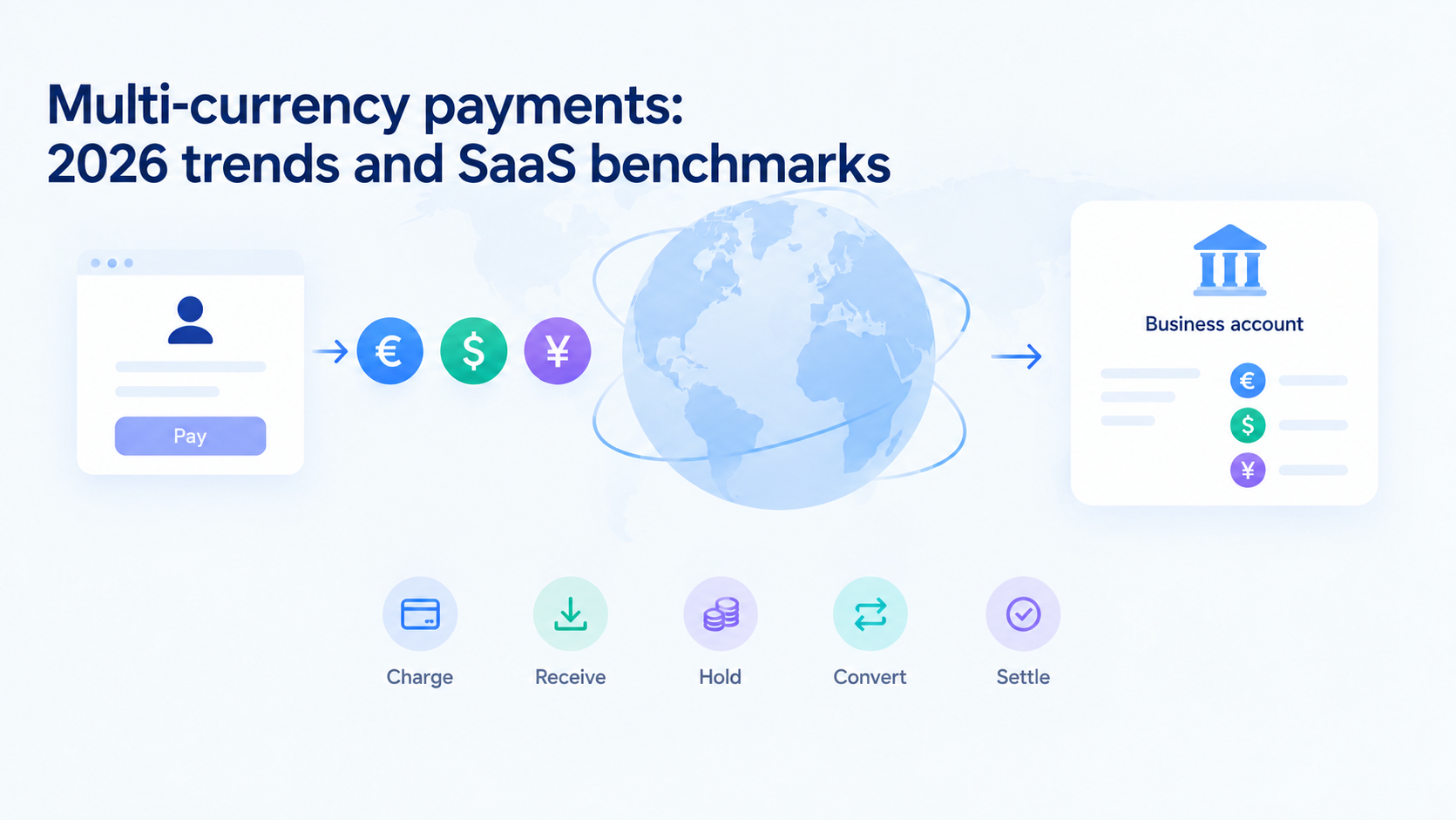
A multi-currency payment flow lets a business charge, receive, hold, convert, or settle funds in more than one currency. The payer-facing currency and the business-received currency can be different.
| Currency role | What it means |
|---|---|
| Presentment | The currency shown to or used by the payer |
| Settlement | The currency delivered to the business account |
| Conversion | The exchange between currencies |
| Reconciliation | Matching original and settled amounts |
Payment methods and settlement accounts can support different currencies. When presentment and settlement currencies differ, the transaction needs a conversion step or a provider that can hold and settle multiple balances.
For example, a customer might pay in EUR while the business receives USD. The finance record should preserve the original EUR amount, applied FX rate, USD settlement value, and associated fees. This information supports accurate revenue reporting and reconciliation.
Cross-border payments involve senders and recipients based in different countries. The process can include payment processors, banks, card networks, foreign-exchange services, compliance controls, and settlement systems. Cross-border payment infrastructure therefore extends beyond the checkout experience.
The main control points for finance teams are:
•Original transaction amount
•Conversion rate
•Converted amount
•Fees
•Settlement timing
•Reconciliation record
Why multi-currency payment adoption is accelerating in 2026
Multi-currency payment adoption is accelerating because businesses increasingly operate across borders, even when their customers remain mainly domestic. A software company may still pay international cloud providers, contractors, advertising platforms, and suppliers.
Visa reported that 38% of SMB expenses are international. These expenses include supplier payments, overseas contractors, software subscriptions, international advertising, and imports.
Digital payment adoption is also expanding. Worldpay’s 2026 Global Payments Report covers 42 leading markets representing 89% of global GDP. It reported that payment apps accounted for 67% of global e-commerce transaction value and 37% of global point-of-sale value in 2025.
Those Worldpay figures describe consumer and merchant payment adoption. They are not SaaS-specific benchmarks, but they show the broader digital payment environment supporting cross-border commerce.
Bank investment points in the same direction. More than 72% of surveyed Asia-Pacific banks were investing in or expanding cross-border peer-to-peer capabilities. Nearly 76% were investing in cross-border business-to-business payments, according to Visa’s Asia-Pacific banking research.
The market is broader than online checkout. Businesses need multi-currency capability for suppliers, contractors, subscriptions, marketplaces, trade settlement, and international treasury operations.
The BIS Innovation Hub described the retail cross-border payments market as exceeding $800 billion in annual transaction value. It identified cost, speed, access, compliance, foreign exchange, and settlement complexity as persistent constraints in its cross-border payments report.
The IMF estimated that the traditional and crypto cross-border payment market approached approximately $1 quadrillion in 2024. It also noted substantial variation by transaction type, currency, and transaction size in its market analysis.
Global payments are becoming ordinary business infrastructure, not an edge case reserved for multinational corporations.
SaaS payment benchmarks beyond revenue growth
SaaS companies should measure how payment infrastructure affects revenue collection, cash flow, customer experience, and finance operations. Currency coverage alone does not show whether a payment setup works.
Useful SaaS benchmarks include:
| Metric | Why it matters | Recommended segmentation | Management question |
|---|---|---|---|
| International payment success rate | Shows whether customers can complete payments | Currency and corridor | Where are payment failures limiting growth? |
| FX cost per collected dollar | Separates conversion costs from processing fees | Currency and provider | What does each collected dollar cost? |
| Median time to settlement | Connects collection to usable cash | Currency and payment method | When can the business use collected funds? |
| Settlement-to-reconciliation time | Measures finance readiness | Currency and corridor | How quickly do settled funds become finance-ready? |
| Reconciliation exceptions | Shows operational friction | Currency, entity, and provider | Which flows require investigation? |
| Refund and chargeback rate | Highlights payment and customer risks | Currency and corridor | Are certain markets creating higher losses? |
| International days sales outstanding | Measures collection speed | Customer region and currency | Are international invoices taking longer to collect? |
| Manual-intervention rate | Measures process scalability | Currency and payment type | Which flows cannot operate efficiently? |
Teams should compare EUR, USD, AED, GBP etc flows separately rather than reporting one blended international success rate. A blended metric can hide failures in a specific corridor.
Stripe’s 2025 vertical SaaS benchmark was based on more than 200 vertical SaaS companies. It reported that the median payments attach rate doubled in one year, while 87% of companies offering fintech services also provided payments. These figures are directional benchmarks from a specific dataset, not universal SaaS averages.
The same benchmark reported that multiproduct vertical SaaS platforms had a median addressable market increase from $250 million to $513 million. They also grew 21% faster than other companies in the cited benchmark, according to Stripe’s 2025 vertical SaaS report.
Stripe’s 2025 annual letter reported $1.9 trillion in total volume generated by businesses running on Stripe, up 34% from 2024. This is a platform-volume indicator, not a standalone SaaS-market or multi-currency benchmark, as described in Stripe’s 2025 update.
Factors to consider when choosing a payment solution
Businesses should evaluate multi-currency payments across cost, speed, transparency, access, and compliance. Faster settlement is valuable only when the transaction remains compliant, traceable, and economically predictable.
The Financial Stability Board’s cross-border payment targets provide useful reference points. For retail cross-border payments, the G20 target is a global average cost of no more than 1%, with no corridor above 3%, by the end of 2027. The target covers retail payments and should not be treated as a universal SaaS price.
The targets also call for 75% of cross-border retail payments to make recipient funds available within one hour. The remainder should be available within one business day by the end of 2027, according to the FSB cross-border payment targets.
By the end of 2027, payment service providers are expected to provide:
•Total transaction cost
•FX and conversion charges
•Expected delivery time
•Payment-status tracking
•Terms of service
The World Bank reported a global average remittance cost of 6.36% in its August 2025 update. This illustrates the gap between current cross-border payment economics and international policy targets. It is a remittance benchmark, not a direct SaaS payment-cost benchmark, as shown by the World Bank remittance data.
Total cost can include transaction fees, cross-border fees, FX spread, fixed currency charges, intermediary charges, and manual reconciliation. A provider advertising instant conversion without disclosing these factors has not provided a complete benchmark.
Compliance and data interoperability are also operational requirements. Cross-border data frameworks must support payment processing, risk management, fraud prevention, anti-money laundering controls, sanctions compliance, and privacy, as outlined in the FSB’s data framework recommendations.
Stablecoins, central bank digital currencies, real-time payment networks, and tokenized settlement are relevant trend categories. Their potential should be considered alongside regulatory, commercial, compliance, and operational risks. They should not be treated as settled replacements for existing payment rails, as reflected in BIS considerations on stablecoins and its digital currency research.
How finance and operations teams should evaluate multi-currency capability
Start by mapping the money. Document customer receipts, supplier payments, payroll or contractor payments, treasury conversions, refunds, and settlement destinations.
A business may be able to charge a customer in a currency without being able to hold, settle, or use that currency efficiently. Acceptance and receipt should therefore be evaluated as separate capabilities.
Finance and operations teams should review:
•Currency map
•Corridor map
•All-in cost
•Settlement service level
•Compliance review
•Reconciliation workflow
•Exception reporting
Compare providers using total economics. Include transaction fees, cross-border fees, FX spread, fixed currency charges, intermediary charges, and the cost of manual reconciliation.
Settlement speed should match the business use case. SaaS cash collection, supplier release, inventory purchase, trade settlement, and emergency liquidity can require different timing.
Validate access to difficult corridors and the currencies the business actually needs. Currency availability alone does not prove usable local coverage.
Review onboarding, sanctions screening, transaction monitoring, data handling, documentation, and compliance requirements before scaling a corridor. The payment process must remain traceable as volume grows.
Create a recurring reporting pack with payment success, settlement time, FX cost, exceptions, refunds, chargebacks, and unreconciled balances. Report each metric by currency and corridor where possible.
For global trade and supply-chain teams, connect payment performance to inventory release, supplier terms, working capital, and shipment timing. A supply-chain manager should assess whether a payment can reach the supplier’s required currency quickly enough to avoid delaying a purchase order or shipment.
How to get paid in multiple currencies with Fuze Business
Businesses evaluating multi-currency payments should define their required currencies and corridors first. They should then compare total cost and settlement speed, preserve transparent transaction records, and confirm compliance requirements before scaling.
Fuze Business is built for this. It lets you send, receive, and convert funds across borders in one platform, with banking access in AED, USD, EUR, GBP and more, instant conversion between currencies and stablecoins, and access to trade corridors that traditional banks often struggle to serve. Compliance is built in, and settlement is faster than the typical correspondent-banking route.
Businesses should confirm current availability, terms, compliance requirements, and corridor support before making a decision. If your business needs to send, receive, and convert funds across borders, explore Fuze Business.