
Finance managers, global trade companies, and supply-chain teams need more than a headline transfer speed when sending money abroad.
A stablecoin payment is a transfer involving a digital asset linked to the value of a fiat currency. A bank wire is a bank-account transfer that may use correspondent banks, SWIFT messaging, local clearing systems, and intermediary institutions.
The right option depends on the corridor, payout currency, beneficiary requirements, compliance obligations, urgency, liquidity, and reconciliation workflow. Stablecoin payments still require regulated providers, onboarding, sanctions screening, off-ramp capability, and reliable local payout infrastructure.
Choosing between stablecoin payments and bank wires
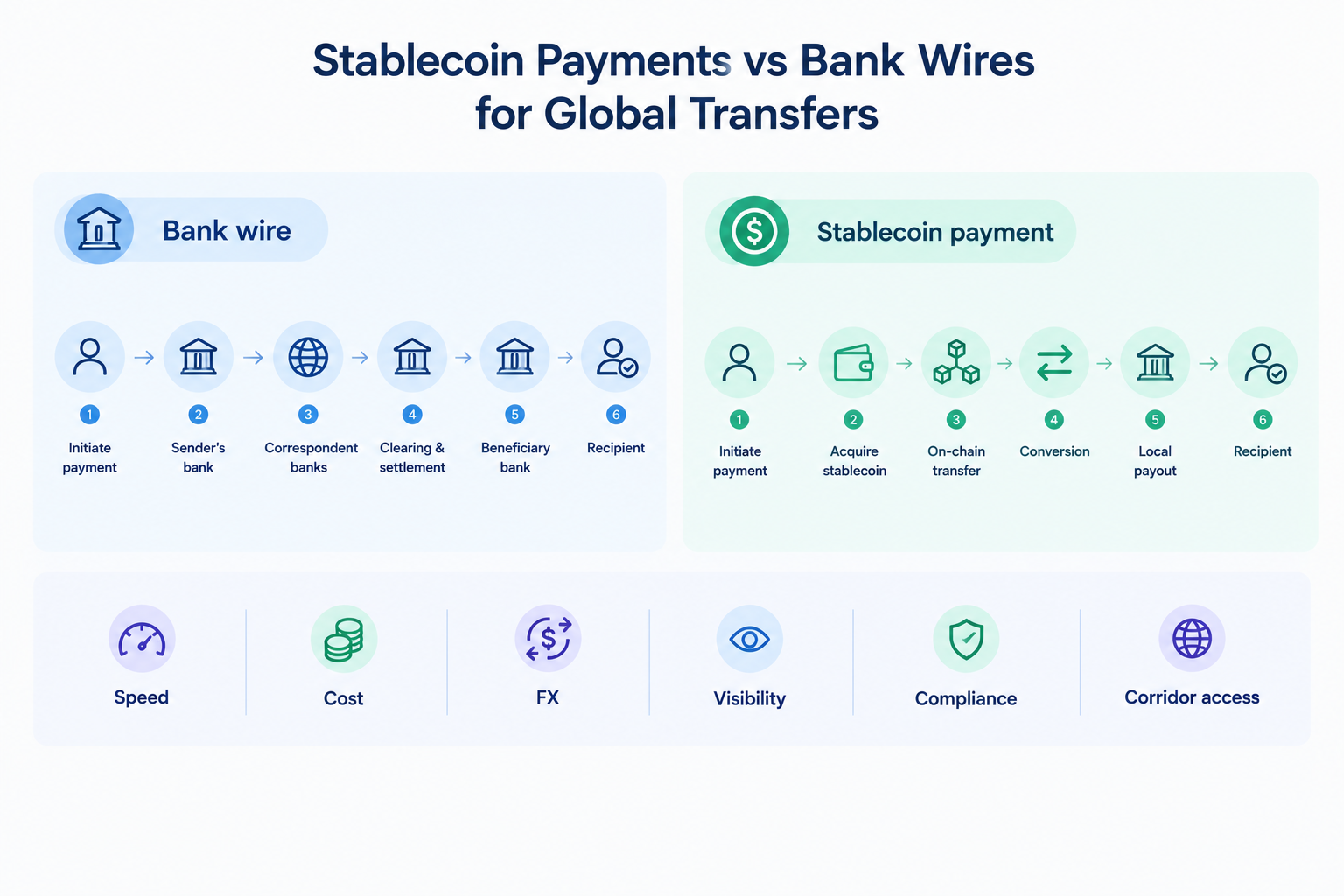
A bank wire can involve the sender’s bank, one or more correspondent banks, the beneficiary’s bank, foreign-exchange conversion, and local clearing or settlement processes. This structure is familiar, but each additional institution can create another handoff.
Stablecoin payments use a digital settlement asset that moves on a blockchain before being converted into fiat or paid out through banking infrastructure. This can reduce some intermediary steps, depending on the corridor and provider setup. However, stablecoin arrangements also require attention to reserves, redemption, legal certainty, governance, compliance, wallet controls, blockchain operations, and jurisdictional acceptance. The BIS framework for stablecoin arrangements outlines several of these considerations.
Speed should not be treated as one elapsed-time metric. Separate the process into:
•Initiation
•Clearing
•FX conversion
•Beneficiary credit
•Settlement finality
•Reconciliation
The best rail satisfies the recipient’s required currency, the corridor’s regulatory and banking constraints, the organization’s controls, and the required settlement window. The best rail depends on corridor, currency, compliance, and settlement requirements, not only headline speed.
For example, a supplier invoice payable in local currency should be assessed by final beneficiary credit and reconciliation time. The speed of a stablecoin leaving the sender’s wallet is only one part of the journey.
Compare how each payment route works from sender to recipient
Traditional cross-border bank payments commonly rely on correspondent relationships and sequential account updates across institutions. Bank operating hours, public holidays, cut-off times, settlement windows, currencies, and compliance reviews can extend the time between payment instruction and final credit. The BIS analysis of payment systems provides context for how these systems operate.
A stablecoin route generally includes funding or acquiring the stablecoin, transferring it to a controlled destination, screening the transaction, monitoring activity, converting or redeeming the asset, and paying the beneficiary in the required currency or account.
Stablecoin rails may operate outside traditional banking hours. The complete payment can still depend on fiat on-ramps, off-ramps, local banking partners, liquidity, compliance review, and corridor availability. A digital transfer is not automatically a completed international payment.
Map every handoff in both journeys:
1.Initiate the payment and confirm the funding source.
2.Screen the sender, beneficiary, wallet, and transaction.
3.Convert the currency or acquire the required digital asset.
4.Transfer and settle through the selected rail.
5.Credit the beneficiary’s account or wallet.
6.Reconcile the payment against the invoice or treasury record.
For a USD-to-CNY supplier payment, the comparison should show the sender’s funding method, FX conversion point, stablecoin or correspondent path, local payout partner, beneficiary credit, and reconciliation record. A payment architecture comparison can help teams identify these separate stages.
Use a side-by-side scorecard for speed, cost, visibility, and access
Bank wires can include sender fees, intermediary fees, beneficiary-bank fees, FX spreads, repair charges, and costs linked to delayed or failed instructions.
Stablecoin payments can reduce some intermediary steps. Total costs may still include stablecoin acquisition, network fees, provider charges, FX conversion, liquidity, compliance, and fiat payout charges. Stablecoin transaction economics are not automatically cheaper. They depend on the route, asset, network, conversion path, liquidity, and local payout method.
Bank wires generally provide familiar account statements and established bank controls. Stablecoin routes can add on-chain transaction records alongside provider records and fiat-ledger records. This may improve transaction visibility, but it can also increase reconciliation requirements.
| Criterion | Stablecoin payments | Bank wire transfers | What to verify |
|---|---|---|---|
| Settlement window | Digital asset movement may occur outside banking hours | May depend on cut-off times, correspondent banks, and local settlement windows | Time to final beneficiary credit |
| Final beneficiary credit | Requires conversion and a supported payout route when fiat is needed | Uses the beneficiary’s bank or local clearing system | Required currency and account type |
| FX conversion | May occur through a provider, liquidity venue, or payout partner | May occur through the sender, intermediary, or beneficiary bank | Rate, spread, and conversion point |
| Intermediary fees | Provider, network, liquidity, and payout charges may apply | Sender, correspondent, and beneficiary-bank fees may apply | Full all-in quote |
| Tracking | On-chain records may supplement provider records | Bank references and account statements are familiar | Traceability across every handoff |
| Reconciliation | May require on-chain, provider, and fiat-ledger records | Usually relies on bank references and statements | Invoice matching and reporting effort |
| Regulatory eligibility | Depends on the asset, provider, customer, and corridor | Depends on banking and payment rules | Legal entity and activity approval |
| Corridor access | May help with difficult corridors when compliant infrastructure exists | Strong where correspondent relationships are established | Supported currencies and destinations |
| Reversibility | Transfers may be difficult to reverse after settlement | Bank recalls or repairs may be possible but are not guaranteed | Error and exception process |
| Operational complexity | Requires wallet, network, conversion, and payout controls | Requires bank details, payment instructions, and exception handling | Internal capabilities and controls |
Difficult trade corridors may be more accessible through a provider that combines banking networks, stablecoin rails, liquidity, and local payout capability. Before selecting either method, require an all-in quote and a complete cost-and-time estimate. The BIS discussion of stablecoin policy challenges supports evaluating these broader risks and costs.
A payment passes the cost test only when the estimate includes sender funding, FX, rail fees, provider charges, payout, intermediary charges, and expected repair or exception handling.
Evaluate compliance, control, and settlement risk before choosing a rail
Stablecoin cross-border use is subject to jurisdiction-specific regulatory approaches. The BIS identifies financial-integrity, financial-stability, monetary-sovereignty, and legal considerations for these arrangements.
A compliant stablecoin workflow still requires customer and business verification, sanctions screening, transaction monitoring, recordkeeping, wallet controls, and procedures for suspicious or blocked transactions.
Bank wires also remain subject to bank compliance checks, sanctions screening, payment-purpose requirements, beneficiary validation, and possible holds or investigations. Choosing a bank wire does not remove compliance obligations.
Verify a provider’s licensing status against the specific legal entity, regulated activity, customer category, and jurisdiction involved. A licence held by one entity does not automatically authorize every service offered under the same brand. Fuze holds a VARA broker-dealer licence for Morpheus Software Technology FZE in Dubai and a CBUAE Category III Retail Payment Services licence for Niobe Payment Services L.L.C. S.P.C. For details on the applicable licence scope, refer to the VARA public register and the Fuze Trust Center.
Before approving a rail, legal, compliance, treasury, and operations owners should sign off on:
•The provider and legal entity handling funds
•The asset and network used
•The corridor and beneficiary
•Conversion and payout partners
•Screening and monitoring controls
•Transaction-record retention
•Escalation procedures for delayed or failed payments
Regulated infrastructure can reduce operational risk. It does not remove corridor-specific or transaction-specific compliance obligations. A finance team should be able to document the full payment path before moving funds.
Match the payment method to the business use case and corridor
Bank wires may remain the practical choice when the beneficiary requires a conventional bank transfer, the corridor is well served by correspondent banking, or internal policy limits digital-asset exposure.
Stablecoin rails may be relevant when speed outside banking hours, access to difficult trade corridors, flexible currency conversion, or digital settlement visibility is especially important. The correct choice depends on whether the recipient needs stablecoins, local fiat, a foreign-currency bank credit, or a payment through a specific banking network.
Test both rails against the organization’s actual payment types:
•Recurring supplier payments
•Urgent treasury movements
•Payroll or contractor payouts
•Customer collections
•Markets with limited banking access
Common mistakes include comparing only advertised transfer speed, ignoring off-ramp time, omitting FX spreads, assuming every stablecoin is interchangeable, overlooking beneficiary acceptance, and treating licensing in one jurisdiction as universal authorization.
A fast on-chain transfer is not the same as a fast completed international payment. For a recurring supplier corridor, compare three completed transactions on each rail. Record instruction time, compliance review time, FX rate, total fees, beneficiary credit time, failure rate, and reconciliation effort.
A controlled corridor pilot should define the payment amount, beneficiary type, settlement target, exception path, and reconciliation requirement before launch.
How Fuze Business helps with faster global payments
Faster global payments depend on the complete journey. That includes funding, screening, conversion, settlement, payout, beneficiary credit, and reconciliation.
Fuze Business helps businesses accelerate cross-border payments through a unified platform that combines banking network access, stablecoin rails, currency and stablecoin conversion, and enterprise-grade compliance. By reducing reliance on traditional correspondent-banking chains where suitable, it can support faster settlement across supported corridors while simplifying the process of sending, receiving, and converting funds.
With access to difficult trade corridors and a single workflow for managing cross-border transactions, Fuze Business helps finance teams streamline payment operations, improve visibility, and reduce operational complexity. Businesses can explore Fuze Business to understand how its banking connectivity and stablecoin-enabled payment capabilities can support their specific currencies, corridors, and settlement requirements.