

International wire transfers need accurate instructions so banks can identify the institutions and accounts involved. SWIFT is a secure financial-messaging network, not a bank or custodian of customer funds. It sends standardized payment messages between financial institutions and other users.
A BIC means Business Identifier Code. It is the standardized identifier commonly called a SWIFT code in banking workflows. Exact transfer requirements vary by the sending institution, receiving institution, destination country, currency, and payment route.
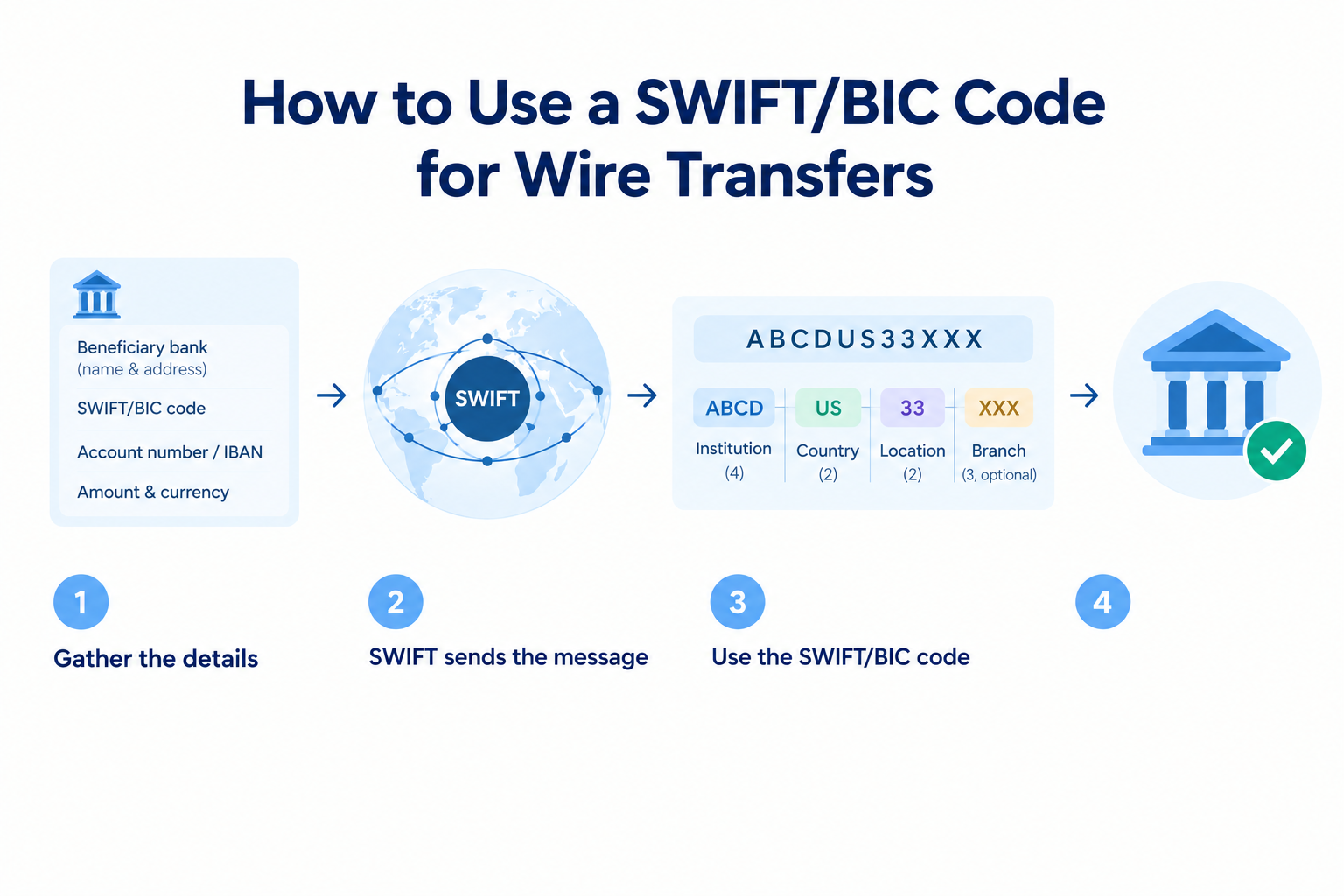
Before starting, gather the recipient’s legal name and address, bank name and address, account number or IBAN where applicable, SWIFT/BIC code, and any required domestic clearing code. You may also need the transfer currency, amount, payment purpose, or reference.
Understand what a SWIFT/BIC code identifies
A SWIFT/BIC code identifies a financial institution or business party involved in international financial messaging. It helps address payment instructions to the correct bank or routing institution.
SWIFT provides secure, standardized messaging between banks, financial institutions, and corporate users. However, SWIFT does not hold customer funds or transfer money itself.
BIC stands for Business Identifier Code. The BIC standard identifies financial and non-financial institutions under ISO 9362. In everyday banking instructions, “SWIFT code” and “BIC” usually refer to the same type of identifier.
The terms are closely related, but not every BIC is connected to the SWIFT network. The receiving bank, correspondent institutions, local payment systems, and compliance checks determine how payment instructions are processed after the message is sent.
A SWIFT/BIC code addresses the bank. It does not replace the recipient’s account details. The account number or IBAN identifies the beneficiary’s specific account.
For example, a sender may enter a recipient bank’s BIC with the beneficiary’s account number or IBAN. Entering only the BIC does not identify the individual account.
Read the 8- and 11-character SWIFT/BIC format
A BIC contains either 8 or 11 contiguous characters. Its structure identifies the institution, country, location, and, optionally, a branch or business unit.
| Part | Length | Purpose |
|---|---|---|
| Institution | 4 characters | Identifies the business party or institution |
| Country | 2 characters | Identifies the country using an ISO country code |
| Location | 2 characters | Identifies the location or business-party suffix |
| Branch | 3 characters | Optionally identifies a branch, department, service, or unit |
An 8-character BIC contains the institution, country, and location sections. An 11-character BIC adds a three-character branch identifier.
An 8-character BIC can be supplemented with a branch identifier. “XXX” may appear as a generic head-office suffix in some instructions. The recipient’s institution should confirm whether that version is correct.
For format illustration only, an anonymized pattern might look like ABCDUS33 or ABCDUS33XXX. These are not usable bank codes. Obtain the actual code from the beneficiary or receiving bank.
Swift reference data can support structural and directory checks. However, pattern checking does not prove that a BIC is published, active, connected, or suitable for a particular payment route.
SWIFT/BIC vs. IBAN vs. routing number for wire transfers
These identifiers serve different purposes. A payment form may request more than one of them.
| Identifier | What it identifies | Typical use |
|---|---|---|
| SWIFT/BIC | The receiving or routing institution | Commonly used for international wires |
| IBAN | An eligible international bank account | Required or useful in many countries, but not universal |
| Domestic routing code | A national clearing system or local bank identifier | Depends on the destination market |
| Account number | The beneficiary’s account at the institution | Usually supplied with a bank identifier |
A SWIFT/BIC identifies the financial institution or business party. An IBAN identifies a specific bank account in countries and territories that use the International Bank Account Number system.
A domestic routing code may be called a routing number, sort code, or another national clearing identifier. It can be required for local clearing or for cross-border payments involving a particular country.
Requirements differ by destination, currency, receiving bank, and sending institution. A corporate payment workflow may validate the BIC, clearing code, account-number format, and other payment information before submission.
If the recipient’s instructions list both an IBAN and a BIC, enter both exactly as provided. Do not place an IBAN, account number, and BIC interchangeably in the payment form.
For example, a payment to a country that uses IBAN may need the beneficiary’s IBAN and the bank’s BIC. A U.S.-based receiving account may instead require an account number and the bank’s BIC, as shown in bank-specific wire instructions.
Use a SWIFT/BIC code to set up an international wire
Use independently confirmed payment instructions before authorizing an international wire. The following sequence helps reduce data-entry and routing errors.
1.Obtain the payment instructions. Gather the beneficiary’s legal name and address, bank name and address, account number or IBAN, BIC/SWIFT code, currency, and any required local clearing code.
2.Compare the institution details. Check the BIC’s institution and country against the beneficiary’s instructions. Do not infer a code from a similar bank name or search result.
3.Open the international-wire workflow. Use your sending bank or payment provider’s international transfer process. Enter the BIC in the designated SWIFT/BIC field.
4.Enter the payment information. Add the beneficiary account identifier, amount, currency, payment purpose, reference, and sender information exactly as requested.
5.Review the payment preview. Check the exchange rate, sender fees, possible intermediary-bank charges, recipient charges, estimated delivery time, and cancellation or recall conditions. You can also use a currency converter to estimate the value of the transfer amount in the recipient's currency before reviewing the final exchange rate offered by your payment provider.
6.Save the confirmation. Keep the transaction reference and confirmation. If the recipient does not receive the payment within the quoted timeframe, ask the sending institution about a trace or investigation.
The transfer is ready for authorization only when the beneficiary, bank, BIC, account identifier, amount, currency, and fee option match the confirmed instructions.
Treat any last-minute change to bank details as a verification event. Confirm the change through a trusted channel before sending funds.
For a supplier payment, a finance manager might compare the invoice instructions with approved banking details. The manager can then verify the BIC with the receiving institution and review the final payment preview before approval.
Verify the code and troubleshoot delays or rejections
A BIC can be checked for formal validity and directory publication through Swift reference-data services. A structurally correct code is not enough to prove that it is correct for a specific beneficiary or transaction.
The Swift BIC Directory can provide registered entity details, such as an institution’s name and address. Reference-data tools can also support validation of BICs and related identifiers.
Payment delays can happen after a message reaches the destination bank. Possible causes include fraud screening, compliance checks, local regulations, intermediary processing, or the receiving bank’s own procedures.
If a transfer is rejected or delayed, follow this sequence:
•Check the payment status and transaction reference with the sending institution.
•Recheck the beneficiary name, account number or IBAN, BIC, local clearing code, currency, and payment purpose.
•Ask whether an intermediary or compliance review is delaying the payment.
•Request a trace, investigation, or recall if the sending institution makes one available.
Correct payment details only after confirming the source instructions. If the originating institution shows the payment as sent but the recipient remains uncredited, the receiving bank may still be reviewing, rejecting, or processing it.
A valid code does not guarantee delivery, instant settlement, or successful compliance approval. Before contacting the recipient about a suspected failure, obtain both BIC or bank confirmation and the transaction reference.
Simplify international business payments with Fuze Business
Successful international wire transfers depend on accurate bank details, the right currency, and a clear understanding of fees and settlement timelines. Always verify the SWIFT/BIC, any required local routing code, and the beneficiary's account details before sending a payment.
For recurring cross-border payments, Fuze Business helps businesses send, receive, convert, and track funds through a unified platform. Its capabilities include access to difficult trade corridors, banking network connectivity, faster settlement, and enterprise-grade compliance.
Businesses can also convert supported currencies and stablecoins, including AED, USD, GBP, EUR, and more, to manage international payments more efficiently. For finance managers, global trade companies, and supply chain teams, Fuze Business offers a way to streamline cross-border payment workflows while improving visibility and control over global transactions.