

International wire instructions use several types of identifiers. A routing number is a broad term for information that directs or identifies a payment. However, ABA, SWIFT/BIC, and IBAN are not interchangeable.
An ABA routing number identifies an eligible U.S. financial institution for domestic payment systems. A Business Identifier Code, or BIC, identifies a financial or other organization. It is commonly called a SWIFT code when associated with the Swift network. An International Bank Account Number, or IBAN, identifies an individual account under an international structure.
Use the exact wire instructions supplied by the recipient’s bank. Confirm whether the receiving country uses IBAN. International instructions may also require the beneficiary’s name, address, account number, payment purpose, intermediary-bank details, and currency-specific information. Not every transfer requires all three identifiers.
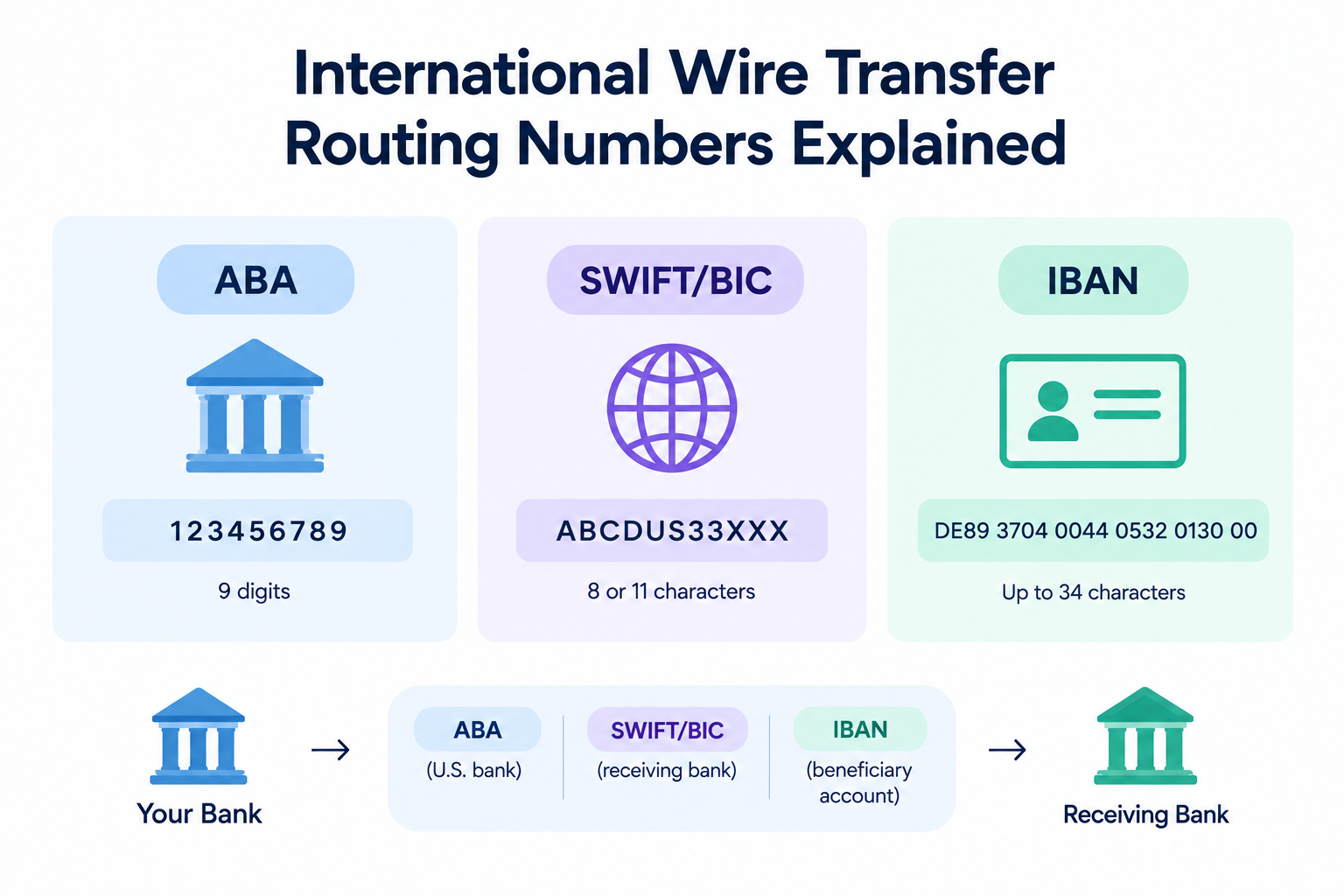
Start with the core distinction of institution, account, and payment-network identifiers
The simplest way to understand these codes is to match each one to its function. An ABA routing number identifies a U.S. financial institution for payment processing, including ACH and certain wire transfers.
A BIC identifies a business or financial organization under ISO 9362. The term SWIFT code is widely used in payment instructions, but BIC is the formal identifier.
An IBAN identifies an individual account at a specific financial institution in a particular country. ISO 13616 defines IBAN for automated processing and account identification. It is not designed to route messages within a network.
| Identifier | Main function |
|---|---|
| ABA | U.S. institution and routing identifier |
| SWIFT/BIC | Institution identifier for international messaging and addressing |
| IBAN | Structured international account identifier |
These codes are complementary, not competing versions of the same number. They can appear in one payment instruction because they answer different questions:
•Which U.S. institution is involved?
•Which international institution should receive or address the payment?
•Which specific account should receive the funds?
A payment instruction passes the basic classification test when each supplied code is labeled by function. Do not treat one code as a universal replacement for the others.
Understand ABA routing numbers in U.S. wire transfers
An ABA routing number is a nine-digit identifier for a U.S. financial institution. The American Bankers Association routing-number system supports payment processing across several U.S. payment activities.
The ABA identifies the institution or payment destination. It does not identify the beneficiary’s individual account. The account number performs that separate function.
Routing-number data can include clearing-system attributes. These indicate whether a number supports ACH, wire transfers, or another payment activity. The Federal Reserve routing directory provides routing information for Fedwire Funds Service and FedACH transactions. It is synchronized with Federal Reserve databases daily.
A bank’s wire-routing number may differ from its ACH routing number. Fedwire is a U.S. high-value electronic funds-transfer service used for same-day transactions. Therefore, do not assume that the routing number printed on a check is correct for a wire.
Before sending a U.S. wire, ask the receiving bank to confirm that the nine-digit ABA number is:
•Active for the requested wire service.
•Correct for the receiving institution.
•Appropriate for the requested currency and payment route.
The receiving bank’s wire instructions control. Ask for the wire routing number, not only the ACH routing number.
Use SWIFT codes and BICs to identify the receiving institution internationally
BIC stands for Business Identifier Code. It is defined by ISO 9362 and registered by Swift.
A standard BIC has eight characters. It contains a four-character business-party prefix, a two-letter country code, and a two-character business-party suffix. An optional three-character branch identifier can extend the code to 11 characters.
The payment industry commonly calls a BIC a SWIFT code. The terms often refer to the same identifier in wire instructions, but they describe different aspects. BIC is the formal ISO identifier. SWIFT refers to the network and organization commonly associated with international financial messaging.
A BIC identifies an organization. It does not prove that the organization is a Swift customer or that it can send or receive messages over the Swift network. Swift distinguishes between connected BICs and non-connected BICs used for identification or reference.
Check the BIC against the beneficiary bank’s official wire instructions or a trusted directory. Do not infer the correct branch from the bank name alone. Branch-specific details may matter when the BIC includes an optional branch identifier.
Read an IBAN as an account identifier, not a replacement for every bank code
IBAN stands for International Bank Account Number. ISO 13616 defines IBAN as an expanded version of a country’s Basic Bank Account Number, or BBAN.
An IBAN identifies an individual account at a specific financial institution in a particular country. Its format includes a country code, check digits, and country-specific account and bank-identification elements.
Length and structure vary by country. Check digits support validation and machine-readable processing. An IBAN is therefore more than an unstructured local account number. However, it is not a universal replacement for every domestic code.
IBAN adoption is country-dependent. A destination may use an IBAN, a local account number, another domestic identifier, or a combination of fields. Country-specific IBAN standards determine the expected format.
Do not create or guess an IBAN. Request the exact beneficiary instructions from the receiving bank. A validation check passes only when the country format, character length, check digits, and bank-provided account details align.
Compare ABA vs. SWIFT/BIC vs. IBAN before sending a wire
Each identifier answers a different operational question. The correct combination depends on the receiving bank, destination country, currency, intermediary institutions, and payment rail.
| Identifier | Primary role | Typical format | Scope | Account-level identifier | May be required for |
|---|---|---|---|---|---|
| ABA routing number | Identifies a U.S. financial institution for domestic payment-system processing | Nine digits | United States | No | U.S. domestic or U.S.-side wire instructions |
| SWIFT/BIC | Identifies a financial or other organization for standardized international addressing and messaging | Eight characters, optionally extended to 11 | International | No | Cross-border bank instructions |
| IBAN | Identifies a specific account through a country-specific international structure | Country-dependent alphanumeric string with check digits | Participating countries and territories | Yes | Destinations and payment schemes that use IBAN |
One code cannot be substituted for another simply because all are called bank details. Some international wires to or from the United States may require a U.S. ABA number on one side and a BIC, IBAN, or local account identifier on the other.
Start with the beneficiary bank’s official instructions. Then map each requested field to its institution, account, or routing function. A payment is ready for submission only when every required field is present and the receiving bank confirms the format.
Follow a verification checklist before submitting an international wire
Confirm the payment details before release. An accurate routing code cannot compensate for an incorrect beneficiary account.
1.Confirm the destination country and payment currency.
2.Obtain the beneficiary’s legal name, account identifier, bank name, and bank address.
3.Check whether the destination requires an IBAN.
4.Confirm whether the receiving bank also requests a BIC, SWIFT code, or local clearing code.
5.For a U.S. bank, confirm whether the ABA number supports Fedwire, ACH, or another service.
6.Ask whether an intermediary or correspondent bank is required.
7.Match the beneficiary name and account details with the receiving bank’s records.
8.Review the payment purpose, cutoffs, holidays, compliance checks, fees, foreign-exchange conversion, and possible beneficiary deductions. Before confirming the transfer, use a currency converter to estimate the amount in the recipient’s currency, then check the final exchange rate and fees quoted by your payment provider.
9.Keep the bank’s written instructions and payment confirmation for reconciliation or investigation.
The Federal Reserve routing directory can support validation of U.S. routing information. The beneficiary bank’s official instructions should remain the controlling source.
Review the BIC against the bank’s instructions and validate the IBAN using its country-specific structure. If a transfer is rejected, compare the rejected field with the bank’s latest instructions. Do not replace one code with another without confirmation.
The pre-send review passes when the bank or payment provider accepts the instruction format without a missing-code warning. The beneficiary should also confirm the intended receiving account.
Simplify international payments with Fuze Business
Choosing the right routing number or bank identifier is essential for accurate international wire transfers. For businesses managing payments across multiple countries, simplifying the wider payment workflow can also help reduce operational complexity and improve settlement efficiency.
Fuze Business provides a unified platform to send, receive, convert, and track cross-border payments. With banking network connectivity, access to difficult trade corridors, and stablecoin-enabled settlement options, it helps finance managers, global trade companies, and supply chain teams manage international payments more efficiently.
Businesses can explore Fuze Business to see how its cross-border payment capabilities can support their global payment workflows.