

Finance managers, global trade companies, and supply-chain teams often receive payments from overseas customers, suppliers, distributors, and partners. Successful receipt depends on more than sharing an account number.
You must provide accurate beneficiary and bank information, confirm the sending and receiving currencies, understand intermediary-bank deductions, prepare for compliance checks, monitor cutoffs, and include a reconciliation reference. Businesses may receive funds through traditional bank accounts, local account details where available, or alternative payment rails such as stablecoin-enabled workflows.
Availability, timing, fees, and required information vary by institution, country, currency, and payment corridor. Use the following process to reduce delays and mismatches.
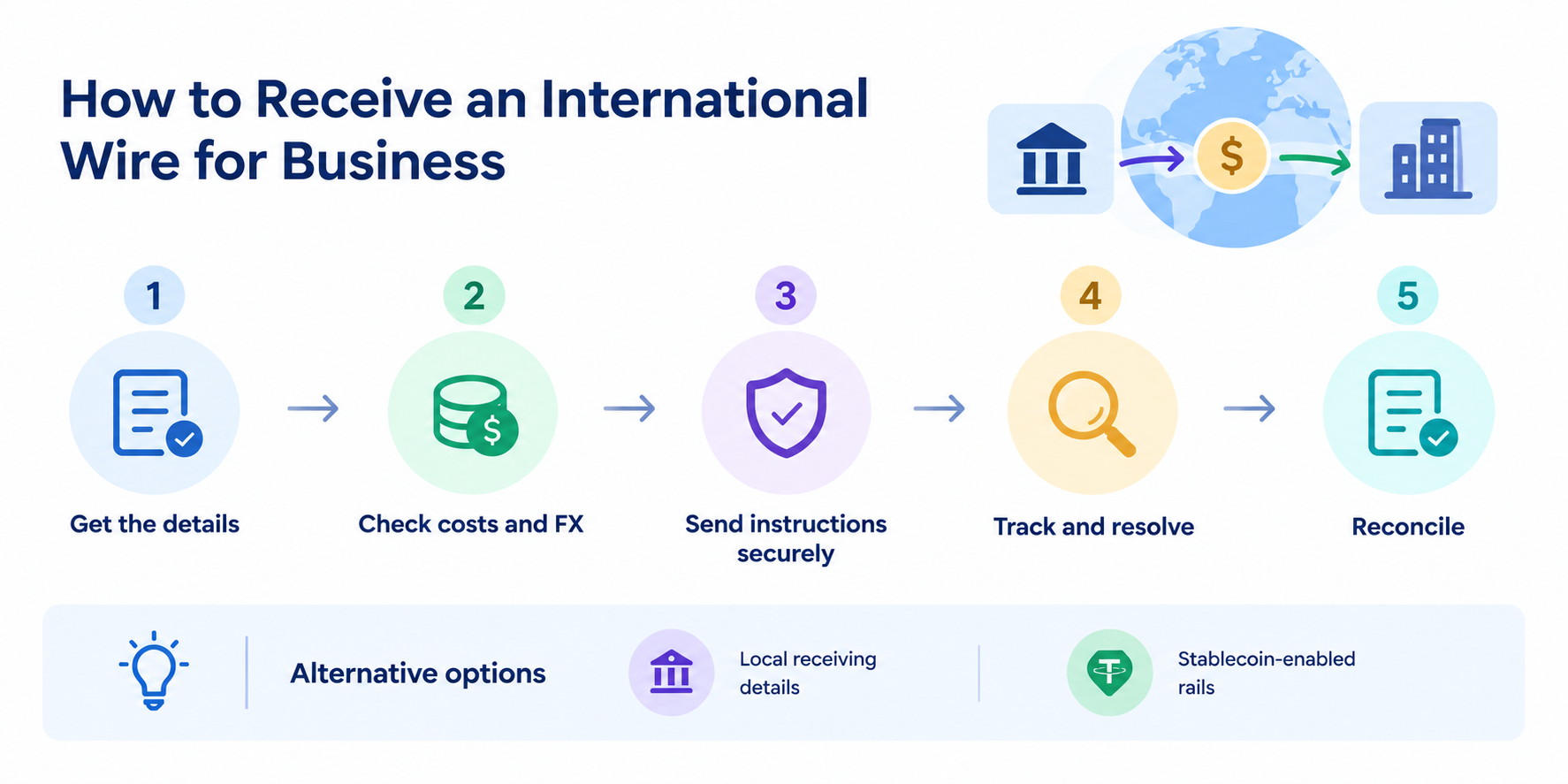
Prepare the exact receiving instructions before the payer sends funds
Give the payer a complete instruction set that matches the receiving institution’s current records. Confirm the instructions directly with your bank or payment provider before sending them.
International wire requirements vary. Banks may request a SWIFT/BIC code, an IBAN, or an additional local identifier. These can include an IFSC, BSB, sort code, CLABE, or clearing code. Bank wire instructions and local requirements should always be checked for the specific corridor.
| Payer field | What to provide | Where to verify | Common failure if wrong |
|---|---|---|---|
| Beneficiary name | Legal business name exactly as held by the institution | Receiving bank or provider | Payment is delayed, rejected, or placed under review |
| Beneficiary address | Registered business address | Corporate records and receiving institution | Name or address mismatch |
| Receiving institution | Bank or payment provider name and required branch address | Current incoming-wire instructions | Payment routes incorrectly |
| Account identifier | Account number, beneficiary number, or equivalent | Receiving institution | Funds cannot be credited |
| SWIFT/BIC | Applicable SWIFT/BIC code | Receiving institution or official bank materials | Wire is routed incorrectly |
| IBAN or local code | IBAN, IFSC, BSB, sort code, CLABE, or clearing code where required | Receiving institution | Local processing fails |
| Currency | Currency the business expects to receive | Account terms and invoice | Conversion or rejection occurs |
| Payment reference | Invoice number, customer reference, or remittance information | Invoice and accounting system | Receipt cannot be matched automatically |
Specify whether the payer should send the invoice amount in the receiving currency. If conversion is required, document which party performs it and when.
Confirm the payer should not rely on an old invoice or a third-party directory. Send a test instruction sheet and ask the payer to confirm the legal name, account identifier, SWIFT/BIC, currency, and reference. This step is complete when the payer confirms the full instruction set before initiating the wire.
Confirm currency, fees, and the amount that should arrive
The amount sent is not always the amount credited. Intermediary institutions and the receiving institution may deduct fees or taxes. Currency conversion may occur before the wire is sent, during processing, or at the receiving institution. Consumer guidance on reduced receipts explains why the recipient may receive less than the amount sent. Before the payer initiates the transfer, use a currency converter to compare currencies and estimate the conversion involved, then confirm the actual rate, fees, and net amount with the provider.
Ask the payer and receiving institution which fee arrangement applies. Confirm whether intermediary charges can be deducted from the principal. For invoice payments, state whether the payer must cover all fees so the net receipt equals the invoice amount.
Compare the full payment economics:
| Item | What to confirm |
|---|---|
| Send amount | Gross amount the payer releases |
| Currency sent | Currency used for the wire |
| Expected credit currency | Currency the business should receive |
| Sender fee | Charge applied by the payer’s institution |
| Intermediary-fee risk | Possible deductions by correspondent institutions |
| Receiving fee | Charge applied when funds are credited |
| Net amount expected | Amount available for reconciliation |
For a USD 10,000 invoice, document the expected USD credit, known fees, the assumed exchange rate if conversion applies, and the short-payment escalation path. Finance should be able to calculate the expected net receipt before the payer sends the wire.
Send the payer a secure, transaction-specific instruction pack
Use a controlled template for every payment corridor and currency. Include the beneficiary, receiving account, currency, invoice reference, and effective date of the instructions.
Verify any request to change bank details through an independent channel already on file. Do not rely only on a reply to an email requesting new payment instructions. Guidance on secure payment instruction controls supports independent verification of payment information.
Keep the receiving details consistent with the legal entity named on the invoice and contract. Use a different beneficiary only when the payment arrangement documents that structure clearly.
Tell the payer not to combine invoices if doing so removes the references needed for reconciliation. Keep evidence of the instructions provided, the payer’s confirmation, and the final payment message or confirmation.
Maintain version-controlled receiving instructions by currency and corridor. A suitable confirmation request is:
Please confirm the beneficiary name, account identifier, SWIFT/BIC, sending currency, and invoice reference before releasing the payment.
For any changed account detail, a second employee should independently call a known payer contact. Store the approved instruction version and payer confirmation with the invoice record.
Track the incoming wire and resolve exceptions early
Request the payer’s transfer confirmation and payment reference after the wire is released. Use those details to track the payment through the sending bank, intermediary chain, receiving institution, or payment platform when status visibility is available.
A payment marked as sent may still be pending compliance review, intermediary processing, currency conversion, beneficiary validation, or receiving-bank credit. A business wire tracking process should distinguish payment release from actual account credit.
Maintain an exception log with these fields:
•Payment reference
•Invoice and payer
•Amount sent and currency
•Release date
•Expected credit date
•Current status
•Owner
•Resolution and next action
Escalate when the expected credit date passes without a posted receipt. Also escalate when the payer’s confirmation shows a different beneficiary, currency, or amount from the approved instructions.
Ask the payer’s bank to initiate a trace using the transaction reference. At the same time, ask the receiving institution to check pending or rejected incoming payments. The process works when every unresolved wire has a reference, owner, next action, and escalation deadline.
Reconcile the receipt against the invoice and ledger
Match the credited amount to the invoice, contract, customer account, currency, and payer reference. Do not close the invoice automatically when the received amount differs.
Record the gross amount sent, fees deducted, FX conversion, net amount credited, value date, payment reference, and variance. Multi-currency receiving workflows can help teams organize receipt and conversion information across currencies.
| Reconciliation field | Required record |
|---|---|
| Invoice | Invoice being settled |
| Payer | Customer, supplier, distributor, or partner |
| Currency | Currency sent and currency credited |
| Gross sent | Amount released by the payer |
| Fees | Sender, intermediary, and receiving charges |
| FX rate | Rate used when conversion occurred |
| Net credited | Amount posted to the account |
| Variance | Difference from the expected receipt |
| Accounting treatment | Fee, FX variance, short payment, or other treatment |
| Status | Reconciled, pending, or under review |
Investigate partial receipts instead of closing the invoice. Possible causes include intermediary deductions, receiving-bank fees, taxes, conversion differences, or payer underpayment.
Define approval rules for FX variances, bank charges, credit notes, and residual balances. Reconcile the payment status with the bank statement or platform transaction record. Retain supporting evidence for audits and customer-service queries.
Close the invoice only when the receipt and ledger agree, or when the variance has an approved treatment. An unreconciled queue should contain no receipt without an owner or explanation.
Compare a traditional wire, local receiving details, and stablecoin-enabled rails
The right receiving method depends on the corridor, currency, compliance requirements, cost, settlement time, and payer preference. Choose the rail that delivers the required currency with acceptable control and visibility. When comparing receiving methods, consider how cross-border payments fit your business’s currency needs, payment corridors, fees, and settlement requirements.
| Option | Best fit | Information payer needs | Currency flexibility | Fee risks | Settlement considerations | Reconciliation approach |
|---|---|---|---|---|---|---|
| Traditional international wire | Payers that require a bank-only process | SWIFT/BIC, IBAN, local codes, beneficiary details, and payment purpose where required | Depends on the receiving account and corridor | Sender, intermediary, receiving, and FX charges | May involve correspondent-bank chains, cutoffs, holidays, and reviews | Match the bank credit, reference, currency, and fees |
| Local receiving details | Supported currencies and corridors where payer friction must be reduced | Local account details and required beneficiary information | Depends on available account capabilities | Local fees, limits, conversion charges, or eligibility restrictions | Availability and settlement behavior vary by business and corridor | Match the local account receipt to the invoice and currency |
| Stablecoin-enabled rails | Eligible businesses and counterparties that can use the relevant assets compliantly | Provider instructions, wallet or account details, currency, and reference | May support currency and stablecoin conversion | Conversion spread, provider charges, and route-specific costs | Can provide an alternative to correspondent-bank processing | Record the asset movement, conversion, net receipt, and invoice reference |
Traditional wires may require SWIFT/BIC, IBAN, local codes, purpose-of-payment information, and intermediary processing. Bank wire requirements vary by institution and corridor.
Local receiving details can reduce payer friction in supported currencies. Confirm availability, eligibility, account ownership, limits, and settlement behavior for the specific business.
Stablecoin-enabled rails are not universally available. Both sides must be legally and operationally able to use the relevant assets and provider workflow. Compliance requirements, jurisdiction, conversion terms, and reconciliation controls must be documented before use. Businesses evaluating digital-asset-based settlement should assess the provider’s digital asset infrastructure alongside its compliance controls, conversion options, and supported payment routes.
Choose a conventional wire when the payer requires a bank-only process. Evaluate local account details when the currency and corridor are supported. Consider a stablecoin-enabled route when the business and counterparties can use it compliantly and the settlement and conversion terms are clear.
How Fuze Business helps with faster global payments
Faster global payments depend on the right corridor, currency, compliance workflow, and settlement rail. Fuze Business brings receiving, sending, conversion, and cross-border payment operations into one platform. Its banking network and stablecoin rails are designed to reduce reliance on slower correspondent-banking paths. For eligible businesses exploring alternatives to correspondent-bank processing, stablecoin payments infrastructure may support additional settlement workflows, subject to corridor availability, regulatory requirements, and counterparty eligibility.
Fuze Business includes access to difficult trade corridors, banking-network connectivity, AED, USD, EUR,GBP and more cross-border payments, currency conversion, stablecoin conversion, enterprise-grade compliance, and faster settlement.
Before onboarding, validate the target currency, payer corridor, receiving route, conversion requirement, compliance requirements, expected settlement window, and reconciliation process. Fuze’s faster settlement guidance can support that evaluation.
For finance managers, global trade companies, and supply-chain teams, explore Fuze Business for faster global payment workflows using banking networks and stablecoin-enabled rails.