

“Faster settlement” is a context-dependent term. It is used across payments, securities, foreign exchange, and trade transactions.
First, settlement is the completion of a transaction through the transfer of money, securities, or another settlement asset. In securities markets, this generally means the buyer transfers money and the seller transfers the asset. Settlement finality is the point at which that transfer becomes irrevocable and unconditional.
Faster settlement does not always mean instant settlement. A transaction may be processed quickly or credited to a recipient before the underlying transfer becomes legally final. This guide uses cross-border business payments as its practical focus for Finance Managers, Global Trade Companies, and Supply Chain Managers.
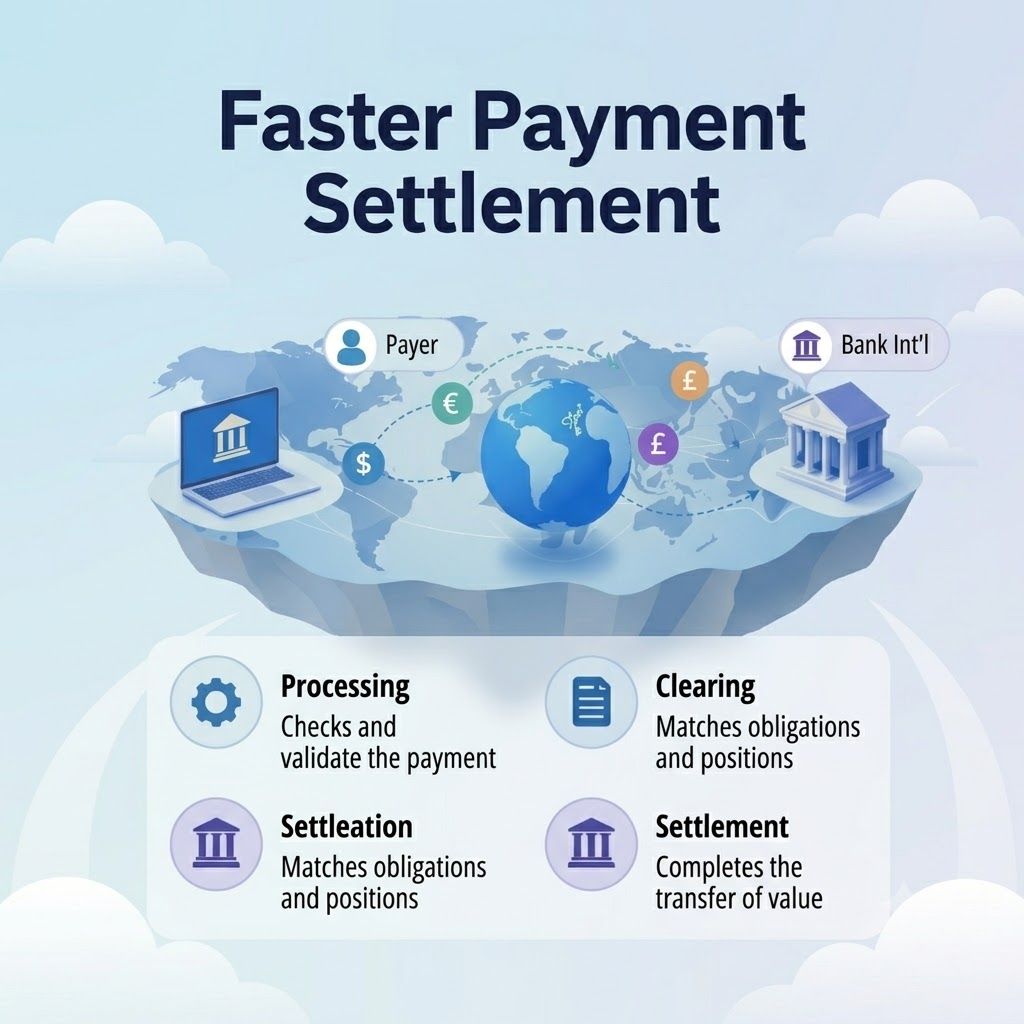
What faster settlement means in payments and financial transactions
Faster settlement means reducing the time between a transaction and the point at which the related funds, assets, or obligations are settled with the applicable degree of finality.
The phrase can describe several different improvements:
•A shorter settlement cycle, such as moving from T+2 to T+1.
•A shorter processing window before funds become available.
•Quicker access to usable funds.
•Settlement during the same business day.
•Settlement in real time after a payment passes system controls.
Processing, clearing, and settlement are separate stages. Processing handles transaction instructions. Clearing determines obligations or positions. Settlement completes the transfer of value. Payment system standards treat these stages as part of a broader system of rules, controls, and risk management.
Fast does not automatically mean final. A payment may be acknowledged or credited before the underlying settlement becomes irrevocable. The relevant meaning of “faster” depends on the payment rail, currency, market, business-day convention, and legal framework.
For example, a securities trade moving from T+2 to T+1 settles one business day after the trade date rather than two. A real-time payment system may settle an eligible payment immediately after acceptance, subject to its rules and controls.
How faster settlement works
A payment may pass through several stages before it becomes final:
1.Submission: The payer or participant sends the transaction instruction.
2.Validation: The system checks the instruction, account details, funding, and required information.
3.Acceptance for settlement: The system accepts the payment subject to its rules and controls.
4.Settlement processing: The payment is settled individually or through a netting process.
5.Settlement with finality: The transfer becomes irrevocable and unconditional under the applicable framework.
In a real-time gross settlement model, payments generally settle individually after passing system controls. In a deferred net settlement model, obligations may be netted and settled at a designated time. Settlement system guidance helps distinguish these operating models.
A user-facing confirmation does not by itself establish settlement finality. Finality depends on the system rules and the applicable legal framework. This distinction matters when a business releases goods, pays a supplier, or updates its treasury position.
Faster settlement may require earlier data submission, automated matching, sufficient liquidity, longer operating hours, interoperable systems, or direct connectivity between participants. Cross-border payments can take longer because of correspondent banks, multiple payment systems, time-zone differences, foreign-exchange conversion, sanctions screening, and local cut-off times.
For any proposed faster-settlement route, validate four points:
•When the instruction is accepted.
•When the recipient is credited.
•When the transaction becomes irrevocable.
•What happens if a compliance or funding check fails.
The ECB settlement glossary provides useful terminology for assessing these stages.
Faster settlement models compared: T+1, same-day, and real-time
The fastest model is not always the best model. The right choice depends on the transaction type, value, currency, legal finality, risk controls, and recipient access to funds.
| Model | Settlement timing | Key considerations |
|---|---|---|
| T+1 | One business day after the transaction date | Common in securities-market settlement; it is not instant |
| Same-day | During the transaction date | Depends on cut-off times, eligibility, funding, and operational conditions |
| Real-time | Individually as transactions are accepted and processed | Requires suitable infrastructure, controls, and liquidity |
| Deferred net | After obligations are netted | Can reduce payment flows but creates a waiting window |
T+1 is a shortened settlement cycle rather than instantaneous settlement. In the United States, the standard settlement cycle for most broker-dealer transactions changed from T+2 to T+1 on May 28, 2024. SEC guidance on T+1 also highlights the need to manage trade breaks and exceptions.
Same-day settlement can provide earlier access to funds, but access is not always the same as final settlement. A recipient may see a credit during the day while a later control or settlement step remains outstanding.
Real-time settlement processes transactions continuously or individually. Instant payments can improve cross-border efficiency and reduce the time transactions remain exposed to settlement risk. However, reach depends on linked systems, participating institutions, currencies, and local rules. Industry research on payment speed explains why speed depends on the full payment chain.
Use this checkpoint: can the recipient use the funds during the same operating window, and is the transfer final at that point?
Benefits and tradeoffs of faster settlement for businesses
Faster settlement can reduce the period during which a counterparty may fail to deliver funds or assets. This can lower settlement and counterparty exposure.
It can also improve capital efficiency. Cash, collateral, and inventory may remain tied up for less time in unsettled transactions. Earlier access to funds can support supplier payments, inventory replenishment, payroll timing, treasury management, and working-capital planning.
The business value of faster settlement is not speed alone. It is the ability to access, deploy, reconcile, and plan around funds with less waiting and uncertainty.
However, faster settlement does not remove every payment risk. Foreign-exchange risk, compliance obligations, fraud risk, payment errors, and liquidity requirements still apply. Cross-border payments may also require conversion between currencies or additional checks.
A shorter settlement window can increase operational pressure. Businesses have less time to resolve trade breaks, missing information, funding shortfalls, and exception cases. A shorter clock can improve liquidity while making data quality, automation, and exception handling more important.
A faster-settlement program should pass an operational review only when the business can complete these activities within the shorter window:
•Confirm payment instructions and beneficiary data.
•Complete funding and compliance checks.
•Match and reconcile the transaction.
•Assign ownership for exceptions.
•Resolve returned or failed payments.
The DTCC accelerated settlement initiative and related SEC risk guidance illustrate why shorter cycles require stronger operational readiness.
How to evaluate faster settlement for cross-border business payments
Compare a payment route by end-to-end timing. Do not measure only the time to submit an instruction or receive a status update.
For a global supplier payment, measure the time from instruction approval to recipient access in the destination currency. Then record when the payment becomes final. Also identify whether an intermediary or currency-conversion step can delay completion.
Evaluate each route across these areas:
•Actual settlement point.
•Recipient availability of funds.
•Supported currencies and trade corridors.
•Banking connectivity and operating hours.
•Foreign-exchange conversion steps.
•Compliance controls and exception handling.
•Reconciliation effort and reporting.
•Failed or returned payments.
•Total transaction cost.
•Liquidity requirements.
Businesses can evaluate a global payment platform by comparing corridor access, banking connectivity, supported currencies, conversion processes, settlement timing, compliance controls, and total transaction cost.
Cross-border settlement can involve different jurisdictions and currencies. The payer and payee may use financial institutions in different countries. Settlement may also occur in a country or currency area where neither party is located.
Useful performance indicators include time to recipient availability, time to finality, failed-payment rates, exception-resolution time, reconciliation effort, and total cost. These measures show whether faster settlement improves a real business workflow.
The most valuable use cases are practical. Faster settlement may help a company release goods, pay suppliers, manage treasury balances, or reduce idle working capital. The ECB’s cross-border payment material highlights why payment speed must be considered alongside access, controls, and the wider transaction process.
How Fuze Business helps with faster global payments
Faster settlement is not just about moving money quickly. Businesses need reliable payment corridors, efficient currency and stablecoin conversion, banking connectivity, and compliance controls to move funds with greater speed and predictability.
Fuze Business brings these capabilities together in one platform, enabling businesses to send, receive, and convert funds across global payment corridors. With access to difficult trade corridors, banking networks, cross-border payments, enterprise-grade compliance, and instant currency and stablecoin conversion, Fuze Business helps businesses reduce payment friction and accelerate settlement.
For businesses looking to improve the speed and efficiency of cross-border payments, Fuze Business provides the infrastructure to support faster global settlement.