
Cross-border payment performance depends on more than the time needed to send a SWIFT message. SWIFT is a global financial messaging network, not a bank, clearing system, or settlement system.
A complete payment journey includes initiation, intermediary processing, beneficiary-bank receipt, compliance checks, foreign exchange conversion, and final credit to the recipient. Current SWIFT trends show that messaging is becoming faster and more data-rich. However, local infrastructure, regulation, currency conversion, and last-mile processing still shape the customer’s end-to-end experience.
Businesses need practical access to cross-border payments, currency conversion, and stablecoin rails, not only faster messaging.
How SWIFT payments work and what their speed measures
SWIFT is a secure financial messaging network used by financial institutions to exchange standardized payment instructions. It does not hold customer funds, manage customer accounts, or operate as a payment or settlement system. SWIFT describes its role as financial messaging, rather than the movement or final settlement of funds.
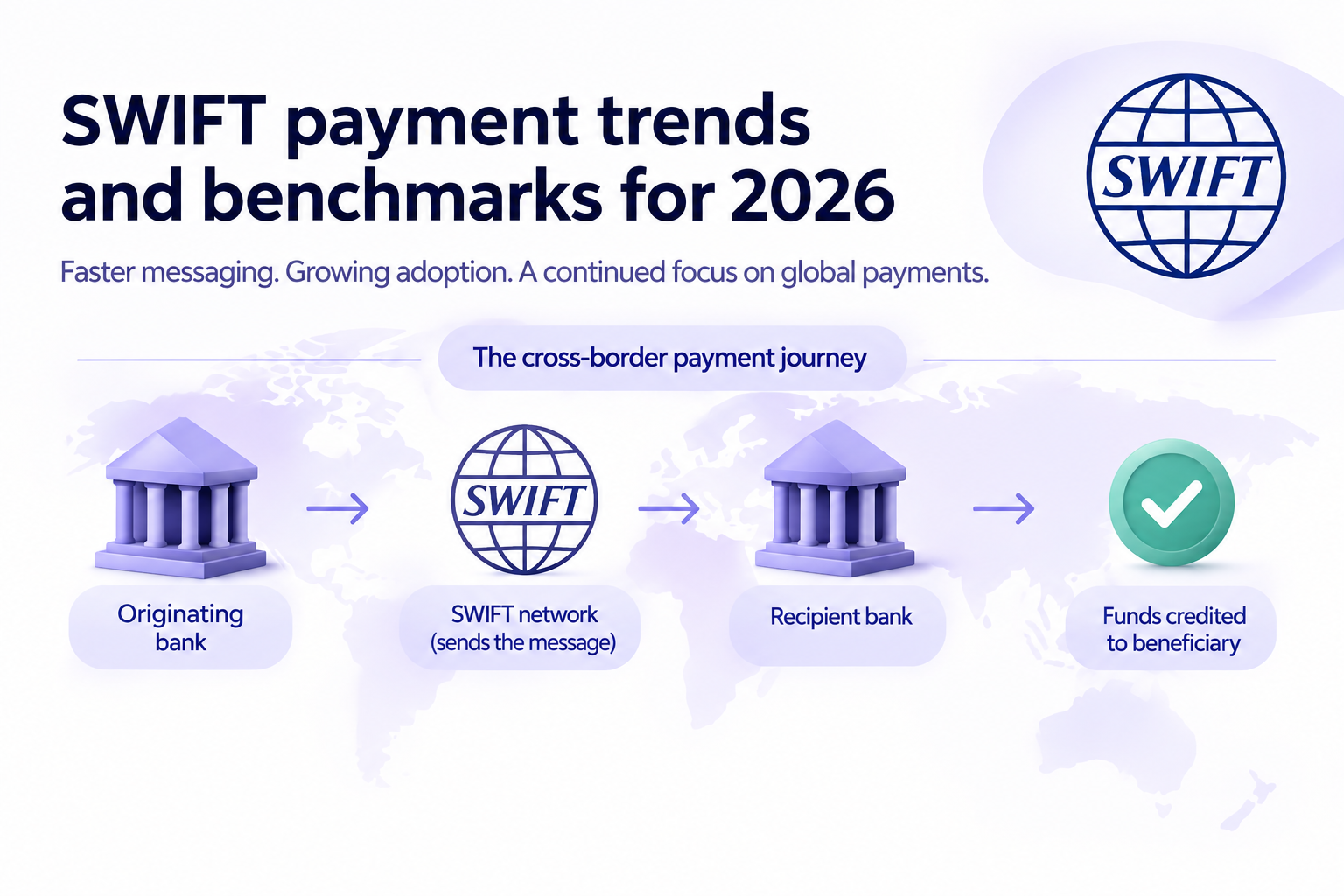
In a typical cross-border payment, the originating bank sends an instruction over SWIFT. The recipient bank, correspondent banks, and local payment systems then process the underlying transfer and credit the beneficiary.
In simple terms, SWIFT carries the payment instruction; the banks and local payment systems complete the movement and crediting of funds. The payment’s timing therefore includes several separate stages:
•Originator-leg time: how long the sending institution takes to prepare and release the payment.
•In-flight time: how long the instruction takes to reach the relevant financial institution.
•Beneficiary-bank processing time: how long the receiving institution takes to review and process it.
•Final credit time: how long it takes for funds to become available to the recipient.
SWIFT refers to the stage after receipt by the beneficiary institution as the “last mile.” Local regulations and payment conditions affect this last mile, including fraud checks, compliance reviews, operating hours, foreign exchange controls, and domestic payment infrastructure.
A payment can reach the beneficiary bank quickly but still take longer to appear in the recipient’s account. For this reason, SWIFT speed and settlement speed should not be treated as interchangeable measures. Businesses can also compare different stages of the payment journey using our guide to global payment settlement speed.
SWIFT adoption and the shift to richer payment data
SWIFT reported that the global financial community completed the universal shift to ISO 20022 for cross-border payments on November 22, 2025. In a 2025 progress update, SWIFT reported more than 97% of network messages were being sent in ISO 20022 format.
ISO 20022 is a structured financial messaging standard. It allows payment messages to carry more consistent and detailed information. That can support better compliance processes, reconciliation, payment tracking, and automation.
SWIFT’s published 2025 network figures also included approximately 59.8 million average daily payment messages, 40,000 active payment corridors, access across more than 200 markets, and support for 150 currencies. These figures describe network reach and activity. They do not guarantee the same experience for every bank, corridor, or payment type.
The adoption trend is therefore broader than message volume. It includes interoperability, structured data, tracking, and compatibility with tokenized or digital forms of value. The next SWIFT benchmark is not only how fast a message travels, but how much usable data travels with it.
ISO 20022 can improve the quality of information moving through the network. It cannot, by itself, guarantee faster settlement or immediate access to funds.
SWIFT network speed vs. final settlement time
SWIFT’s November 12, 2026 speed update reported that 50% of transactions sent over its network reached the recipient institution within 40 seconds. It also reported that 75% reached the recipient institution within 10 minutes. These are important network-arrival measures, but they are not universal guarantees of final beneficiary access. SWIFT’s speed figures describe arrival at a recipient institution.
SWIFT separately reports that approximately 80% of the average cross-border payment journey occurs after the payment leaves the SWIFT network, in the last mile. This helps explain why a fast message does not always produce a fast customer outcome.
The main causes of delay can include regulatory reporting, currency and foreign exchange controls, limited 24/7 infrastructure, and manual operational or compliance processes. Corridor design also matters. Receiving-bank cut-off times, weekends, public holidays, currency, and compliance requirements can all change the result.
Businesses should measure three clocks:
•Message transit time.
•Beneficiary-bank receipt time.
•Final funds-availability time.
A sub-minute network leg does not guarantee sub-minute access to funds. The relevant benchmark depends on whether the business needs a payment instruction delivered quickly, a bank account credited, or funds available for use.
How the G20 benchmarks cross-border payment performance
The G20 cross-border payments framework evaluates performance through four challenges: cost, speed, access, and transparency. This provides a more complete comparison than a single transfer-time figure.
For wholesale cross-border payments, the G20 target is for 75% to be credited within one hour of payment initiation or the agreed settlement time by the end of 2027. The remainder should be credited within one business day. Retail and remittance payments also use a one-hour availability target for 75% of payments by the end of 2027, with the remainder available within one business day.
The framework also addresses what customers and businesses should be able to understand before sending money. By the end of 2027, payment service providers are expected to disclose total transaction cost, intermediary and FX charges, expected delivery time, payment-status tracking, and terms of service. The G20 framework sets these speed and transparency targets.
Cost targets include a global average of no more than 1% for retail cross-border payments. The framework also aims for no corridors above 3% by the end of 2027. Remittance goals align with the UN target of 3% for a $200 remittance by 2030, with no corridor above 5%.
These benchmarks should be reported by payment type and corridor. A wholesale bank transfer, supplier payment, treasury conversion, and consumer remittance are different use cases. A useful corridor assessment records initiation-to-credit time, total fees including FX and intermediary charges, availability outside banking hours, and end-to-end tracking.
The right question is not simply whether a payment is fast. It is whether the payment is predictable, transparent, accessible, and economical on the corridor that matters to the business.
How instant payment systems and stablecoins are changing cross-border payments
SWIFT is working with payment-market infrastructures on interoperability models that connect cross-border payments with domestic instant-payment systems. These models include one-leg-out arrangements and direct or multilateral interlinking. SWIFT outlines interoperability between instant-payment systems.
Connecting faster systems can reduce friction between networks. It does not remove every local constraint. Compliance, liquidity, foreign exchange, operating hours, and beneficiary crediting can still affect the final result.
Stablecoins add another possible route for moving value. BIS research states that stablecoins are not a universal solution for cross-border payment friction. Their competitiveness depends on liquidity, fiat access, regulatory compliance, and trusted intermediaries. BIS estimated stablecoin transaction volume at approximately $28 trillion in 2025, while noting that values are materially lower after excluding transactions between wallets owned by the same party. BIS discusses stablecoin competition and payment frictions.
Stablecoin comparisons should distinguish blockchain transfer time from the full payment journey. Understanding the conversion process is also important. Our guide to currency and stablecoin conversion explains the costs, liquidity, and settlement considerations involved. That journey can include on-ramp access, off-ramp access, FX conversion, compliance review, and bank-account access.
A stablecoin transfer may be rapid between wallets but still require additional time before the recipient can access fiat funds in a local bank account. Stablecoin rails can shorten parts of the value-transfer journey, but they do not automatically remove every compliance, liquidity, FX, or local payout constraint.
How Fuze Business supports global payments
SWIFT has improved speed, data quality, tracking, and global connectivity. However, end-to-end performance still depends on the corridor’s last mile. Businesses must assess the full journey, including conversion, compliance, local payout, and final account access.
Fuze Business is a cross-border payments platform that enables businesses to send, receive, and convert fiat currencies and stablecoins from one account. Our capabilities include cross-border payments and payouts, instant conversion of currencies and stablecoins, access to difficult trade corridors, AED, USD, EUR, GBP and more, banking-network access, and enterprise-grade compliance.
For finance, treasury, payments operations, global trade, and supply-chain teams, the practical question is which payment route best reduces delay and operational complexity. Fuze Business is faster and quicker because we use stablecoin rails to support global payment flows. Specific speed, cost, corridor, licensing, or settlement outcomes still depend on the relevant route and should be assessed for each use case.
When faster global payments matter, explore Fuze Business to send, receive, and convert fiat currencies and stablecoins across international payment flows.