
Global payment settlement is the process of completing the final transfer of funds between parties in different countries or currencies. It is one stage in a wider cross-border payment journey. For a broader view of the full payment lifecycle, see our guide to cross-border transactions.
The word “faster” can describe several different milestones. These include payment initiation, beneficiary credit, settlement finality, reconciliation, and funds being available for business use.
This distinction matters to Finance Managers, Global Trade Companies, and Supply Chain Managers. They need to move funds across currencies and jurisdictions while managing cost, transparency, access, compliance, and settlement risk.
The G20 cross-border payment targets provide a useful external benchmark. However, these targets do not guarantee a specific transaction time for every currency corridor or payment.
Define global payment settlement before measuring speed
Settlement is the point at which the payment obligation is discharged through the final transfer of funds. A cross-border payment may involve several institutions and payment systems before that point.
A payment can include separate stages for instruction, messaging, clearing, currency conversion, settlement, beneficiary credit, and reconciliation. These stages may not happen at the same time.
Correspondent banking is one common structure. In this model, one bank holds deposits for another bank and provides payment services in a particular currency. A single payment can therefore involve several account updates and intermediaries.
Faster settlement is not one universal metric. A payment may be initiated quickly but credited later. It may also be credited before the payer’s internal reconciliation is complete.
Settlement risk can arise when one party delivers the currency it owes but does not receive the currency it is due. The BIS explanation of FX settlement risk describes why the timing of both currency legs matters.
| Stage | What it means |
|---|---|
| Initiation | The payer submits the payment instruction. |
| Clearing and screening | The payment is processed, validated, and checked. |
| FX conversion | One currency is exchanged for another, where required. |
| Settlement | The final transfer discharges the payment obligation. |
| Beneficiary credit | The recipient’s account is credited. |
| Reconciliation | The transaction is matched to the payer’s internal records. |
For example, a supplier may receive a payment instruction immediately. The finance team should still verify when the funds become available in the supplier’s account and when the transaction is reconciled in the payer’s ledger.
Map the cross-border settlement journey from instruction to reconciliation
A cross-border payment usually moves through several connected steps:
Payer instruction → Data and compliance validation → Intermediary or banking-network processing → FX conversion → Settlement in destination currency → Beneficiary credit → Reconciliation.
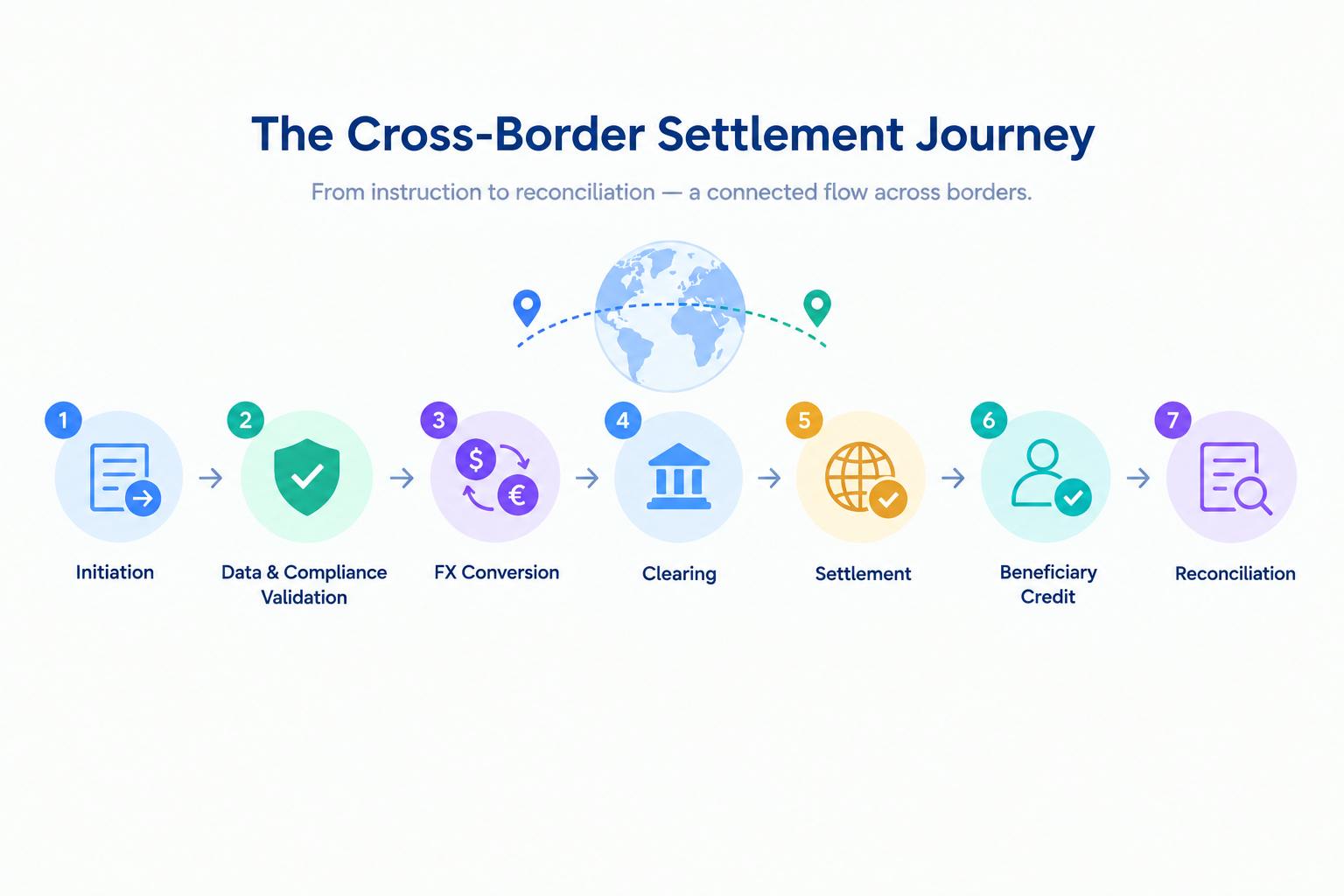
Traditional cross-border payments may pass through multiple correspondent banks. Each leg can require processing, account updates, and additional controls. A structured cross-border execution workflow helps finance teams identify where instruction, compliance, FX, settlement, and reconciliation delays occur.
National payment systems also operate under different conditions. Operating hours, public holidays, cut-off times, and settlement windows can extend the time between instruction and final credit.
Payment messages, compliance checks, liquidity positioning, FX conversion, and beneficiary-bank processing can each affect the end-to-end timeline. Poor data quality and limited standardisation can add further complexity.
The BIS work on payment-system coordination shows why different systems and institutions can affect cross-border processing. A platform may improve the coordination of instructions, conversion, and reconciliation without changing every underlying payment rail.
A payment sent late in one market’s business day may wait for the next available processing or settlement window. This can happen even when the payment instruction was accepted immediately.
Your treasury dashboard should identify the timestamp it reports:
•Instruction received
•Funds credited
•Settlement finality
•Reconciliation complete
Without this distinction, a reported processing time may not show when the recipient could actually use the funds.
Compare settlement models, currencies, and speed trade-offs
The settlement model affects the number of intermediaries, the available currencies, and the points where delays or controls may arise.
Correspondent banking can use foreign-currency accounts held between banks. A single payment may require more than one intermediary, depending on the currency and corridor.
Direct or linked payment-system access can reduce intermediary steps in eligible corridors. Availability depends on the currencies, jurisdictions, participants, and infrastructure involved.
Payment-versus-payment arrangements coordinate delivery of both currencies. They can reduce foreign-exchange settlement risk, although not every currency or transaction uses the same arrangement.
Stablecoin-based conversion or settlement may provide a different operational path from conventional bank settlement. It should not automatically be treated as universally instant, final, available in every corridor, or subject to the same regulatory treatment.
The relevant comparison is not simply “instant versus slow.” Finance teams should assess the full operating model.
| Model or capability | Typical intermediary structure | Potential speed benefit | Main dependency | Finance-team validation question |
|---|---|---|---|---|
| Traditional correspondent route | One or more correspondent banks | Depends on processing across each leg | Intermediary coverage and operating windows | Which institutions process the payment? |
| Banking-network route with consolidated access | Fewer coordinated banking-network steps | May reduce handoffs | Supported corridors and currencies | Which corridors and currencies are available? |
| Linked or interoperable payment systems | Connected payment systems | May improve coordination between systems | Interoperability and participant access | Where does settlement finality occur? |
| Digital-asset or stablecoin conversion path | Digital-asset conversion and settlement providers | May provide another conversion or transfer path | Currency support, compliance, liquidity, and regulation | When does conversion occur, and what does “settled” mean? |
A route should pass review only when the provider can state which currencies it supports, when conversion occurs, what “settled” means operationally, and how the transaction appears in reconciliation records.
Evaluate what “faster” means against cost, transparency, access, and risk
The G20 framework evaluates cross-border payment improvements across four challenges: cost, speed, transparency, and access. These measures help finance teams avoid judging a route by speed alone.
For cross-border wholesale payments, the G20 target is for 75% of payments to be credited within one hour of initiation by the end of 2027. For forward-dated transactions, the measurement begins within one hour of the pre-agreed settlement date and time. The remaining payments are targeted for completion within one business day.
The wholesale framework also includes end-of-day reconciliation on the day funds are credited by the end of 2027. These are policy targets, not guarantees for every payment or corridor. The G20 target framework provides the relevant benchmark.
Transparency should include total transaction cost, intermediary and conversion charges, expected delivery time, payment-status tracking, and terms of service. The FSB progress report also notes that global measurement remains difficult because of data limitations, with only slight overall improvement and regional variation.
A faster payment is not necessarily a better payment if its cost, status, or finality is unclear.
Use this evaluation checklist when reviewing a provider:
•Stated delivery time
•Settlement definition
•Total landed cost
•FX rate and spread
•Intermediary fees
•Status visibility
•Compliance exceptions
•Reconciliation timing
A provider claim of “same-day settlement” is incomplete until it identifies the relevant time zone, cut-off time, currency, business-day calendar, and milestone being measured.
Build a B2B settlement scorecard for finance and supply chain teams
Finance teams should measure settlement performance by corridor, currency, transaction type, and milestone. One average processing time can hide slow currencies, difficult corridors, or frequent exceptions.
Useful measures include time from instruction to beneficiary credit, time from instruction to settlement finality, exception rate, failed or returned payment rate, reconciliation completion time, total cost, and FX conversion cost.
Access is also important. A route may be fast where a provider has strong coverage but unavailable or slower in a difficult trade corridor. Compliance requirements and inconsistent payment data may also trigger manual review.
Resilience should be assessed alongside speed. Where relevant, teams should review backup settlement or correspondent arrangements and understand how operational failures are handled.
| Scorecard area | What to review |
|---|---|
| Speed | Beneficiary credit and settlement-finality times |
| Cost | Total fees, intermediary charges, and FX cost |
| Corridor access | Supported countries, jurisdictions, and trade corridors |
| Currency coverage | Available sending, receiving, and conversion currencies |
| Compliance workflow | Review requirements, exception handling, and response times |
| Status visibility | Tracking from instruction through settlement |
| Reconciliation | Timing and quality of ledger output |
| Resilience | Backup routes, liquidity, and operational continuity |
A practical pilot could compare 30 transactions in the same corridor. It could measure median and 95th-percentile time to beneficiary credit, total fees, exception count, and time to ledger reconciliation. These should be labelled as hypothetical pilot measures unless actual data is supplied.
Approve a faster route only when its measured settlement milestone, total cost, compliance controls, and reconciliation output are clear.
How Fuze Business helps with global payment settlement
Fuze Business provides a unified platform for businesses managing cross-border payments. Instead of coordinating separate systems for payment execution, currency conversion, and transaction tracking, businesses can manage these workflows through a single account.
Fuze Business supports cross-border payments across multiple corridors, access to harder-to-reach markets, banking-network connectivity, AED, CNY, and EUR, instant currency and stablecoin conversion, enterprise-grade compliance, and faster settlement.
For finance teams, the key questions are:
•Which payment corridors are available?
•Which currencies can the business send, receive, and convert?
•How is FX conversion handled and when does it take place?
•What compliance processes are applied to each payment?
•At what point is settlement considered complete?
•What transaction data is available for reconciliation and reporting?
The right payment infrastructure ultimately depends on the business’s specific requirements. Finance Managers, Global Trade Companies, and Supply Chain Managers should consider factors such as corridor coverage, currency availability, banking-network access, compliance processes, conversion speed, settlement timelines, and reconciliation capabilities when evaluating a cross-border payments platform.
If your business needs a clearer route for sending, receiving, and converting funds across borders, explore Fuze Business.