

Finance managers, global trade companies, and supply chain managers often face more than a logistics problem when moving goods-related funds. Limited banking access, complex regulations, heavy documentation, currency constraints, and unpredictable settlement can make a corridor difficult to use. Businesses managing these flows should also understand how cross-border payments work across currencies, payment networks, compliance checks, settlement, and reconciliation.
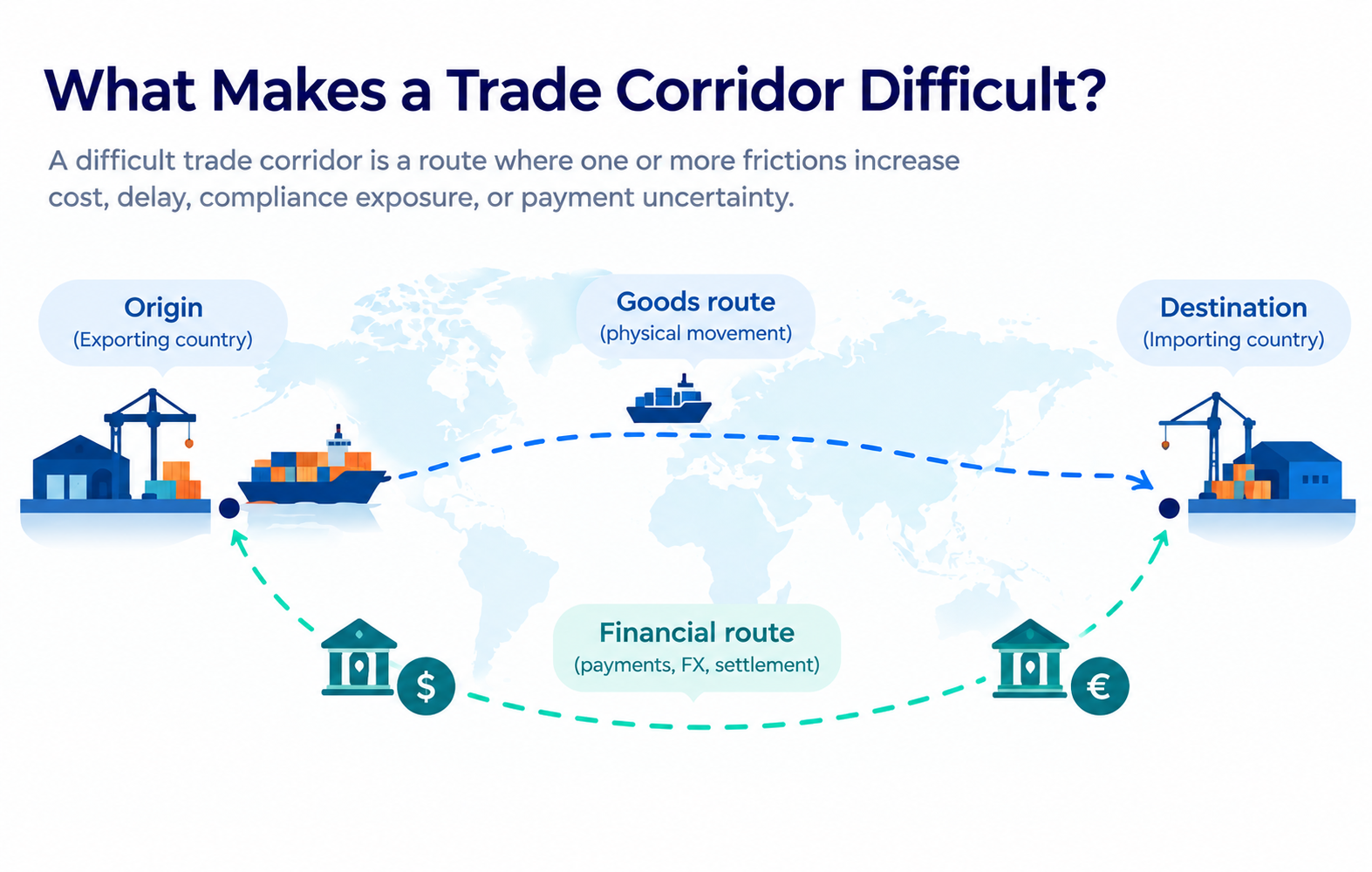
A difficult trade corridor is a route where one or more of these frictions materially increases cost, delay, compliance exposure, or payment uncertainty. Before choosing a payment tool, identify the origin and destination jurisdictions, goods, counterparties, currencies, transaction value, frequency, delivery timing, Incoterms® rule, and internal approval owner.
Payment tools do not override sanctions, anti-money laundering and countering the financing of terrorism (AML/CFT) rules, customs requirements, export controls, licensing obligations, or local foreign-exchange requirements. Use the following process to diagnose the corridor and design a controlled route.
Define the corridor and diagnose its failure points
Start by mapping both routes involved in the transaction. The first is the physical route for the goods. The second is the financial route for invoicing, collections, foreign-exchange conversion, and settlement.
The WTO trade-cost framework identifies transport and travel costs, information and transaction costs, information and communications technology connectivity, governance quality, and trade-policy differences as important trade-cost factors. These factors help separate a specific operational constraint from a general perception that a corridor is difficult.
Customs delays, duplicated documents, weak border-agency coordination, and unclear transit procedures are trade-facilitation risks. They should not be treated only as logistics issues. Also record the exact currencies needed at each stage:
•Invoice currency
•Supplier-receipt currency
•Currency used for funding
•Currency ultimately held by the business
Separate an operationally difficult corridor from a legally prohibited or restricted corridor. A restricted route requires specialist legal and compliance review before proceeding.
Use this diagnostic table:
| Friction category | Evidence | Likely business impact | Owner | Mitigation |
|---|---|---|---|---|
| Regulation | Applicable rules and licenses | Delay or rejection | Compliance | Confirm requirements |
| Sanctions and AML/CFT | Screening and ownership results | Blocked or escalated payment | Compliance | Review and document disposition |
| Customs documentation | Required documents and data | Border delay or mismatch | Trade operations | Standardize document set |
| Logistics | Transit and delivery constraints | Late delivery | Supply chain | Confirm route and fallback |
| Banking access | Available banks and providers | Payment failure | Treasury | Identify eligible rails |
| FX liquidity | Available currencies and rates | Higher cost or delay | Treasury | Confirm conversion route |
| Settlement timing | Required and expected windows | Supplier disruption | Finance | Set service and fallback plan |
| Counterparty risk | Beneficiary and ownership data | Fraud or compliance exposure | Procurement | Verify counterparties |
| Reconciliation | Available payment data | Unresolved accounting breaks | Finance | Define confirmation process |
A corridor is ready for route design only when the team can name the payment origin, beneficiary, currencies, expected settlement window, required documents, and the specific reason the current route fails.
The corridor passes this diagnostic stage when every friction has an evidence source, a responsible owner, and a proposed mitigation. It fails when the team describes it only as “high risk” without identifying the underlying constraint.
Verify legal, sanctions, customs, and counterparty eligibility
Create a pre-transaction control before selecting a payment rail. Review the parties, beneficial owners where applicable, banks and payment providers, countries, goods, end use, currencies, and intended payment route.
An effective sanctions-compliance program includes management commitment, risk assessment, internal controls, testing and auditing, and training, according to OFAC compliance guidance. These are control-design concepts, not a replacement for jurisdiction-specific legal advice.
The World Trade Organization Trade Facilitation Agreement addresses publication of import, export, and transit procedures. It also covers customs risk management, post-clearance audit, border-agency cooperation, and transit formalities. These areas can inform the control design for a difficult corridor.
For stablecoin-related flows, identify:
•The specific asset
•The service provider
•The wallet or account type
•The relevant jurisdiction
•Travel-rule obligations
•Licensing and reporting requirements
•The recipient’s required currency
The FATF virtual-asset standards extend AML/CFT measures to virtual assets and virtual asset service providers. A different payment rail cannot be used to evade restrictions, conceal a party, misstate goods, or bypass licensing.
Use this compliance checklist:
•Restricted-party screening
•Beneficial-owner review
•Goods and end-use review
•Origin and destination checks
•Sanctions-jurisdiction review
•License determination
•Payment-provider eligibility
•Recordkeeping owner
Stop the payment and escalate when screening produces a true match, the goods or end use require a license, ownership is unclear, or the payment route cannot provide required transaction information.
Keep a pilot on hold until compliance documents a clear disposition for every party, jurisdiction, goods category, and payment rail. The control passes when an authorized reviewer signs the record and the payment route can preserve required originator, beneficiary, and transaction data.
Choose the payment and settlement route against measurable trade-offs
Compare payment routes by legality, access, settlement speed, total cost, foreign-exchange exposure, data transparency, operating hours, failure handling, liquidity, and reconciliation effort. Businesses can also use a global payments framework to evaluate corridor access, banking connectivity, conversion, settlement, tracking, and compliance.
Traditional correspondent-bank chains can involve multiple intermediaries, currency conversions, operating-hour mismatches, repeated checks, and additional administrative steps. The BIS cross-border payments work identifies interoperability, legal and regulatory frameworks, cross-border data exchange, and message standards as important themes for improving these payments.
Banking networks, direct or correspondent routes, local payment access, and stablecoin-enabled settlement are different tools. The right option depends on the corridor, transaction type, permissions, counterparties, and required recipient currency.
| Route | Access condition | Best-fit use case | Settlement dependency | FX step | Compliance evidence | Fallback route | Reconciliation method |
|---|---|---|---|---|---|---|---|
| Bank transfer or correspondent route | Eligible banks and payment instructions | Established banking relationships | Intermediary processing | Bank conversion or separate FX | Bank and transaction records | Alternate bank route | Bank confirmation and ledger match |
| Local banking-network route | Provider access in the destination market | Recipient requires local currency | Local network availability | Local conversion or prefunding | Provider and beneficiary records | Correspondent route | Provider status and beneficiary confirmation |
| Stablecoin-to-fiat settlement route | Permitted asset, provider, wallet, and jurisdiction | Approved digital-asset settlement workflow | Asset liquidity and fiat off-ramp | Stablecoin-to-fiat conversion | Wallet, provider, and transaction records | Banking or local route | On-chain and fiat records |
| Multi-rail operating model | More than one approved route | Repeated flows needing resilience | Primary and fallback availability | Route-specific | Records for each rail | Pre-approved secondary rail | Unified transaction reference |
The BIS cross-border payments overview also supports evaluating interoperability and data exchange rather than focusing only on headline fees.
Fuze Business can be evaluated as a potential option where its supported coverage and compliance requirements fit the corridor. It includes cross-border payments, a banking network, instant currency and stablecoin conversion, AED, CNY, EUR, GBP, INR, SAR, and USD enterprise-grade compliance, and faster settlement. Availability depends on the supported corridor, jurisdiction, asset, and account eligibility.
Select the route that meets the legal and delivery requirement with the lowest combined operational and settlement risk. Do not select it solely because it has the lowest quoted fee.
For an invoice payable in CNY, confirm that the route can legally accept the funding currency, convert or settle into CNY, provide beneficiary and transaction data, and complete settlement within the supplier’s required window. The route passes when it has a documented primary rail, fallback rail, recipient-currency plan, total-cost estimate, and settlement confirmation method.
Prepare documents, payment instructions, and counterparties
Use one source of truth for the transaction record. It should include the commercial invoice, purchase order, contract, packing list, bill of lading or airway bill, certificate of origin, licenses, tax data, and payment instructions where applicable.
Incoterms® rules allocate key delivery, cost, risk, and transport responsibilities. The selected rule should match the actual movement of goods and each party’s ability to arrange transport, insurance, customs, and delivery.
The WTO supports the publication and simplification of import, export, and transit formalities. Its trade-facilitation framework also addresses electronic submission, electronic payment, and single-window approaches where implemented.
Before releasing payment, validate the beneficiary name, account identifier, bank details, invoice reference, currency, payment purpose, and required intermediary information. Assign clear owners for customs, freight-forwarder coordination, bank communication, compliance escalation, payment approval, and reconciliation.
| Document | Issuing party | Required jurisdiction | Version/date | Data fields reused in payment | Reviewer | Storage location |
|---|---|---|---|---|---|---|
| Commercial contract | Buyer and seller | Relevant trade jurisdictions | Current signed version | Parties, goods, terms | Legal or procurement | Approved repository |
| Commercial invoice | Seller | Import and payment jurisdictions | Current invoice date | Beneficiary, amount, currency, purpose | Finance and trade operations | Approved repository |
| Purchase order | Buyer | Internal and trade records | Current order version | Goods, amount, references | Procurement | Approved repository |
| Shipping and customs documents | Carrier, seller, or broker | Origin, transit, and destination | Shipment-specific | Goods and shipment references | Customs owner | Approved repository |
| Origin or license documents | Issuer or authority | Where applicable | Current validity period | Origin, goods, authorization | Compliance | Approved repository |
| Payment instructions | Beneficiary or approved provider | Payment route jurisdictions | Verified date | Account and intermediary details | Treasury | Restricted payment record |
| Approval and screening record | Internal control owners | Internal policy | Transaction date | Approval and screening status | Authorized reviewer | Compliance repository |
Do not accept payment-instruction changes by email alone. Confirm them through an approved counterparty channel and retain the verification record.
A supplier payment packet is complete when the commercial documents, customs data, beneficiary details, payment purpose, currency, approval record, and escalation contact agree. It passes when an independent reviewer can reconstruct the transaction without requesting missing core information.
Run a controlled pilot and monitor settlement end to end
Start with a representative transaction within approved exposure limits. Define the amount, beneficiary, route, currency, timing, and failure response before initiating the payment.
Track the transaction from funding through compliance review, conversion, payment initiation, intermediary processing, beneficiary credit, and final reconciliation. Measure more than the quoted fee. The relevant indicators include total landed payment cost, elapsed settlement time, failed or returned payments, information requests, FX variance, manual touches, and reconciliation exceptions.
The World Bank Logistics Performance Index uses shipment-tracking data and includes indicators across aviation, maritime, and postal modes. Use comparable operational evidence instead of relying on anecdotal corridor reputations.
Use a pilot scorecard:
•Initiated timestamp
•Approval timestamp
•Compliance-clear timestamp
•Conversion timestamp
•Beneficiary-credit timestamp
•Total cost
•FX rate
•Exception count
•Final status
Keep a documented fallback plan for delayed settlement, rejected beneficiary details, unavailable banking infrastructure, liquidity constraints, or changes in regulatory status.
Pause the next transaction when a pilot produces an unexplained return, unresolved screening alert, missing settlement evidence, or material variance from the approved route.
The pilot succeeds when the beneficiary confirms receipt in the required currency, the payment record matches the commercial documents, and finance reconciles the transaction without unexplained breaks. It passes when the pre-approved settlement window and exception threshold are met.
Scale the corridor with controls, redundancy, and periodic review
Convert pilot findings into a corridor playbook before processing repeated transactions. The playbook should cover approved counterparties, documents, payment routes, currencies, settlement windows, limits, escalation paths, and fallback options.
Review the corridor when sanctions or licensing rules change, a bank or provider changes access, currencies become less liquid, logistics performance deteriorates, or transaction exceptions increase.
A second payment rail can improve resilience, but it also adds onboarding, reconciliation, compliance, and treasury complexity. Diversify only when the additional rail has a defined purpose and remains within approved controls.
Monitor both goods movement and money movement. A fast payment route does not solve customs, licensing, transport, or delivery failures. The WTO Trade Facilitation Agreement’s focus on risk management, post-clearance audit, coordinated border controls, and simplified transit formalities can inform the governance process.
Use this review cadence:
•Daily exception monitoring for active shipments
•Monthly key performance indicator review
•Quarterly corridor-risk review
•Immediate review after a material regulatory, banking, or logistics event
Track successful settlement rate, median settlement time, total cost, return rate, compliance-review time, FX variance, reconciliation breaks, and supplier-confirmed on-time payment.
Scale only when the business can process repeated transactions through the approved route with complete records and a tested fallback. The corridor passes when its owner can show current approval, route documentation, counterparty records, and evidence that the fallback route has been tested.
How Fuze Business can help access difficult trade corridors
Accessing a difficult corridor requires a sequence: diagnose the route, verify legal and counterparty conditions, choose a compliant payment and settlement method, prepare complete documents, run a pilot, and monitor measurable outcomes.
Fuze Business is a commercial option for businesses managing cross-border money movement. It provides a unified platform for sending, receiving, converting, and managing cross-border payments across supported markets.
It includes access to difficult trade corridors, banking-network connectivity, cross-border payments, currency and stablecoin conversion, transaction tracking, and faster settlement. Availability depends on the supported corridor, jurisdiction, asset, and account eligibility.
Evaluate those capabilities against the corridor’s approved jurisdictions, recipient currency, asset requirements, compliance controls, and account eligibility. Fuze Business does not replace legal advice, customs expertise, sanctions screening, or local regulatory approval.
For businesses facing payment, conversion, or settlement friction in difficult corridors, Fuze Business can be evaluated as one potential payment infrastructure option alongside banking and other approved settlement routes. Explore Fuze Business to assess whether its available payment, conversion, and settlement capabilities fit your approved trade corridor.