
Finance managers, global trade companies, and supply chain managers need more than a conversion quote. They need a reliable way to fund, convert, send, receive, and reconcile international payments.
This review compares seven platforms: Fuze Business, Wise Business, Revolut Business, Airwallex, BVNK, Circle, and Coinbase. The comparison is unranked and organized by operational fit rather than a universal winner.
The platforms serve different purposes. Some are business payment platforms. Others provide stablecoin infrastructure or exchange execution. A platform that works well for a USDC-to-USD trade may not suit recurring supplier payments in a difficult corridor.
Here, instant conversion means that a platform can quote or execute a conversion within its supported workflow. It does not guarantee identical settlement times for every corridor, funding method, compliance review, or bank payout.
How we evaluated the platforms
This is a proposed editorial comparison, not a market ranking. The platforms do not provide the same product type, so operational fit is more useful than a single overall score.
The main priority is whether a platform can convert between fiat currencies and stablecoins within a business payment or treasury workflow. The review also considers rate, spread, fee, and settlement transparency before execution.
Other factors include currency and corridor coverage, including difficult corridors relevant to global trade. Compliance, onboarding, transaction monitoring, operational controls, and the implementation model also matter. A provider may offer a unified dashboard, API, hosted flow, or exchange interface.
For a practical assessment, a finance manager should be able to answer one question: can the provider move the required asset through the required corridor, under the required compliance process, within the required settlement window?
At-a-glance comparison of currency and stablecoin converters
The table provides an initial view of each platform’s operating model. Best fit depends on whether the buyer needs payment operations, stablecoin infrastructure, or exchange execution.
| Platform | Best fit | Conversion workflow | Settlement model | Main limitation |
|---|---|---|---|---|
| Fuze Business | Unified business payments and treasury workflows | Send, receive, convert, and settle currencies and stablecoins | Banking-network connectivity and faster settlement, subject to route and eligibility | Availability and timing depend on corridor, funding method, counterparty, and compliance |
| Wise Business | Fiat multi-currency accounts and international transfers | Hold, convert, send, and receive fiat currencies | International transfer and bank account workflow | Cited material does not establish native stablecoin conversion |
| Revolut Business | In-app fiat account management and exchange | Exchange between currency accounts in the app | Revolut Business account and exchange workflow | Stablecoin coverage and business crypto pricing require confirmation |
| Airwallex | Business payments and programmable settlement | Multi-currency settlement with API-based stablecoin payouts | Multi-currency balance and API payout routes | Stablecoin payouts are documented as API-only |
| BVNK | Stablecoin-native payments and treasury | Send, receive, store, convert, spend, and settle stablecoins and fiat | Conversion requests can be made 24/7; bank runs and withdrawals may take longer | Bank payments and withdrawals may involve scheduled runs and reviews |
| Circle | Institutional USDC payment infrastructure | Wallets, custody, minting, redemption, orchestration, and settlement | Infrastructure, integration, and payout-partner model | Usually requires institutional onboarding and implementation |
| Coinbase | Exchange execution and stablecoin liquidity | Stablecoin and fiat trading pairs, including USDC-to-USD | Exchange conversion followed by withdrawal or payout | Does not by itself provide full supplier payment and reconciliation operations |
For every platform, compare the total delivered amount, not only the displayed conversion fee. A supplier invoice denominated in EUR but funded in USDC may require separate wallet, exchange, banking, and payout steps depending on the provider.
1.Fuze Business
Fuze Business is best for businesses seeking one workflow for cross-border payments, collections, fiat conversion, stablecoin conversion, and transaction management.
Features: Fuze Business provides a unified account for sending, receiving, and converting funds. Its described capabilities include instant currency and stablecoin conversion, access to difficult trade corridors, banking-network connectivity, enterprise-grade compliance, faster settlement, transaction tracking, and reconciliation. Supported assets listed on the company site include AED, EUR, GBP, USD, USDT, and more. The Fuze Business platform describes a unified route from held stablecoins or currencies to the recipient’s required settlement currency.
Limitation: Availability and settlement depend on the currency, corridor, funding method, counterparty, eligibility, and applicable compliance requirements.
Best for: Finance managers, global trade companies, and supply chain managers consolidating recurring supplier, partner, and cross-border payment workflows. A business holding stablecoins can use the described workflow to pay a counterparty in the required fiat currency, subject to corridor and eligibility availability. The platform also describes access to difficult trade corridors and faster global settlement.
2.Wise Business
Wise Business is a strong fit for businesses prioritizing transparent fiat conversion and international transfers through a multi-currency account rather than a stablecoin-native workflow.
Features: Wise Business supports sending and receiving money, converting currencies, holding funds, and using account details for multiple currencies. Its pricing material states that Wise does not inflate the mid-market exchange rate. The workflow is designed around fiat balances and international transfers.
Limitation: The cited business pricing material documents fiat conversion and international payments. It does not establish a native stablecoin conversion workflow.
Best for: Companies needing established fiat multi-currency account and transfer functionality with an upfront fee presentation. Businesses should treat the published fee-from figures as a starting point and calculate the full delivered amount for the exact currency route and payment method.
3.Revolut Business
Revolut Business suits companies already using Revolut currency accounts and needing in-app fiat exchange, while stablecoin support requires jurisdiction- and product-specific confirmation.
Features: Revolut’s US Business documentation describes exchanging money between currency accounts in the app. Its developer documentation says the API supports the same currencies as the Revolut Business app and provides an exchange-rate endpoint. The Revolut exchange guidance explains the in-app currency workflow.
Limitation: The cited business sources do not establish a stablecoin-to-fiat workflow, supported stablecoin list, or current business crypto pricing for every jurisdiction. Buyers should confirm which business entity, plan, jurisdiction, and market hours apply to the quote.
Best for: Teams wanting app-based fiat account management and API-accessible exchange functionality, provided the required currency and asset coverage is confirmed. A live quote during and outside market hours can help assess rate differences and the complete delivered amount.
4.Airwallex
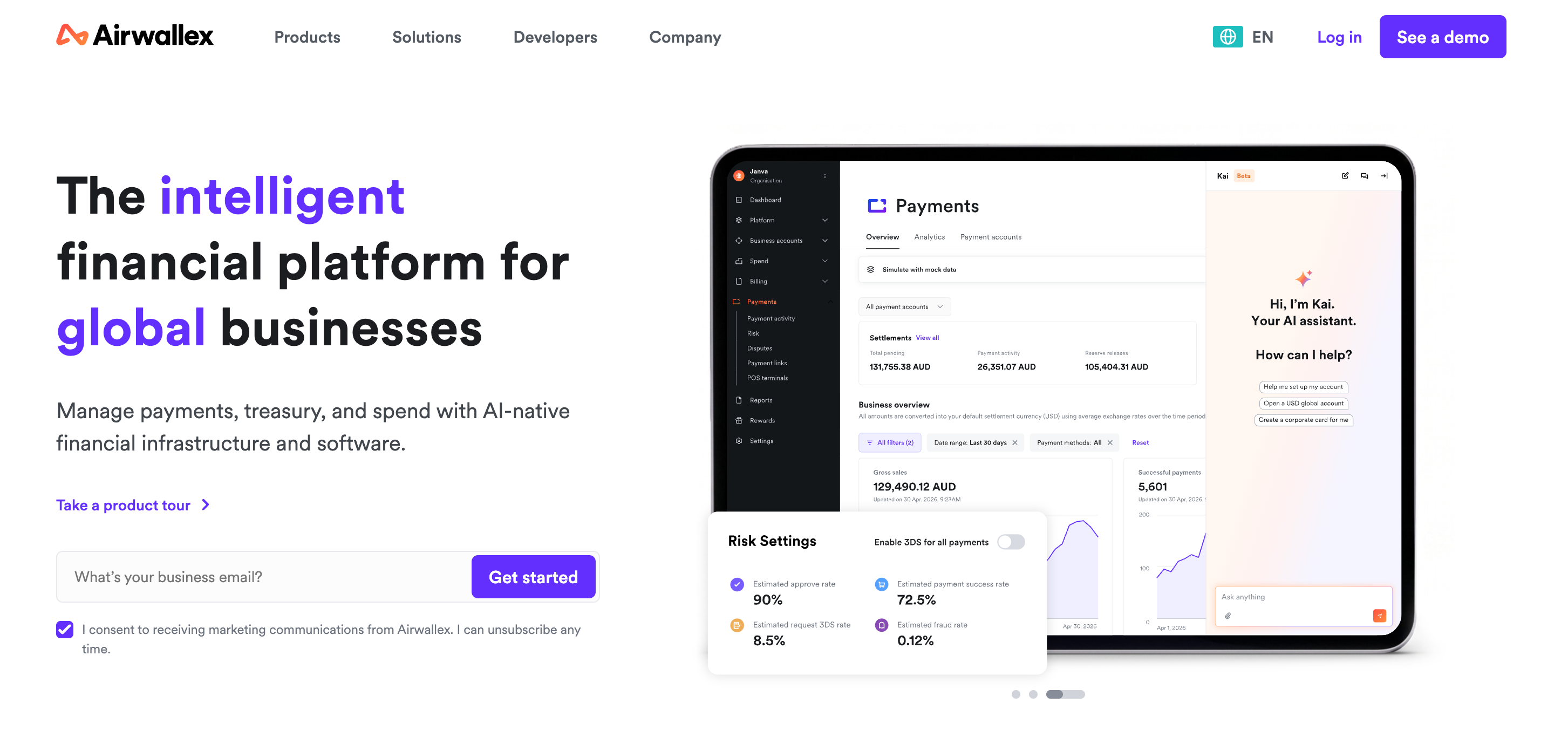
Airwallex is a broad business payments and multi-currency platform whose stablecoin payout capability is documented as an API-based route rather than a general web-app feature.
Features: Airwallex supports automatic currency conversion for localized checkout and multi-currency settlement. Its transfer API documentation includes conversion and digital-wallet fields, while its stablecoin documentation describes programmable payout routes. The stablecoin payout requirements indicate that stablecoin payments are currently available through an API route.
Limitation: Stablecoin payments are currently documented as API-only and are not supported in the Airwallex web app. This means businesses should treat stablecoin payouts as an integration project, not a switch-on dashboard feature.
Best for: Businesses with engineering resources that need payment acceptance, multi-currency settlement, and programmable stablecoin payouts. Before implementation, confirm the required stablecoin route, beneficiary wallet format, business registration data, and settlement currency.
5.BVNK
BVNK is a strong fit for stablecoin-native payment acceptance, treasury, and fiat settlement where a business wants digital assets and fiat accounts in one infrastructure layer.
Features: BVNK describes send, receive, store, convert, spend, and earn capabilities. It supports stablecoin-to-fiat conversion to USD, EUR, or GBP and offers hosted payment pages, payment links, API flows, and channel addresses. Its business payments offering is designed for companies accepting stablecoins while managing fiat settlement.
Limitation: BVNK documentation says bank payments may run at set times on business days. Withdrawals can take one to three business days, with possible delays for manual review, weekends, or holidays. A buyer should compare the quoted stablecoin-to-fiat amount with the expected bank credit after the payment-run schedule and any review.
Best for: Businesses accepting stablecoins while needing fiat settlement and programmable payment flows. The key diligence question is the all-in customer rate after the blended market rate, commercial margin, bank payout, and network costs.
6.Circle
Circle is best understood as institutional stablecoin and payment infrastructure for organizations building or integrating stablecoin-enabled money movement, rather than as a simple consumer currency converter.
Features: Circle describes USDC wallets, custody, minting, redemption, blockchain interoperability, payment orchestration, compliance workflows, and stablecoin settlement. Its payments infrastructure covers use cases such as business-to-business payments, merchant settlement, payroll, and payment-service-provider workflows. The Circle stablecoin payments network presents USDC as infrastructure for institutional payment flows.
Limitation: The implementation model is infrastructure- and partnership-oriented. Buyers may need integration, onboarding, regulatory review, and local payout partners instead of a simple self-serve conversion account.
Best for: Financial institutions, fintechs, payment providers, and enterprises embedding USDC-based payment flows. Circle is infrastructure for building stablecoin payment flows, not the same buying experience as a retail exchange. Businesses should assess whether they need USDC minting, redemption, wallet infrastructure, and local payout connectivity.
7.Coinbase

Coinbase is best suited to exchange-style execution and liquidity access when a business already has an exchange workflow, rather than end-to-end supplier payment operations.
Features: Coinbase Exchange supports stablecoin and fiat trading pairs. Its fee documentation distinguishes stable-pair pricing, trading fees, network fees, and USDC-to-USD conversion fees. The platform is useful when a business needs exchange execution and stablecoin liquidity.
Limitation: The conversion-fee schedule does not by itself provide local-currency payout coverage, difficult-corridor access, supplier workflow controls, or unified cross-border reconciliation. A zero conversion fee on one pair does not equal zero total cost across trading, withdrawal, network, banking, and payout steps.
Best for: Businesses that need exchange execution, stablecoin liquidity, and a clearly documented USDC-to-USD conversion schedule. Model the complete path from wallet deposit to exchange conversion to bank withdrawal, including network fees, settlement timing, and compliance review.
Stablecoin conversion risks to check before choosing a platform
Stablecoins are designed to track a reference asset, but their market price can move below or above the intended peg on secondary markets. The Federal Reserve has described stablecoins as private money subject to run risk and has noted that depegs have occurred in its discussion of stablecoin risks.
Circle states that USDC is backed by highly liquid cash and cash-equivalent assets and is redeemable 1:1 for US dollars through the applicable redemption process. However, secondary-market pricing can still differ from issuer redemption conditions, as described in Circle’s transparency materials. Tether’s legal terms state that one USD₮ is redeemable for one US dollar, less fees where applicable, subject to supported conditions in its legal terms.
Before choosing a platform, compare reserve transparency, redemption access, supported blockchains, issuer and platform controls, wallet screening, transaction finality, and fallback procedures. Do not treat USDC, USDT, and DAI as interchangeable without checking the reserve model, redemption path, liquidity, network support, and jurisdictional availability.
Before a large conversion, confirm whether the platform quotes the asset against USD, uses direct issuer redemption, or executes a secondary-market trade.
How Fuze Business helps with global payments
Fuze Business brings sending, receiving, currency and stablecoin conversion, and settlement together in one business payment workflow. It supports businesses managing cross-border payments, supplier payments, and transactions involving supported currencies and stablecoins.
Businesses can view the FX rate and applicable fees before confirming a payment. The platform also provides banking-network connectivity, transaction tracking, and access to selected trade corridors, subject to availability and eligibility.
For finance teams paying overseas suppliers, the relevant considerations include the destination currency, supported payment route, conversion cost, compliance requirements, and expected settlement time.
Explore Fuze Business for global sending, receiving, conversion, and settlement capabilities. Availability, pricing, and settlement timing depend on the specific business, asset, jurisdiction, and payment corridor.