
Global payment settlement is the point when funds become available to the recipient and the transaction can move into reconciliation. It differs from payment initiation, clearing, foreign exchange conversion, compliance review, and final settlement. For a broader view of the full payment lifecycle, see our guide to cross-border transactions.
A transfer may appear instant at initiation but still face delays before the recipient can use the funds. Speed depends on corridor availability, operating hours, data quality, liquidity, FX handling, compliance checks, and the selected payment rail.
The G20 and Financial Stability Board framework evaluates cross-border payments through four separate goals: faster, cheaper, more transparent, and more accessible payments. Improving one does not automatically resolve the others.
Map where the payment slows down before changing providers
Start by tracing one payment from approval through recipient credit and reconciliation. A structured cross-border execution workflow can help teams identify where payment, compliance, FX, settlement, and reconciliation delays occur. Cross-border payments can involve payment service providers, correspondent or local banking infrastructure, FX services, compliance controls, settlement assets, and reconciliation processes.
A payment may be initiated quickly but settle later because of missing information, manual review, unavailable liquidity, local operating hours, FX conversion, or recipient-side processing. The earliest stage with recorded elapsed time, queue time, or exception handling is the first actionable bottleneck.
The Financial Stability Board’s targets for the end of 2027 call for 75% of cross-border wholesale payments to be credited within one hour. The remainder should be credited within one business day, with reconciliation completed by the end of the crediting day, according to the G20 cross-border payment targets.
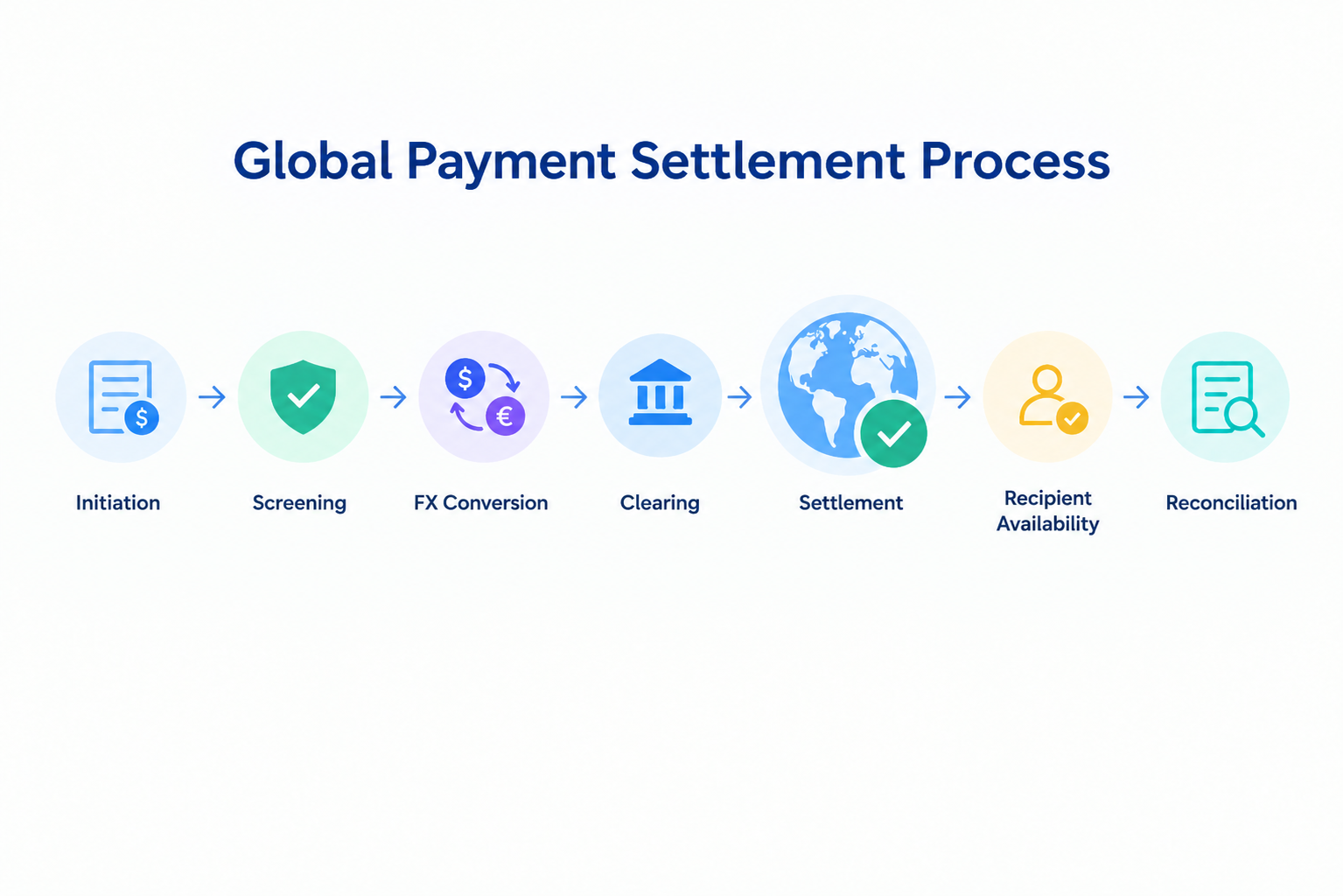
Use a timestamped map with these stages:
| Stage | Typical delay signal | Data to capture | Corrective action |
|---|---|---|---|
| Initiation | Approval or release queue | Approval time and owner | Set clear approval rules |
| Screening | Manual review or exception | Review status and reason | Complete required payment data |
| FX conversion | Currency unavailable or delayed quote | Rate, spread, and conversion time | Plan conversion before release |
| Clearing | Payment waits for a local or correspondent process | Submission and acceptance times | Select an available corridor and rail |
| Settlement | Recipient is not yet credited | Settlement timestamp and asset | Confirm liquidity and settlement route |
| Recipient availability | Funds are credited but not usable | Credit time and recipient status | Verify bank or wallet delivery requirements |
| Reconciliation | Payment cannot be matched internally | Reference and ledger match time | Use a consistent reconciliation reference |
Produce a timestamped payment map covering initiation, screening, FX, clearing, settlement, recipient availability, and reconciliation. If any stage has no timestamp or owner, the process is not yet measurable.
Prepare complete payment data and compliance inputs before initiation
Complete, standardized data reduces avoidable processing complexity. It can also improve the speed, price, and transparency of a cross-border payment.
Payment information may need to support sanctions screening, anti-money-laundering and counter-terrorist-financing controls, payment-purpose checks, beneficiary validation, and regulatory reporting. These controls should be prepared for, not bypassed.
The Financial Stability Board’s transparency target includes total transaction cost, FX and currency-conversion charges, expected delivery time, payment-status tracking, and terms of service. Record these details before release where the selected provider makes them available.
A complete beneficiary profile should include:
•Legal name
•Account or wallet details
•Bank identifiers, where applicable
•Destination currency
•Payment purpose
•Required supporting documentation
•Expected delivery time
•Internal approval record
Use a pre-flight check that returns either ready to send or a specific exception reason. The payment should pass only when beneficiary details are validated, compliance fields are complete, currencies are confirmed, and the approval record is attached.
The fastest rail still slows down when the payment arrives with incomplete data. Data-framework recommendations identify data alignment and interoperability as important parts of improving cross-border payment processing.
Choose the settlement rail that matches the corridor, currency, and delivery requirement
Choose the rail based on the complete delivery route, not on the technology used for one step. The right route must support the corridor, recipient currency, compliance treatment, liquidity, and reconciliation outcome.
Banking rails remain useful when a payment requires local-currency delivery, established bank-account connectivity, or corridor-specific compliance and operating procedures.
Stablecoin rails can provide an alternative settlement path in some cross-border use cases. However, the full payment may still require compliance screening, FX conversion, and delivery into a bank account or local payment system. BIS research describes potential speed or cost benefits for some use cases while also noting policy, risk, and financial-system considerations in its stablecoin analysis.
Compare routes using the following framework:
| Rail | Best fit | Main dependency | Settlement asset | Recipient outcome | Control to verify |
|---|---|---|---|---|---|
| Bank-funded payment | Local-currency delivery to a bank account | Banking connectivity and corridor procedures | Bank money | Recipient receives funds in the required currency | Account details and delivery route |
| Stablecoin-funded payment | Movement across supported digital-asset rails | Conversion, liquidity, and final delivery | Stablecoin, followed by required conversion | Recipient receives stablecoin or local currency | Compliance, wallet, currency, and off-ramp |
| Hybrid route | Stablecoin movement with banking final delivery | Coordination between digital and banking infrastructure | Stablecoin and bank money | Recipient receives local currency or account credit | Conversion, settlement status, and reconciliation |
For example, compare a bank-funded EUR payment, a stablecoin-funded payment converted into local currency, and a hybrid route. Select a route only after confirming the recipient’s required currency and account or wallet destination.
For each candidate rail, record corridor availability, expected delivery window, fees, FX spread, compliance requirements, operating-hour constraints, and reconciliation method. Reject any route that cannot meet the recipient-currency requirement or provide a clear settlement status.
The decision rule is simple: use the rail that minimizes total time to recipient availability, not merely the number of banking or blockchain steps.
Plan FX conversion and liquidity before the payment queue forms
Confirm the required settlement currency before releasing the payment. Delays often occur when the sender holds one currency or asset, while the recipient requires another.
BIS identifies FX services, settlement assets, and liquidity availability as factors that add complexity to cross-border payments in its project Rialto report.
Before initiation, record:
•Amount sent
•Source currency or asset
•Required recipient currency
•FX rate or spread
•Conversion charge
•Intermediary or receiving fees
•Expected amount delivered
•Settlement window
•Approved conversion route
Operating-hour gaps can also create timing friction. Weekends and public holidays affect jurisdictions differently. The BIS notes that aligned payment-system hours can improve speed and reduce liquidity costs and settlement risks.
A payment passes the liquidity gate when the source asset, conversion path, expected recipient currency, rate or spread disclosure, and settlement window are recorded before initiation.
Depending on the corridor, the operational plan may include holding the required currency before release, converting before a local cut-off, or using a stablecoin-funded route where available. The route must still confirm that the recipient receives the required currency.
Track settlement status and reconcile from one operational record
Settlement is not complete when a payment is merely sent. The recipient must be able to use the funds, and the sender must match the transaction to its accounting or treasury record.
The Financial Stability Board separates expected delivery time, payment-status tracking, and reconciliation in its cross-border payment targets. Use separate status labels so teams do not treat “sent” as “settled.”
A practical status model is:
1.Initiated
2.Under review
3.Compliance cleared
4.Sent
5.Converted
6.Recipient credited
7.Exception, if applicable
8.Reconciled
Centralized transaction data can reduce the need to check separate bank, wallet, FX, and accounting records. The visibility available will depend on the provider and corridor.
A useful transaction record should show the source amount, destination amount, conversion details, recipient, current status, and reconciliation reference. Close the process only when recipient credit is confirmed and the payment is matched to the internal ledger or payment reference.
Track these measures:
•Median time to recipient availability
•Percentage settled within the target window
•Exception rate
•Repair rate
•Time from settlement to reconciliation
A “sent” status alone is insufficient. Faster settlement should be measured by recipient availability and reconciliation completion.
Use Fuze Business to simplify faster global payment execution
Fuze Business’s platform supports cross-border payments through one account for sending, receiving, and converting funds. Its stated audience includes finance managers, global trade companies, and supply chain managers.
The platform supports access to difficult trade corridors, a banking network, cross-border payments, enterprise-grade compliance, and faster settlement. Businesses can use currency and stablecoin conversion, stablecoin wallets, transaction monitoring, and stablecoin rails for speeding up payments.
The intended workflow combines banking connectivity and stablecoin rails within one operating process. This can make sending, receiving, converting, monitoring, and settling cross-border funds easier to manage.
If your business needs a simpler way to manage cross-border payments, collections, conversions, and settlement, explore Fuze Business.