

Finance managers, global trade companies, and supply chain managers often need more than a standard international bank transfer. Difficult corridors may involve fragmented payment infrastructure, multiple jurisdictions, currency controls, limited correspondent banking access, local documentation requirements, or heightened compliance obligations.
Cross-border payments are generally more costly, slower, less accessible, and less transparent than domestic payments, according to the Bank for International Settlements. This comparison reviews seven business payment providers for those operating conditions.
How we evaluated difficult-corridor payment tools
The evaluation prioritizes documented access to target corridors and local payment or settlement infrastructure. It also considers supported currencies, settlement speed, payment visibility, operational predictability, compliance, documentation, onboarding, and implementation requirements. Businesses can also review this cross-border payments guide when assessing the wider payment workflow.
The BIS overview of cross-border payments identifies challenges such as limited interoperability, different legal and regulatory frameworks, fragmented payment infrastructure, messaging-standard differences, and correspondent-banking concentration.
Fuze Business is the owned brand included in this comparison and is placed first for editorial reasons. Pricing is not compared because the supplied sources do not provide consistent pricing information for all seven providers.
A supplier-payment workflow involving China CNY, UAE AED, EUR, or stablecoin-to-fiat conversion should be tested with the provider before rollout. Support can depend on the entity, beneficiary, documentation, and transaction purpose.
Quick comparison of difficult-corridor payment providers
| Provider | Coverage | Key capabilities | Best fit | Key consideration |
|---|---|---|---|---|
| Fuze Business | Difficult corridors, including AED, CNY, EUR, USD, GBP & more. | Banking-network access, cross-border payments, and currency or stablecoin conversion | Trade teams needing unified cross-border payment operations | Exact corridor and onboarding eligibility |
| Airwallex | Collection in 130+ currencies; CNY is supported | Multi-currency collections and local CNY payment workflows | Businesses needing multi-currency accounts and collections | China payment documentation and entity eligibility |
| Thunes | More than 30 currencies and 50+ countries | Network-led business payments and local-currency delivery | Enterprises and payment providers needing business payouts | Exact corridor, beneficiary type, and payment purpose |
| Nium | 190+ countries and 100+ currencies | Stablecoin and fiat payout flows, including real-time payments in 100+ corridors | API-led global payouts and platforms | Pricing, onboarding, and exact local-rail availability |
| Wise Business | Defined CNY supplier-payment routes from selected currencies | Direct business transfers along supported corridors | Businesses making recurring supplier payments | Destination restrictions and business-payment eligibility |
| dLocal | 60+ emerging markets, including China and the UAE | Local pay-ins, payouts, and payment methods | Enterprise merchants and platforms in emerging markets | Whether the use case requires merchant infrastructure or treasury transfers |
| Rapyd | Local methods across 182 markets | Cards, bank transfers, e-wallets, cash, and stablecoins | Teams needing broad local-method coverage through one integration | Legal-entity requirements, pricing, and corridor-specific methods |
Use this table as a shortlist rather than a final approval. Request a written corridor matrix covering the origin country, destination country, send currency, receive currency, beneficiary type, settlement timing, required documents, limits, and rejection or return handling.
1. Fuze Business
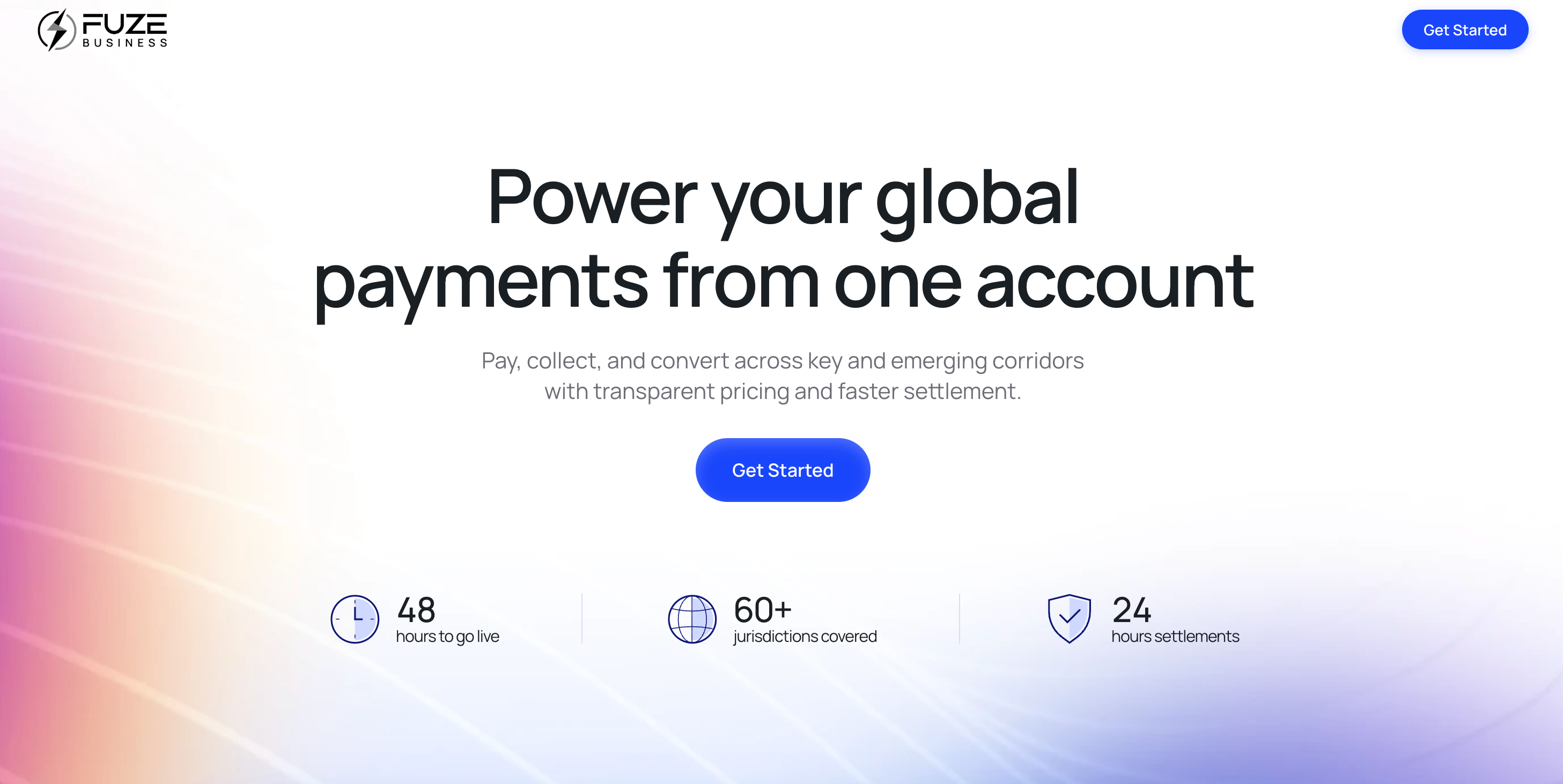
Fuze Business is positioned for businesses that need difficult-corridor access through a unified cross-border payment platform.
Features: The platform is described as supporting difficult trade corridors, AED, CNY, EUR, GBP, INR, SAR, and USD banking-network access, cross-border payments, currency and stablecoin conversion, enterprise-grade compliance, and faster settlement. Its positioning makes it a strong starting point when teams need fiat and stablecoin conversion within one business payment workflow. These capabilities should be confirmed for the company’s entity and use case through Fuze Business.
Limitation: Exact corridor availability, transaction limits, onboarding requirements, and settlement conditions should be confirmed before production use.
Best for: Finance managers, global trade companies, and supply chain managers handling cross-border transactions involving difficult corridors or multiple settlement currencies.
Before committing production volume, ask for supported origin-destination pairs, AED/CNY/EUR flows, conversion paths, settlement timing, compliance documentation, and exception handling. A trading company could test an AED-to-CNY or stablecoin-to-local-currency scenario first.
2. Airwallex
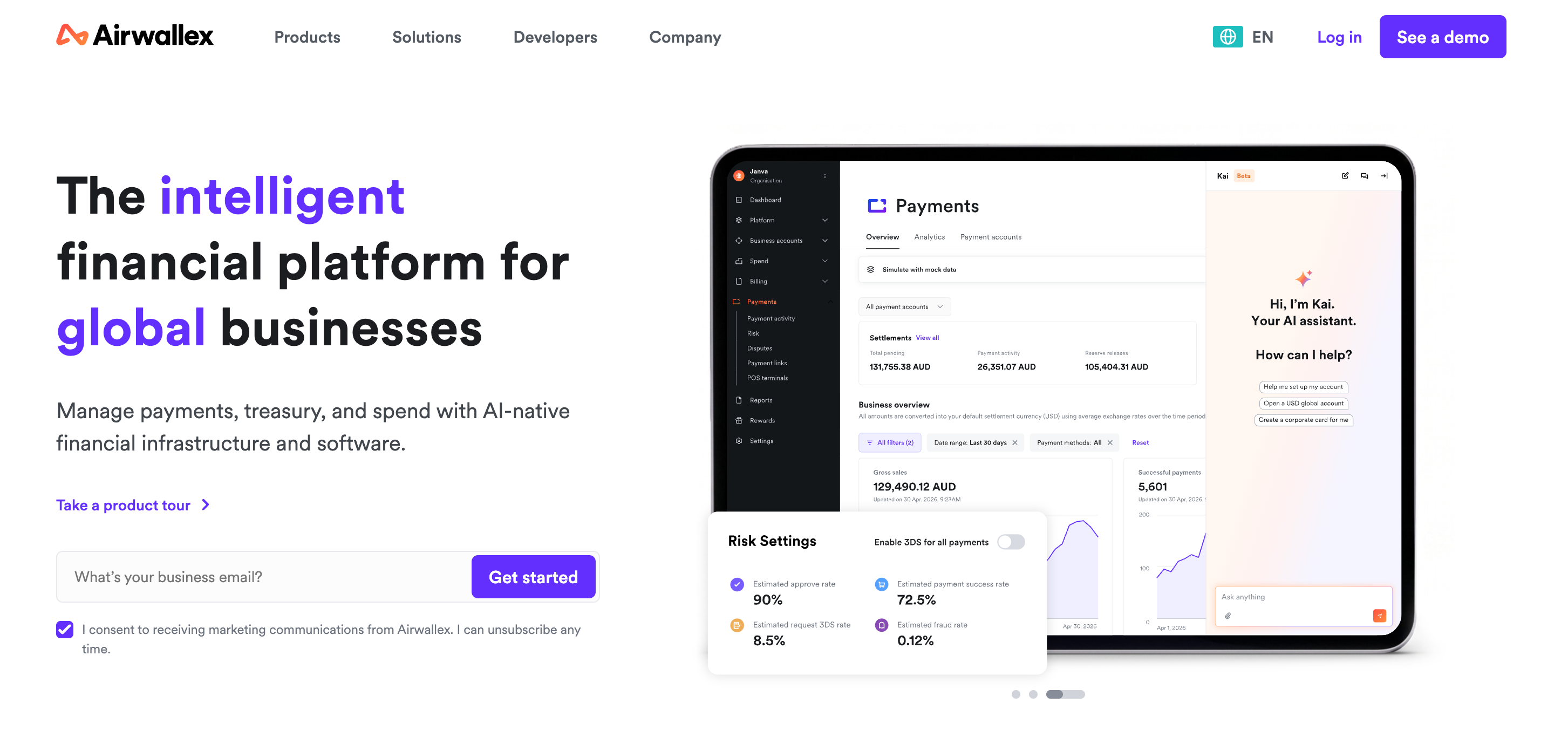
Airwallex fits teams that value broad currency collection but can supply the documentation required for specific local-market payments.
Features: Airwallex documents collection in 130+ currencies and lists CNY among its supported currencies. Its China payment guidance states that local CNY transfers to mainland China require declarant information and relevant order information.
Limitation: China payment availability is documentation-dependent. Currency and payment-method support can also vary by product, entity, and payment route.
Best for: Businesses seeking multi-currency collections and a documented process for China-related payments.
For a China supplier payment, confirm which legal entity can access the required account. Then check whether the route is local CNY or international and identify the required declarant and order information. Airwallex also distinguishes currencies available for collection from those available for payout through its global account documentation.
3. Thunes
Thunes suits organizations that prioritize a broad direct-network approach for business payments and local-currency delivery.
Features: Thunes states that its Business Payments solution supports more than 30 currencies and more than 50 countries, including China, Europe, India, Singapore, and the United Kingdom. Its developer documentation states that China reach can exceed 95% of bank accounts depending on beneficiary settings. It also identifies CNY transactions as using CIPS as a local clearing system.
Limitation: China payments may require supporting documents whose invoice amount, business names, and addresses match the transaction data. Incorrect documentation can lead to reversals.
Best for: Enterprises, merchants, banks, and payment providers needing network-based business payouts across multiple markets.
Validate the beneficiary type, exact corridor, available currency, required documents, sanctions screening, and failed-payment process. A China supplier payment should be tested with the exact invoice, registered names, addresses, and beneficiary information used in production.
4. Nium
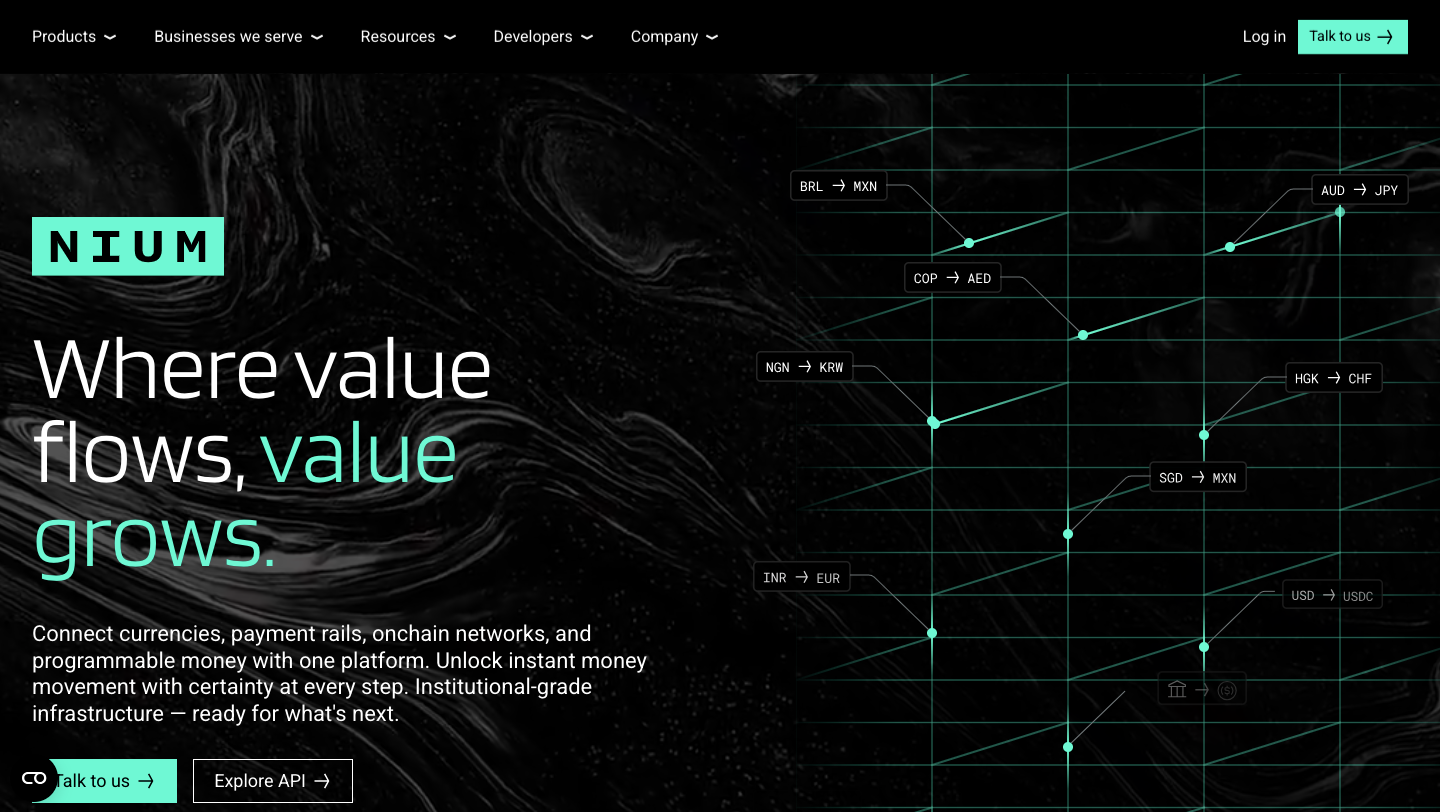
Nium is a strong fit for API-led businesses that need broad global payout coverage and multiple payment-rail options.
Features: Nium documents payouts to 190+ countries and multi-currency accounts covering 100+ currencies. It also describes stablecoin and fiat payout flows, account verification across 50+ countries, and real-time payments in more than 100 corridors through its cross-border payments offering.
Limitation: Published network breadth does not confirm eligibility, pricing, settlement speed, or payment-method availability for every origin-destination pair.
Best for: Marketplaces, platforms, banks, fintechs, and global businesses that need programmable payout infrastructure.
Ask whether the target corridor uses a local rail or correspondent route. Also confirm stablecoin availability for the intended entity, onboarding requirements, KYB checks, and beneficiary verification. A platform paying vendors in several countries should request a corridor-by-corridor matrix rather than relying only on global country and currency totals.
5. Wise Business
Wise Business is best considered for defined, supported supplier-payment corridors rather than as a universal difficult-market infrastructure layer.
Features: Wise announced business-to-business payments to China in CNY from USD, GBP, AUD, JPY, SGD, NZD, CAD, and HKD. Its current documentation describes CNY availability within China from a limited list of countries and identifies destination-specific restrictions for several currencies, as shown in its currency guidance.
Limitation: Corridor and beneficiary restrictions mean support must be checked at the transaction level, especially for business payments and emerging-market currencies.
Best for: Small and mid-sized businesses making recurring supplier payments along clearly supported corridors.
Confirm whether the recipient is a business or individual. Also check the destination currency, country, amount, beneficiary restrictions, and whether Wise uses a local or SWIFT route. A company paying a Chinese supplier should verify both its sending currency and the supplier’s CNY receiving route before relying on Wise as its primary corridor tool.
6. dLocal
dLocal is designed primarily for enterprise merchants and platforms that need local pay-ins, payouts, and payment methods in emerging markets.
Features: dLocal documents coverage across 60+ emerging markets, including China and the UAE. Its model combines local payment methods, local-currency pay-ins and payouts, local entities, licensing, FX access, and a single API, as described in its pay-in solution.
Limitation: dLocal’s strongest fit is merchant, marketplace, platform, and local payment infrastructure. It may not be the closest match for a corporate treasury team seeking general-purpose bilateral supplier transfers.
Best for: Global merchants, digital platforms, marketplaces, and businesses monetizing or paying users in emerging markets.
First identify whether the use case requires a pay-in, payout, split payment, or treasury movement. Then confirm local methods, settlement currency, and settlement schedule. A marketplace onboarding sellers in China, India, or the UAE should compare dLocal’s local payout model with a provider designed for direct supplier settlement.
7. Rapyd

Rapyd is a broad local-payments network option for businesses that need many payment and payout methods through one integration.
Features: Rapyd states that its global network provides local payment and payout methods across 182 markets. It supports cards, bank transfers, stablecoins, e-wallets, and cash methods through its global network.
Limitation: Broad market coverage does not establish that every method, currency, stablecoin, or payout route is available to every business entity or corridor. Rapyd directs businesses to check country-specific availability.
Best for: Product and payments teams building local collection or payout flows across many countries.
Confirm which legal entity must contract with Rapyd. Then identify whether the required method is a pay-in, payout, or settlement method, and check country-specific onboarding, compliance, and settlement conditions. Before selecting Rapyd, filter the target country and required method, then confirm availability with the commercial and compliance teams.
How Fuze Business helps with accessing difficult corridors
The right tool depends on the corridor, not just the provider’s total country count. Buyers should compare local-currency access, compliance requirements, settlement expectations, implementation effort, and exception handling.
Start with one repeatable corridor and document the payment journey from funding through recipient settlement. Businesses can also review cross-border transaction optimization when assessing costs, settlement processes, and operational requirements. Expand only after the workflow meets treasury, compliance, and reconciliation requirements.
For finance and trade teams seeking a unified way to manage difficult-corridor payments, explore Fuze Business and discuss the corridors that matter most to the company. Its listed capabilities include difficult-corridor access, banking-network access, currency and stablecoin conversion, enterprise-grade compliance, and faster settlement. Confirm the exact supported currency, beneficiary, documentation, and settlement requirements before rollout.