

Finance managers, global trade companies, and supply chain managers need a practical way to understand difficult trade corridors. The term describes a corridor with unusually high friction or limited predictability.
It is not a universally standardized legal classification. A corridor is the connected route and systems used to move goods, documents, information, and payments between trading parties.
Difficulty can affect the physical movement of goods and the financial movement of funds. These layers should be assessed separately before businesses manage them together.
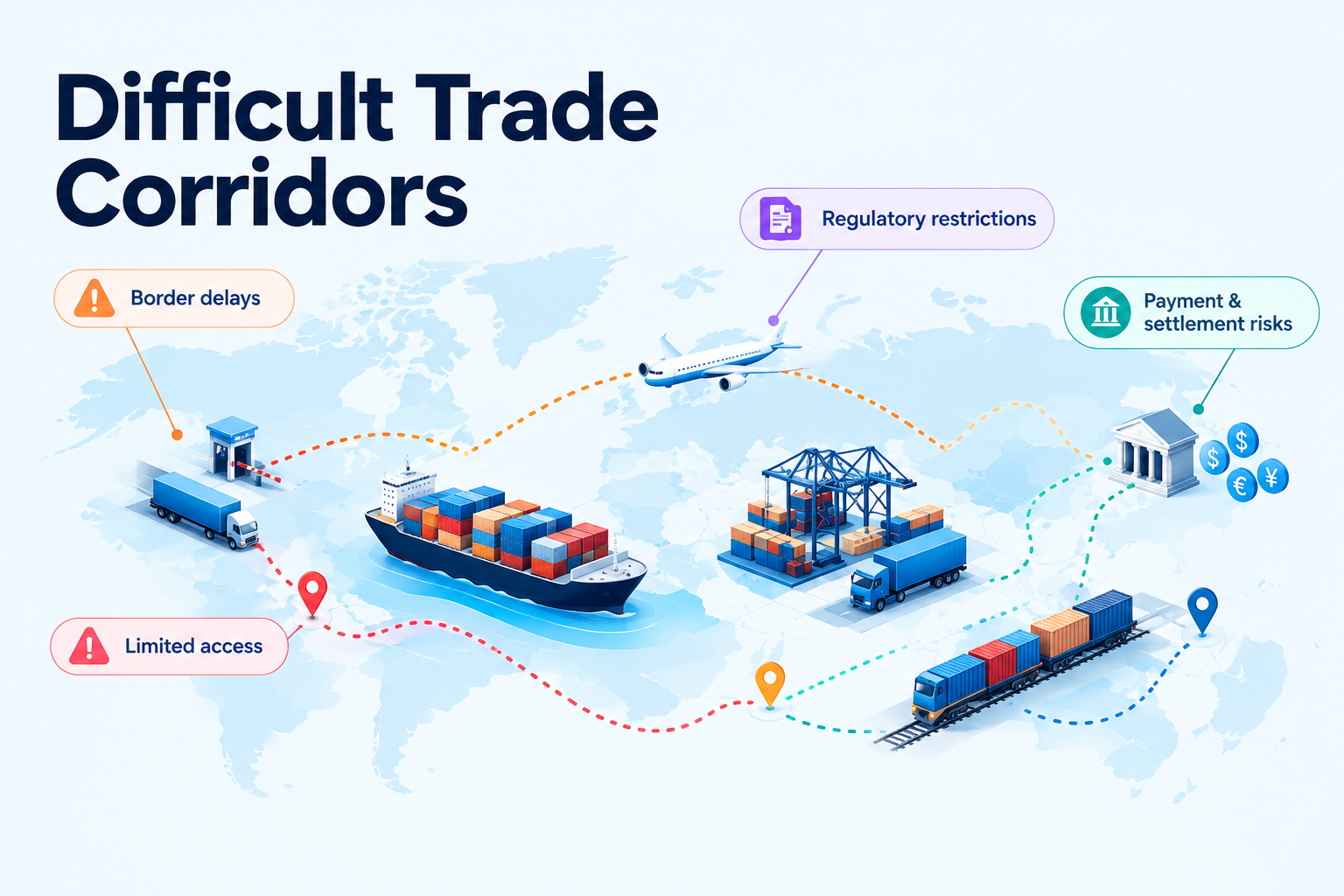
Define a difficult trade corridor before evaluating one
A difficult trade corridor is a cross-border route where moving goods or settling payments is unusually slow, expensive, restricted, or unpredictable.
A trade and transport corridor connects producers, consumers, ports, border crossings, roads, railways, warehouses, logistics providers, government agencies, and financial institutions. The World Bank’s corridor framework identifies national, bilateral, multilateral, multimodal, and intermodal corridor forms.
The function depends on the route. It may connect a landlocked country to a port, link countries directly, or connect ports.
The World Bank evaluates logistics through factors such as:
•Clearance efficiency
•Transport infrastructure
•Shipment arrangement
•Logistics competence
•Tracking capability
•Delivery timeliness
Trade facilitation focuses on simplifying, modernizing, and harmonizing import, export, and transit procedures. The World Trade Organization’s trade facilitation guidance places these procedures at the center of reducing trade friction.
“Difficult trade corridor” is therefore an explanatory umbrella. It describes routes where one or more systems create material delays, costs, access barriers, or uncertainty.
Distance alone does not make a corridor difficult. The relevant question is whether measurable friction affects trade execution. Examples include border delays, limited transport links, payment access constraints, or unpredictable settlement.
Trace how goods, documents, and payments move through a corridor
A corridor is not just a road or shipping lane. It is a connected operating system for goods, information, and money.
The physical movement of goods usually includes:
1.Contract and invoice
2.Compliance review
3.Currency and payment setup
4.Export clearance
5.Inland or international transport
6.Border or port processing
7.Import clearance
8.Final settlement and delivery
Several government agencies, shippers, transport companies, and logistics providers may participate. Coordination is therefore a central management challenge.
The WTO identifies paperwork, customs procedures, border coordination, transit rules, and transparency as important influences on trade time and cost. Its trade facilitation overview explains how these processes affect the movement of goods across borders.
The financial movement follows a separate path. Cross-border payments may move through correspondent banking chains or other payment arrangements. These flows can involve multiple intermediaries, currencies, compliance checks, and settlement steps.
The BIS analysis of payments without borders describes the complexity of cross-border payment arrangements. The IMF also examines how payment frictions can affect international transactions in its analysis of cross-border payments.
The physical and financial legs can fail independently. Goods may be ready while payment is delayed, or payment may be available while cargo remains held at a border.
A useful assessment should use two lanes: physical movement and financial movement. Each lane should have its own bottlenecks, owners, timelines, and performance measures.
Identify the five sources of corridor difficulty
Corridor difficulty usually falls into five connected categories. A single route may contain several categories at the same time.
1. Physical difficulty
Infrastructure friction includes weak roads, railways, ports, border facilities, warehouses, information technology, or multimodal connections.
These constraints can increase transit time, handling requirements, storage costs, and inventory exposure. Poor connections between transport modes can also create delays during transfers.
2. Procedural and regulatory difficulty
Regulatory friction includes duplicated documents, non-harmonized customs requirements, inspections, licensing, rules-of-origin requirements, and limited agency coordination.
The World Bank’s logistics indicators and the WTO’s trade facilitation materials show why clearance, coordination, and process quality matter. Delays can arise even when transport capacity is available.
3. Financial-access difficulty
Financial friction can arise when correspondent banking relationships or payment connections are limited, concentrated, expensive, or unavailable for a specific route.
Businesses may face failed transfers, delayed receipts, additional compliance reviews, or higher transaction costs. These issues can affect supplier relationships and customer commitments.
The BIS research on cross-border payment technologies discusses challenges involving access, cost, speed, transparency, and payment infrastructure.
4. Currency and settlement difficulty
Currency friction increases when counterparties need several conversions, bridge currencies, prefunding, or additional liquidity before funds reach the beneficiary.
The final amount received may differ from the expected amount. Businesses may also face foreign-exchange exposure during a long or uncertain settlement process.
5. Operational and predictability difficulty
Operational friction can involve transaction screening, differing national requirements, incomplete data, time-zone differences, local holidays, and manual exception handling.
The World Bank’s Logistics Performance Indicators highlight connectivity gaps, border and transshipment time penalties, and unpredictability at ports and inland checkpoints.
A useful diagnostic asks: Which constraint is causing the delay: access, approval, movement, conversion, settlement, or reconciliation?
Compare physical, regulatory, financial, and currency corridor risk
The right response depends on where the friction occurs. Payment tools cannot replace customs reform, transport planning, or infrastructure improvements.
| Difficulty type | Typical bottleneck | Business impact | Useful metric | Relevant response |
|---|---|---|---|---|
| Physical | Port, road, rail, warehouse, or transshipment constraint | Longer lead times and inventory exposure | Transit and dwell time | Route and logistics planning |
| Regulatory | Documentation, customs, licensing, or inspection friction | Holds, rework, and compliance costs | Clearance time and rejection rate | Process standardization and trade facilitation |
| Financial | Limited banking or payment access | Failed, delayed, or expensive settlement | Payment success and settlement time | Stronger banking and payment connectivity |
| Currency | Limited currency access or multiple conversions | Foreign-exchange exposure and uncertain received amount | Conversion cost and final amount received | Efficient currency conversion and settlement planning |
Physical corridor difficulty primarily affects the movement, handling, storage, and delivery of goods. Regulatory difficulty affects documentation, customs, transit permissions, inspections, licensing, and agency coordination.
Financial corridor difficulty affects whether funds can move through available payment networks and banking relationships. Currency corridor difficulty affects foreign-exchange access, conversion steps, liquidity needs, and settlement predictability.
For example, cargo may clear customs while payment remains pending. That problem is primarily financial or settlement friction, not a transport bottleneck.
Measure corridor difficulty by cost, speed, access, and predictability
Businesses should track more than headline transport time. A complete assessment covers both logistics and payment performance.
Useful measures include:
•Total landed or settled cost
•Total elapsed time
•Variance from expected time
•Clearance time
•Dwell time
•Transshipment time
•Payment initiation-to-receipt time
•Payment success rate
•Exception rate
•Documentation rework
•Number of intermediaries
•Funds received compared with funds sent
The World Bank reported in its 2023 Logistics Performance Index release that an average of 44 days elapsed across potential trade routes. This period ran from container entry at the exporting country’s port to departure from the destination port, representing 60% of the time needed to trade goods internationally, according to the World Bank’s 2023 LPI release.
The 2025 LPI 2.0 uses shipment-level operational data from 2023–2024. It emphasizes speed, connectivity, time penalties, and unpredictability rather than relying only on perception-based rankings.
BIS research describes cross-border payments as generally slower, more expensive, and more opaque than domestic payments. Correspondent banking chains can contribute to this complexity, as explained in the BIS payments research.
Averages alone can hide operational risk. Two routes may have the same nominal transit time, while one has much wider delivery variance. Businesses can also use cross-border transaction optimization principles when reviewing payment costs, settlement times, and recurring corridor performance.
The more difficult route may be the one with fewer predictable delivery windows. Predictability affects pricing, working capital, customer commitments, and supplier relationships.
A corridor becomes operationally difficult when its cost or uncertainty affects business decisions. Separate route-level facts from provider capability claims. A payment platform may improve payment access or settlement workflow without changing the border, transport, or sanctions environment.
Use stronger payment and settlement access to support difficult corridors
A corridor strategy should match the intervention to the bottleneck. Logistics and customs problems require logistics, process, or public-sector measures.
Payment and currency constraints require financial connectivity, currency conversion, compliance processes, and settlement capabilities. These functions support the financial leg without replacing transport or regulatory systems.
Fuze Business is a unified platform for sending, receiving, and converting funds for global cross-border payments. Relevant capabilities include access to difficult trade corridors, banking network access, cross-border payments, currency and stablecoin conversion, faster settlement, and enterprise-grade compliance.
Difficult corridors combine friction across movement, regulation, banking access, currency conversion, and settlement. The right response starts by identifying the exact bottleneck instead of treating every delay as a transport problem.
When the financial leg is the constraint, businesses need dependable access, conversion, compliance, and settlement capabilities alongside their logistics processes.
Fuze Business helps businesses access difficult trade corridors through cross-border payments, banking network access, currency and stablecoin conversion, supported currencies including AED, CNY, and EUR, GBP and more, faster settlement, and enterprise-grade compliance.