

Fast global payments combine real-time or near-real-time payment systems with cross-border payments, foreign exchange, settlement infrastructure, and compliance controls.. Domestic fast-payment adoption is advancing quickly, but cross-border settlement remains uneven.
There is no single global adoption rate for fast cross-border payments. Performance depends on interoperability, currency conversion, operating hours, regulatory requirements, settlement assets, and corridor coverage. The G20’s end-2027 targets provide a useful benchmark for finance managers, global trade companies, and supply chain managers.
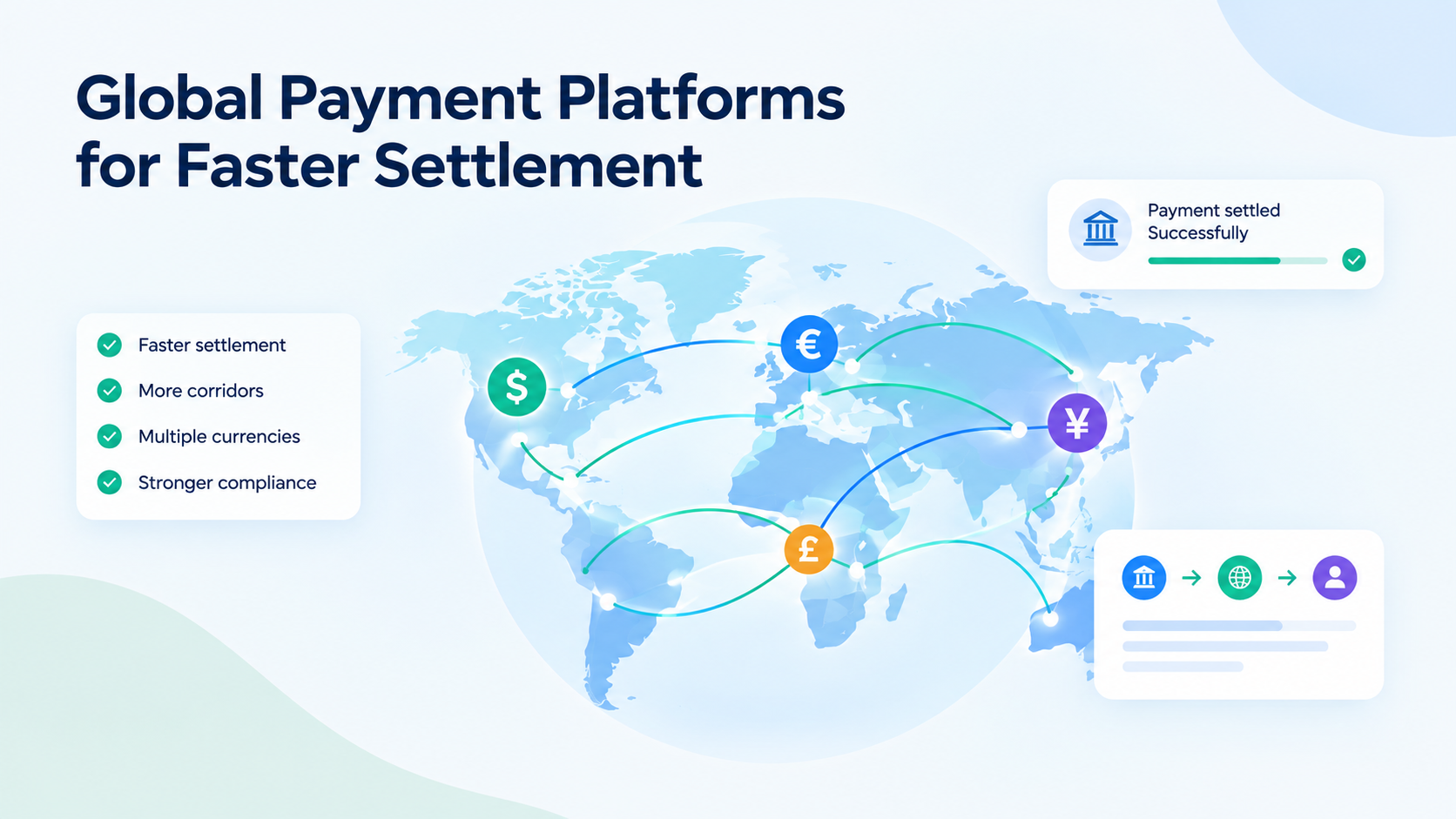
What fast global payments mean and why adoption is difficult to measure
Fast payments process payment messages and make final funds available to recipients in real time or near real time. The strongest systems operate on a near-24/7 basis, although the full experience depends on the connected payment infrastructure.
Fast payment systems and fast cross-border settlement are related, but they are not the same. Fast global payments are not simply domestic instant payments sent internationally. They require connected infrastructure, currency conversion, compliance, and settlement processes to work together across jurisdictions.
Three measurements should be kept separate:
•Domestic fast-payment availability: Whether a jurisdiction has an operating fast-payment system.
•End-user transaction adoption: How frequently individuals and businesses use that system.
•Cross-border payment speed: How quickly funds become available after moving between jurisdictions.
More than 100 jurisdictions had implemented fast-payment systems by late 2024. A separate BIS task-team inventory counted 88 systems in operation during the fourth quarter of 2024. These figures are not equivalent because they use different definitions and coverage.
A domestic instant payment can settle within one country through a single national system. A cross-border business payment may involve several providers, currencies, compliance checks, FX conversion, settlement assets, and operating windows. That added complexity explains why there is no authoritative global percentage for fast cross-border settlement across wholesale, retail, remittance, and business-payment corridors.
The strongest adoption signals
Fast-payment adoption is substantial in several markets, but it is not uniform. BIS data for 2023 shows fast payments represented 82% of cashless-payment volume in India and 63% in Argentina. The comparable figures were 7% in Australia and 1% in France. These differences show why a single global adoption rate would conceal major market variation. BIS payment data provides the comparison.
Per-capita activity also varies significantly. In 2023, fast-payment transactions per capita were highest in Brazil at 193 and Argentina at 179. Korea followed at 172, while Sweden recorded 95.
By total transaction count, the largest fast-payment markets in 2022 included:
•India: 48.6 billion transactions
•China: 16.6 billion
•Thailand: 9.7 billion
•Brazil: 8.7 billion
These figures describe domestic fast-payment activity. They indicate infrastructure readiness and user familiarity, but they do not prove that international payments settle at the same speed.
Adoption tends to be broader when central banks play an active role, non-bank providers can participate, and multiple use cases support regular usage. Cross-border connections can extend those benefits, but only where the relevant corridors, standards, access rules, and compliance arrangements are in place.
How current performance compares with the 2027 G20 targets
The G20’s end-2027 targets focus on whether recipients can access usable funds quickly. For wholesale payments, 75% should be credited within one hour. The remainder should be credited within one business day, with reconciliation completed by the end of the crediting day. These targets are set out in the G20 cross-border payment framework.
The corresponding retail target is that 75% of payments provide recipient access to funds within one hour. The remainder should provide access within one business day. The remittance target applies the same 75% within-one-hour standard in every corridor.
The framework also covers cost, access, and transparency. Providers should disclose total transaction costs, expected delivery times, payment status, and service terms.
Swift reported in 2025 that 75% of payments were reaching the beneficiary bank within ten minutes. That is a useful industry signal, but it is not the same as final recipient access to funds or completed FX settlement. Swift’s 2025 update distinguishes an important measurement issue.
Reaching a beneficiary bank is not always the same as the recipient having usable funds. A payment may still require screening, reconciliation, currency conversion, or account crediting before a business can use it.
The infrastructure trends accelerating cross-border settlement
The next adoption hurdle is interoperability, not merely launching another domestic instant-payment rail. BIS monitoring across 82 jurisdictions identifies interoperability, extended operating hours, data standards, and legal and regulatory alignment as central areas of progress. The latest monitoring survey tracks these developments.
Several infrastructure trends are shaping faster global payments:
•Fast-payment system interlinking: Connecting domestic systems can improve cross-border retail payments, provided corridors and operating rules are compatible.
•ISO 20022 migration: About 80% of payment systems in the latest monitoring evidence had migrated to ISO 20022 for domestic payments or planned to do so.
•Non-bank access: The proportion of fast-payment systems offering direct access to non-bank payment service providers reached 45%. The comparable figure for real-time gross settlement systems was 39%.
•Extended settlement windows: Longer operating hours can reduce delays caused by weekends, holidays, and time-zone differences.
•Tokenised settlement: BIS projects are testing tokenised central-bank reserves and commercial-bank deposits for atomic, multi-currency settlement.
•Compliance automation: Better data standards and connected systems can support more consistent screening and payment processing.
A corridor linking two domestic fast-payment systems may still fail to deliver an instant experience. Different operating hours, message standards, FX processes, or compliance requirements can create delays.
Tokenisation is an emerging infrastructure direction rather than a mature adoption benchmark. Project Agorá reported potential for atomic, multi-currency settlement, but broad commercial adoption remains a separate question.
Why faster settlement still needs FX, compliance, and risk controls
Faster payment messaging does not remove foreign-exchange settlement risk. This risk arises when one party delivers one currency but does not receive the other currency as expected.
BIS data from April 2025 found that 36% of average daily FX settlement used payment-versus-payment arrangements that eliminate FX settlement risk. Another 54% used methods that mitigate, but do not eliminate, the risk. The remaining 10% used gross bilateral settlement that was fully exposed to settlement risk. BIS FX settlement data shows why speed and settlement safety remain separate dimensions.
Cross-border payments also involve compliance, market infrastructure, FX services, settlement assets, and settlement procedures. Non-bank payment service providers can expand delivery channels and offer faster or more convenient options. However, regulatory and supervisory approaches vary across jurisdictions.
For business users, the practical definition of fast should include three factors: fast, usable, and controlled. A useful payment should provide:
•Predictable delivery: The business can estimate when funds will arrive and become available.
•Usable funds: The recipient can access the money, not merely see that a message reached a bank.
•Controlled execution: FX, compliance, reconciliation, and settlement-risk processes are appropriately managed.
A supplier payment may be transmitted quickly but remain operationally incomplete. Currency conversion, screening, beneficiary credit, and reconciliation may still need to finish.
How Fuze Business helps with faster global payments
Domestic fast-payment adoption is already substantial in several markets. Cross-border speed still depends on connected infrastructure, FX, access, and compliance. Businesses need to assess the complete payment workflow, not only message transmission time.
Fuze Business provides cross-border payments and transactions, corridor access, banking network access, faster settlement, currency conversion, stablecoin conversion, and enterprise-grade compliance through one platform.
It supports businesses working across currencies and markets, including AED, CNY, EUR, GBP, INR, SAR, and USD.This can help finance managers, global trade companies, and supply chain teams coordinate payments across difficult corridors and manage conversion requirements.
Businesses can evaluate a global payment platform by checking its corridor access, banking connectivity, supported currencies, FX processes, funds-availability measures, and compliance controls. For businesses looking to simplify faster cross-border payments, explore Fuze Business.