

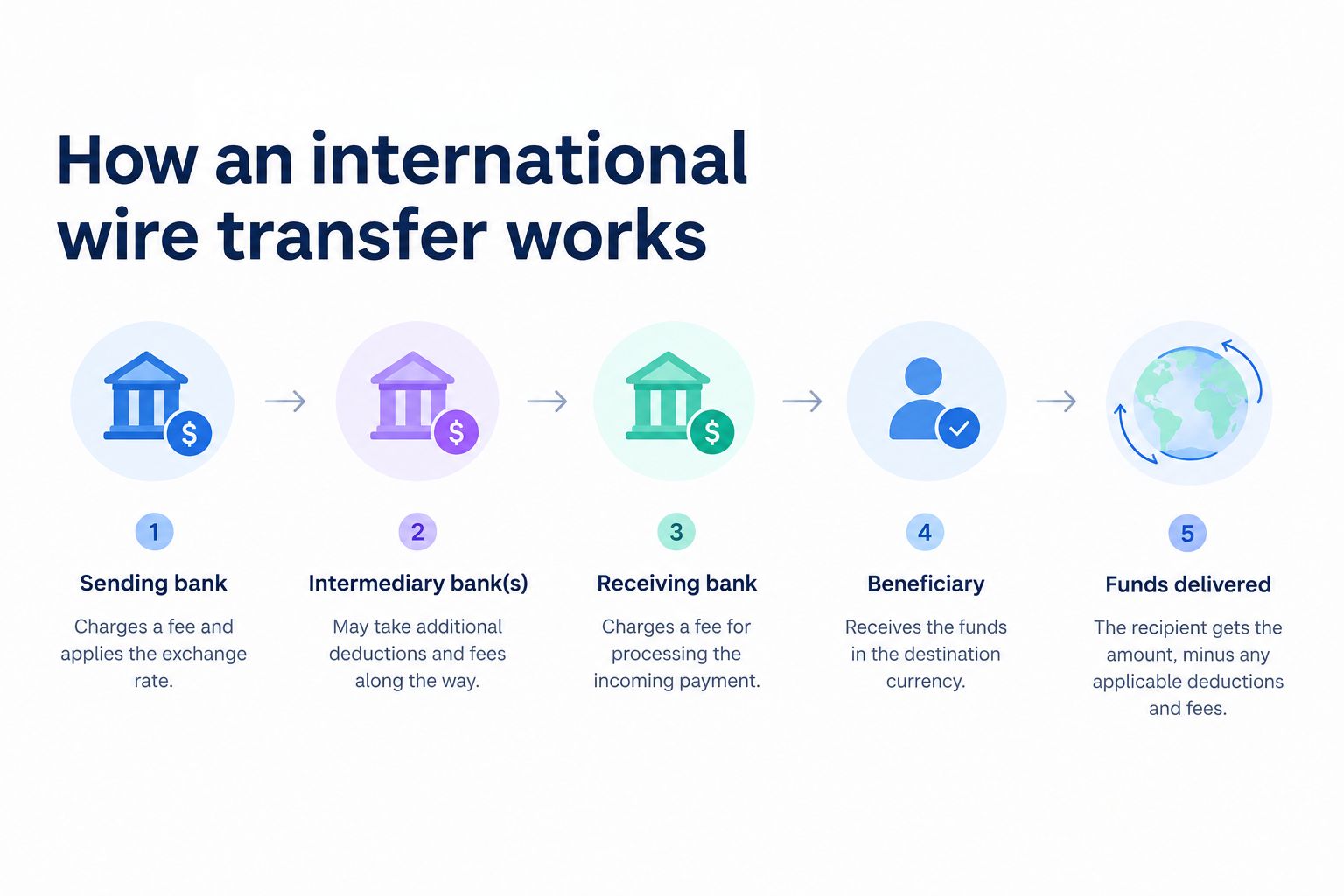
An international wire transfer is a cross-border payment. It may involve the sending bank, one or more intermediary institutions, and the recipient’s bank.
The visible outgoing fee is only one part of the total cost. Businesses may also pay through the exchange rate, intermediary deductions, receiving-bank fees, and taxes.
This guide is for finance managers, global trade companies, and supply chain teams evaluating payment options. Compare the amount paid, exchange rate, total fees, amount received, settlement timing, corridor coverage, and operational requirements.
Do not choose a route based only on its advertised wire fee. Fee-allocation instructions such as OUR, SHA, and BEN can also affect who absorbs deductions. Their detailed treatment belongs in an intermediary-fees review.
What makes up the full cost of an international wire transfer
The full cost can include fees charged by several institutions, plus the cost embedded in the foreign-exchange rate. The cheapest wire fee is not necessarily the cheapest payment.
For covered remittance transfers, CFPB disclosures distinguish provider fees, taxes, covered third-party fees, the exchange rate, and the amount expected to reach the recipient. These categories provide a useful framework for business payment reviews.
| Cost component | How it affects the payment |
|---|---|
| Sender fee | The sending bank’s charge for initiating the wire |
| Intermediary deduction | A charge taken by a bank involved in routing the payment |
| Receiving fee | The beneficiary bank’s charge for processing the incoming payment |
| FX markup | The difference between the provider’s customer exchange rate and a comparison rate |
| Taxes | Applicable taxes charged as part of the transfer |
| Amount received | The destination-currency amount available to the beneficiary |
| Settlement time | How long it takes for funds to become usable |
A provider can charge no separate wire fee and still earn revenue through an exchange-rate markup. Intermediary or final-institution charges may also reduce the amount received, depending on the route and fee arrangement.
For a USD-to-EUR business payment, ask for a quote showing the USD debited, the applied USD/EUR rate, all disclosed fees, Businesses can use a currency converter to compare currency values when estimating international payment amounts. Any estimated third-party deduction, the EUR amount expected to arrive, and the expected availability date. CFPB guidance supports comparing these elements rather than reviewing the outgoing fee alone.
How major banks price international wires
Major banks use different pricing models for international wires. Fees can vary by currency, initiation channel, account type, and transaction size.
Bank of America lists a $45 fee for international wires sent in U.S. dollars. It lists no separate wire fee for international wires sent in foreign currency, while stating that exchange-rate markups apply to those wires. Bank of America’s wire information explains these distinctions.
Chase’s published personal-account schedule lists $50 for an international wire initiated with banker assistance, $40 for an online international USD wire, and $5 for an online international foreign-currency wire. The schedule also states that the foreign-currency fee is waived at or above a stated $5,000 equivalent threshold. It lists a $15 incoming-wire fee, with a waiver condition tied to how the transfer was originally sent.
| Provider | Online USD wire | Online foreign-currency wire | Incoming wire | FX markup disclosure | Conditions |
|---|---|---|---|---|---|
| Bank of America | $45 for international USD wires | No separate wire fee listed | Check current schedule | Markups apply to foreign-currency wires | Currency and account conditions may apply |
| Chase | $40 in the published schedule | $5 in the published schedule | $15 in the published schedule | Spread applies to foreign-currency wires | Banker assistance, account, and threshold conditions may apply |
| Wells Fargo | Check current schedule | Check current schedule | Check current schedule | Markup stated | Third-party and other-bank fees may apply |
Wells Fargo states that its foreign-exchange rate includes a markup. It also warns that third-party or other-bank fees may apply in addition to its listed charges.
These examples are not universal market averages. They show how pricing varies between banks and payment methods. Fee schedules can change, so verify the current schedule for the exact account, currency, corridor, and payment size.
A business comparing Chase and Bank of America should price both the stated wire fee and the destination-currency amount after applying the bank’s exchange rate. A lower visible fee may not produce the lower all-in cost.
What recipients and intermediary banks may charge
The recipient or an intermediary bank may charge fees even when the sender has already paid an outgoing-wire fee. The exact deduction depends on the route, currency, banks involved, and fee arrangement.
An international payment may pass through one or more intermediary institutions before reaching the beneficiary bank. Chase explains that intermediary-bank fees and receiving-bank processing fees can increase the total cost.
Wells Fargo also states that third parties or other banks may charge fees in addition to its own charges. The exact deduction is route-dependent, so do not treat one intermediary or receiving fee as a universal standard.
Before sending a payment, ask the recipient’s bank:
•What is the incoming-wire fee?
•Which intermediary route is likely?
•Does the bank support the required currency?
•Will it automatically convert incoming foreign currency?
•Will the recipient receive the full instructed amount?
OUR, SHA, and BEN are fee-allocation instructions that indicate who may absorb transfer charges. They can affect the final amount received, but the result still depends on the payment route and participating institutions.
The payment passes the cost-review checkpoint only when the sender can identify whether the recipient will receive the full instructed amount or a reduced amount after intermediary and receiving-bank deductions.
Why the exchange rate can cost more than the wire fee
The exchange rate can create a larger cost than the stated wire fee, especially for high-value payments. A fixed wire charge may stay the same while the FX cost increases with the payment value.
The foreign-exchange spread is the difference between the provider’s customer rate and a comparison or wholesale rate. It remains a cost even when a separate wire fee is waived. CFPB materials identify exchange-rate spread as a component of remittance-transfer cost.
Bank of America states that foreign-currency international wires may have no separate wire fee while exchange-rate markups apply. Chase states that its foreign-currency wire exchange rate includes a spread and may be less favorable than rates quoted online or in publications.
Wells Fargo states that its exchange rate includes a markup. The rate can vary by currency pair, transaction size, payment channel, and product type.
A useful review formula is:
Effective cost = sender fee + intermediary and receiving deductions + FX spread + taxes
For a large supplier payment, compare the provider’s quoted destination-currency amount with a clearly identified benchmark rate. Use the percentage difference as an FX-cost signal. Do not treat it as a definitive universal markup unless the provider discloses its methodology.
“No wire fee” should never be treated as “no transfer cost.”
How to avoid international wire transfer fees
You can reduce wire costs by comparing the full payment outcome, using lower-priced initiation channels, and checking the recipient’s likely deductions.
Start with these five questions:
1.What amount leaves our account?
2.What exchange rate is applied?
3.What can intermediary banks deduct?
4.What amount will the recipient receive?
5.When will the funds be usable?
Where a bank’s schedule prices online wires below banker-assisted wires, use online initiation if it meets your internal controls. Compare sending U.S. dollars with sending the recipient’s currency, including the applicable exchange rate and markup.
Also check whether the business account offers fee waivers, volume pricing, or threshold-based discounts. Ask the recipient bank for its incoming-wire fee and currency-conversion treatment.
Consider a non-bank or alternative provider only after confirming corridor support, compliance requirements, recipient-currency delivery, settlement expectations, and total cost. For a practical framework, see our guide to optimizing cross-border transactions. Fuze Business is one option businesses can evaluate against these criteria.
A route qualifies as lower-cost only when a quote or test payment documents the destination-currency amount, disclosed fees, expected deductions, and settlement window for the same corridor and payment size. Choose the route with the lowest verified cost to recipient availability, not the lowest headline fee.
How wire transfer fees impact your business’s bottom line
Wire fees affect more than the payment ledger. Repeated charges, FX spreads, recipient shortfalls, and delayed settlement can create broader operating costs.
Fixed fees become more material for frequent supplier, payroll, trade, and treasury payments. FX spread can also scale with payment value, making the exchange-rate component significant for larger invoices.
Intermediary deductions may create reconciliation differences between the amount approved, amount sent, and amount received. Delayed settlement can affect supplier release, shipment timing, working-capital availability, and payment exception handling.
A payment is not operationally cheap if it creates repeated repair work or recipient shortfalls.
| Metric | Calculation | Why it matters |
|---|---|---|
| Effective cost per payment | Total fees and FX cost divided by payment count | Shows the average cost of each transfer |
| Cost as a percentage of value | Total transfer cost divided by payment value | Shows how material costs are at different payment sizes |
| Recipient shortfall rate | Payments received below the instructed amount divided by total payments | Identifies deduction and routing problems |
| Median time to availability | Median time from initiation to usable funds | Measures settlement performance |
| Exception rate | Payments requiring repair or investigation divided by total payments | Shows operational friction |
| Reconciliation time | Staff time spent matching and resolving payments | Captures indirect processing cost |
For a monthly supplier corridor, compare a 12-month baseline of total fees, FX variance, payment exceptions, and settlement time against the proposed alternative. Approve the change only if the business case improves the required cost and service measures.
How to compare bank wires with alternative global-payment approaches
Compare payment routes across five dimensions: all-in cost, settlement time, corridor and currency coverage, compliance requirements, and reconciliation visibility.
Traditional bank wires may be appropriate when the beneficiary requires established bank-account connectivity or a specific local-currency delivery path. Alternative providers may combine banking connectivity with other settlement rails, but the route can still require FX conversion, compliance screening, liquidity, and final delivery into a bank account or local payment system.
| Payment approach | Potential fit | Questions to verify |
|---|---|---|
| Bank wire | Established bank-account connectivity and required local-currency delivery | What are the full fees, FX rate, route, and settlement time? |
| Specialist money-transfer provider | Specific corridors or currency needs | What currencies, compliance checks, and recipient delivery methods are supported? |
| Unified business payment platform | Businesses managing sending, receiving, and conversion in one workflow | Does it provide transparent pricing, required controls, and reconciliation visibility? |
| Stablecoin or hybrid settlement route | Supported workflows requiring alternative settlement rails | Is the corridor eligible, compliant, liquid, and able to deliver the required currency? |
Ask: Can this route move the required currency through the required corridor, under the required compliance process, within the required settlement window?
Reject any option that cannot document the recipient currency, fee treatment, compliance path, and expected settlement outcome for the exact corridor under review.
How Fuze Business helps with faster global payments
International wire fees are rarely limited to one visible bank charge. Businesses should compare the full cost, recipient amount, FX rate, settlement time, and operational effort.
Fuze Business uses banking-network connectivity and stablecoin rails. Learn more about stablecoin cross-border payments and how stablecoin rails can support international payment flows. Its stated approach is designed to reduce correspondent hops, provide transparent pricing, and support faster settlement than traditional multi-day correspondent-banking chains. Stablecoin rails may also support lower FX costs than traditional routes, but the result depends on the corridor, currency, payment size, and approved pricing evidence.
Explore Fuze Business if your team needs a more transparent way to send, receive, and convert funds across supported corridors.