
Finance managers, global trade companies, and supply chain managers need payment tools that match their operating models. The right option may support suppliers, employees, contractors, or other partners across several currencies and countries, with each cross-border transaction requiring the right corridor, currency, payment rail, and controls.This is an editorial comparison, not an independently audited performance ranking. We evaluated cross-border reach and currency handling first, followed by payee workflows, automation and controls, and implementation fit.Fuze Business is featured first because it is our owned brand; this does not imply comparative test results.
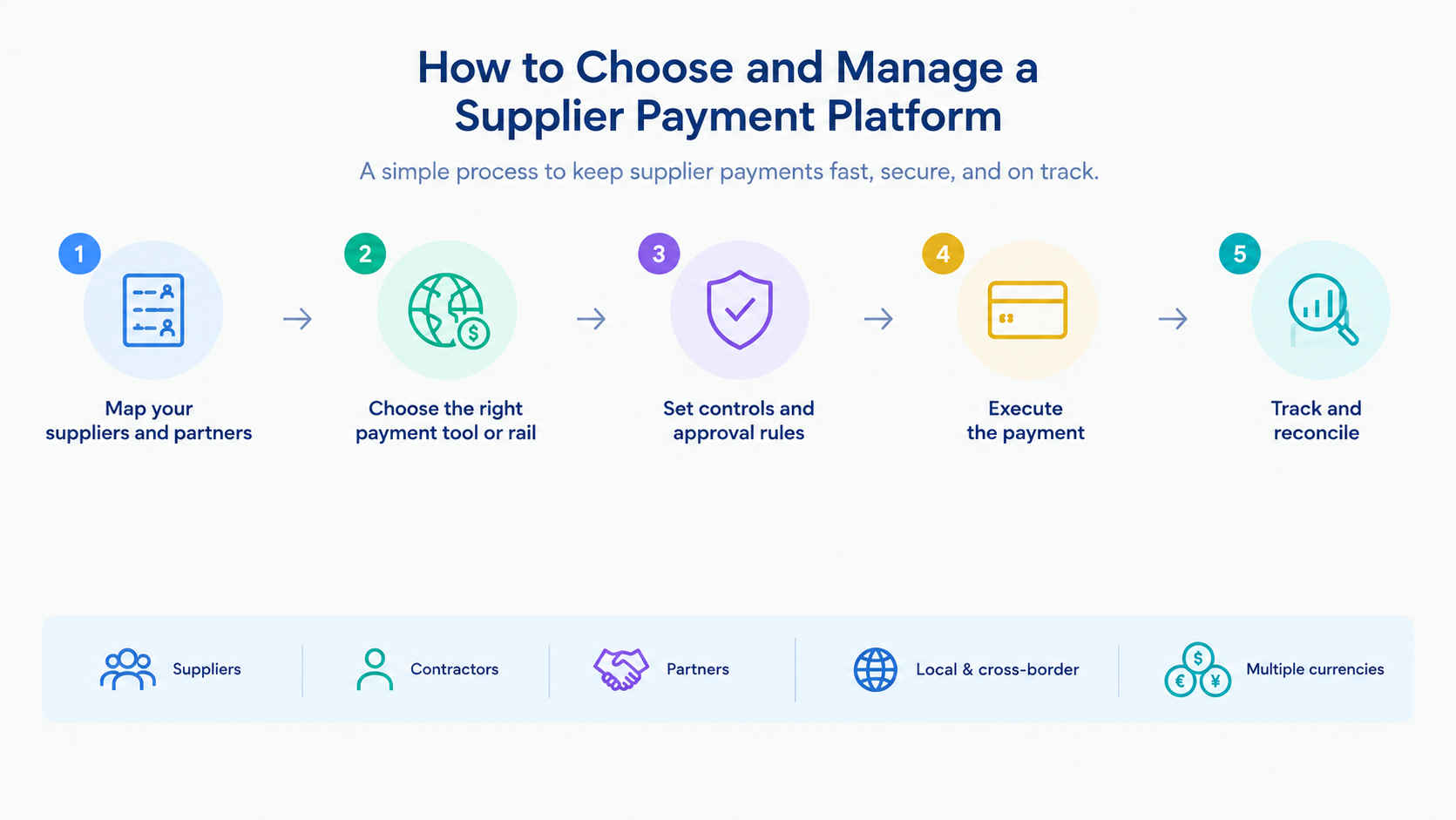
How we evaluated supplier and partner payment tools
The comparison uses four dimensions, in this order:
1.Cross-border reach and currency handling
2.Supplier, contractor, or partner payment workflows
3.Approvals, batch payments, and accounting automation
4.Implementation and integration fit
The tools have different primary use cases. They include cross-border payment platforms, global business accounts, AP automation systems, and SMB bill-pay tools.
| Tool | Best for | Standout capability | Main limitation |
|---|---|---|---|
| Fuze Business | Global supplier and partner payments | Cross-border payments and currency conversion | Confirm corridor coverage, fees, settlement, and onboarding requirements |
| Airwallex | Global companies needing accounts and spend controls | Global accounts, transfers, and spend management | Advanced controls are plan-dependent |
| Wise Business | Recurring international payments | Batch payments and multi-currency transfers | Features vary by country, currency, and route |
| Tipalti | Complex AP and mass payouts | Supplier onboarding and AP workflow automation | May exceed smaller teams’ needs |
| BILL | Approval-led AP operations | Payment methods and accounting connectivity | International payment availability requires route-specific confirmation |
| Melio | Flexible SMB bill pay | ACH, cards, checks, and batch payments | Features depend on eligibility and plan |
| Veem | Simple supplier and contractor payments | Payment tracking and payee visibility | Corridor, currency, and payment-method availability varies by account |
A global trading company should prioritize corridor availability and settlement reliability. A domestic SMB may place more weight on card-based bill pay and accounting simplicity.Before selecting a provider, confirm the relevant countries, currencies, payment rails, compliance requirements, settlement times, and account-eligibility rules.
1. Fuze Business
Fuze Business brings global payments, receiving funds, and currency conversion together in one platform.
Features: Fuze business provides access to difficult trade corridors, support currencies such as AED, CNY, and EUR, banking-network connectivity, and cross-border payments. We also support instant currency and stablecoin conversion, enterprise-grade compliance, and faster settlement. Learn more on the Fuze Business platform.
Limitation: Corridor-by-corridor availability, exact settlement times, onboarding requirements, integrations, and supported currencies beyond AED, CNY, and EUR require confirmation.
Best for: Finance managers, global trade companies, and supply chain managers managing cross-border supplier, team, and partner payments.A supply-chain finance team should confirm its trade corridor, payment currency, compliance process, and settlement target before moving a workflow onto the platform. For teams managing cross-border execution, this also means defining the workflow from payment initiation through settlement and reconciliation.
2. Airwallex
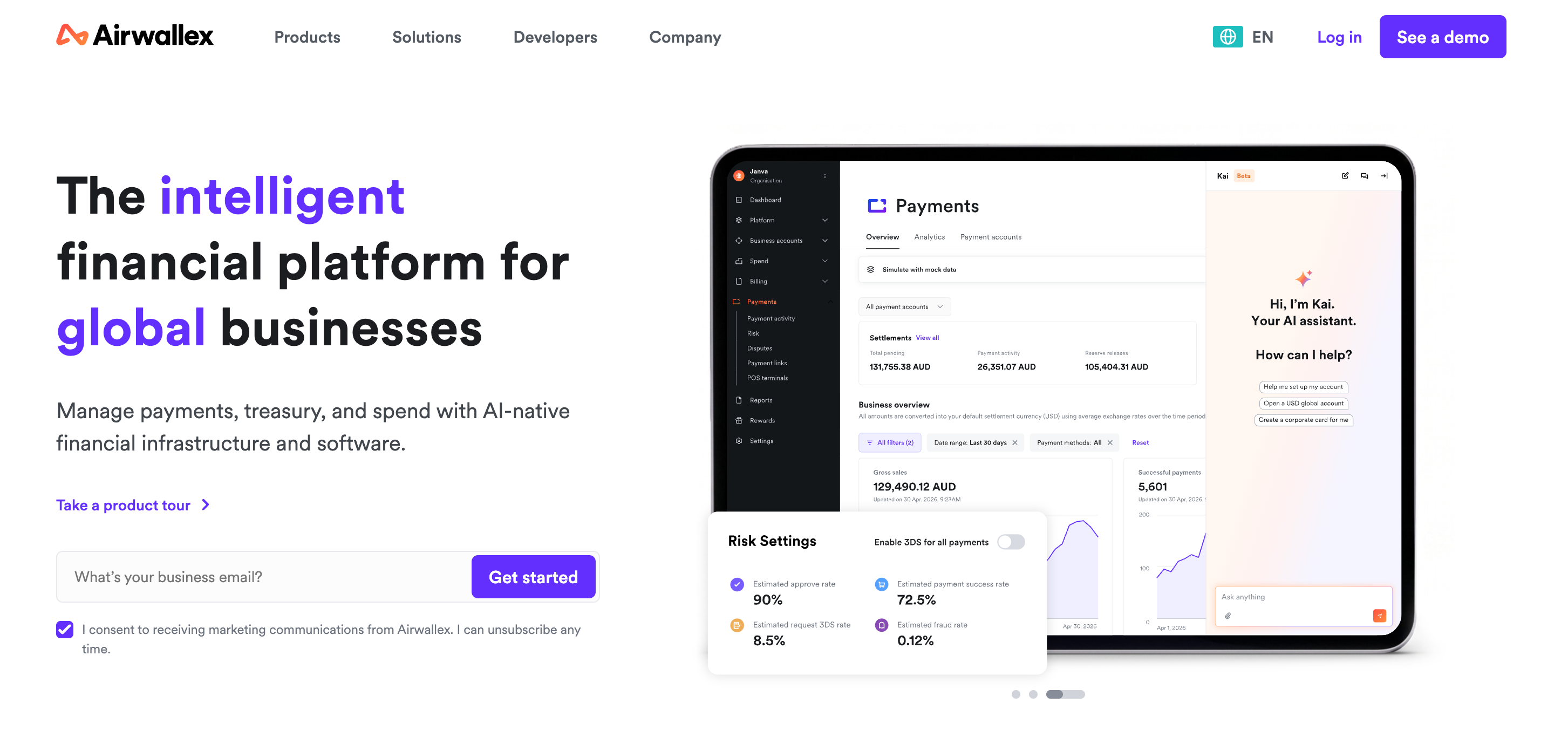
Airwallex combines global business accounts, transfers, spend management, bill pay, and finance integrations.
Features: Airwallex lists transfers to more than 200 countries and support for transfers in more than 60 currencies. Its capabilities include multi-currency accounts, batch transfers, bill pay, batched bill payments, corporate cards, and accounting integrations.Higher plans include vendor approval workflows. Airwallex also lists connections with Xero, QuickBooks, NetSuite, and Dynamics 365 Business Central through its business account and finance tools.
Limitation: Multi-conditional approvals, vendor approval workflows, purchase orders, and three-way matching depend on the plan.
Best for: Growing or global companies that want supplier payments, business accounts, spend controls, and finance integrations in one platform.A company paying suppliers in several currencies should compare its required corridors with Airwallex’s supported countries and currencies. It should also confirm which plan includes its approval controls.
3. Wise Business
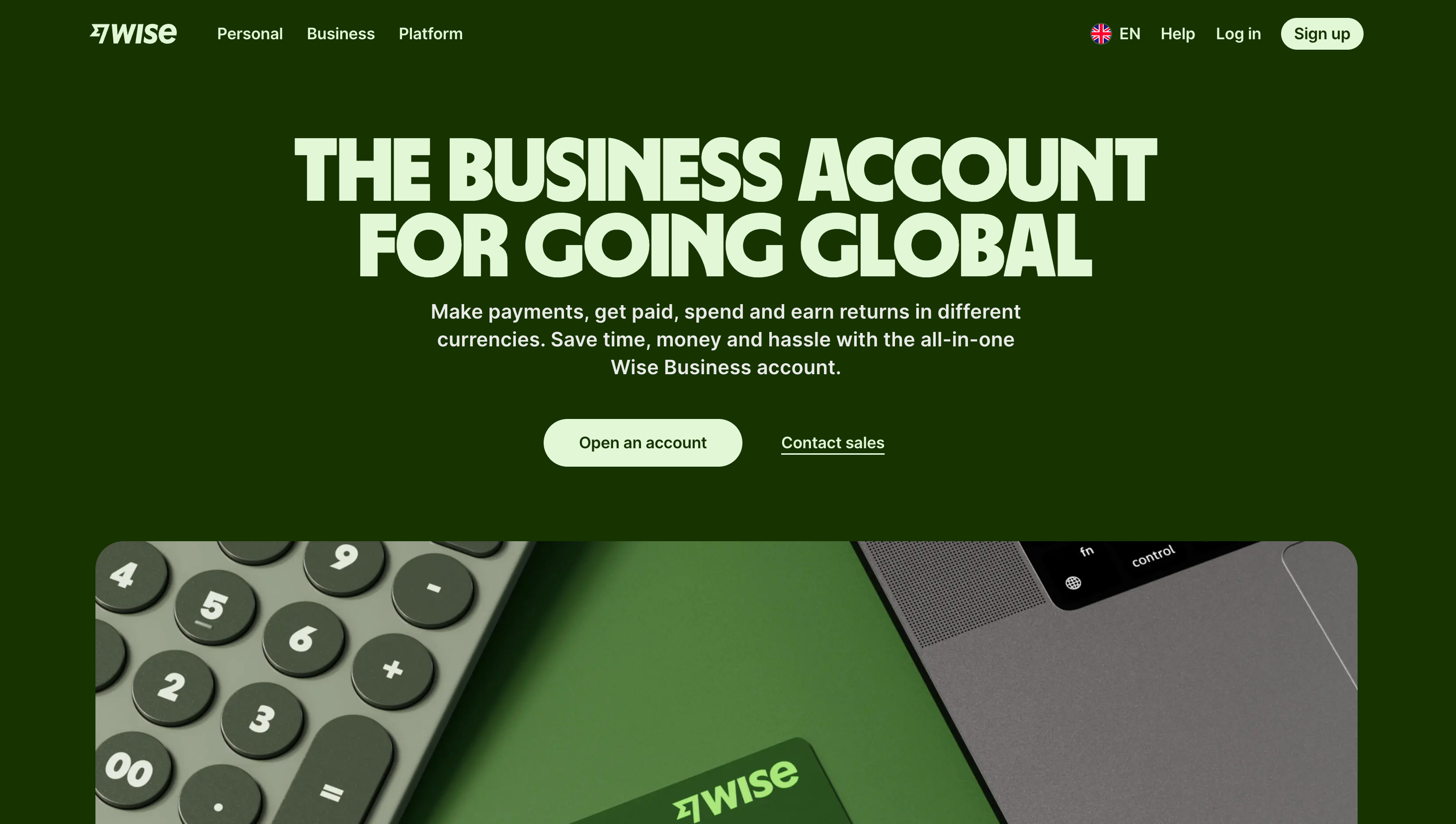
Wise Business suits companies prioritizing transparent international transfers, multi-currency balances, and batch payments.
Features: Wise Business supports international supplier and partner payments, multi-currency holding and conversion, local account details in supported currencies, and payments to recipients without Wise accounts. BatchTransfer supports up to 1,000 payments, while the platform also offers an API and accounting connections through its business payment services.
Limitation: Account-detail availability, payment speed, and eligible features vary by currency, country, customer type, and transaction route. Timing claims may also depend on individual circumstances.
Best for: Small and midsize companies, distributed teams, and ecommerce or service businesses making recurring international supplier, contractor, or partner payments.A finance manager with a contractor or supplier spreadsheet can test whether the required currencies and recipient countries support BatchTransfer.
4. Tipalti
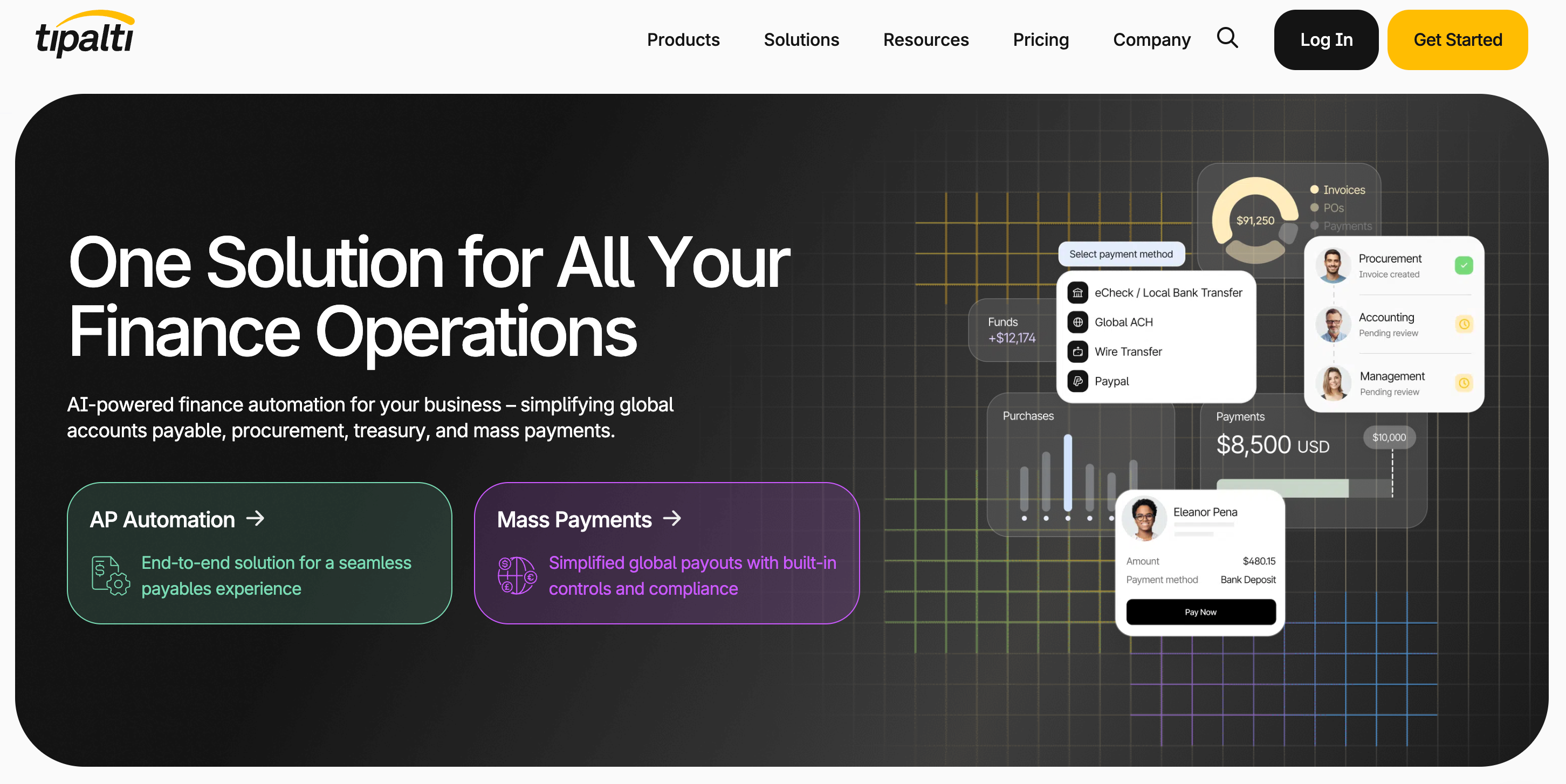
Tipalti is built for structured AP automation, supplier onboarding, invoice workflows, mass payouts, and global payee operations.
Features: Tipalti’s materials list supplier self-service onboarding, invoice processing, purchase-order matching, reconciliation, tax-compliance workflows, and AP automation. Its mass-payment capabilities cover more than 200 countries and territories using multiple payment methods.
Limitation: Tipalti’s broad AP and mass-payment features may exceed the needs of a small team. Custom implementation and enterprise modules may require sales engagement.
Best for: Mid-market and enterprise finance teams with complex supplier onboarding, distributed payees, multi-entity AP, or substantial compliance requirements.A manufacturer should compare supplier onboarding, invoice approval, purchase-order matching, tax, payment methods, ERP needs, and legal entities before adoption.
5. BILL
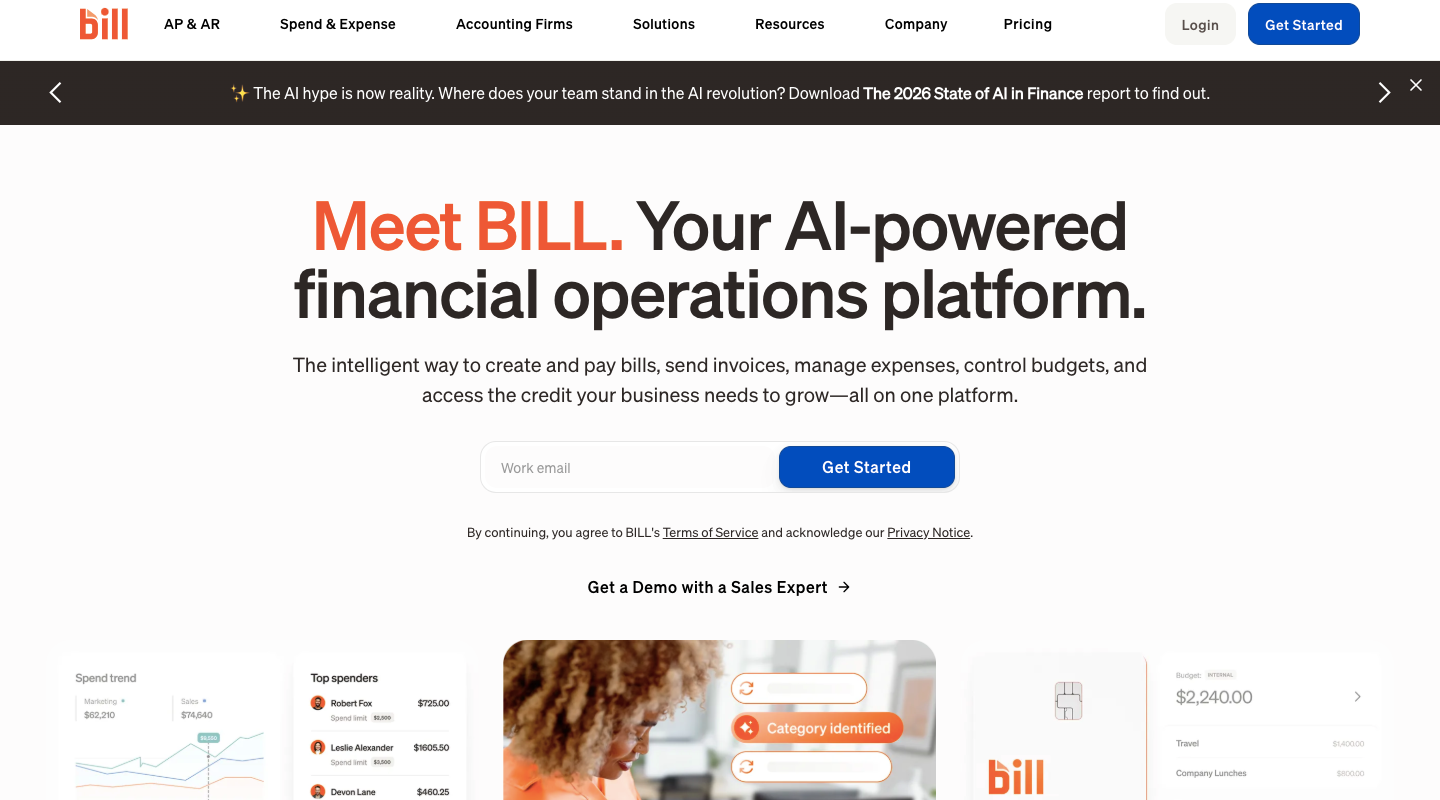
BILL suits organizations seeking AP automation, approval workflows, vendor connectivity, and several payment methods.
Features: BILL lists centralized bill management, automated approvals, ACH, virtual cards, credit-card and check payments, vendor-network connectivity, and accounting integrations. Applicable plans also include purchase requests, purchase orders, two-way matching, API access, and multi-entity capabilities through its payment services.
Limitation: International payment availability and supported payment methods require route-specific confirmation.
Best for: US-centered finance teams needing formal AP controls and accounting connectivity, with domestic and selected international payment options.An AP team should map its approval roles, ERP integration, vendor payment methods, and international payment volume against the relevant BILL plan.
6. Melio
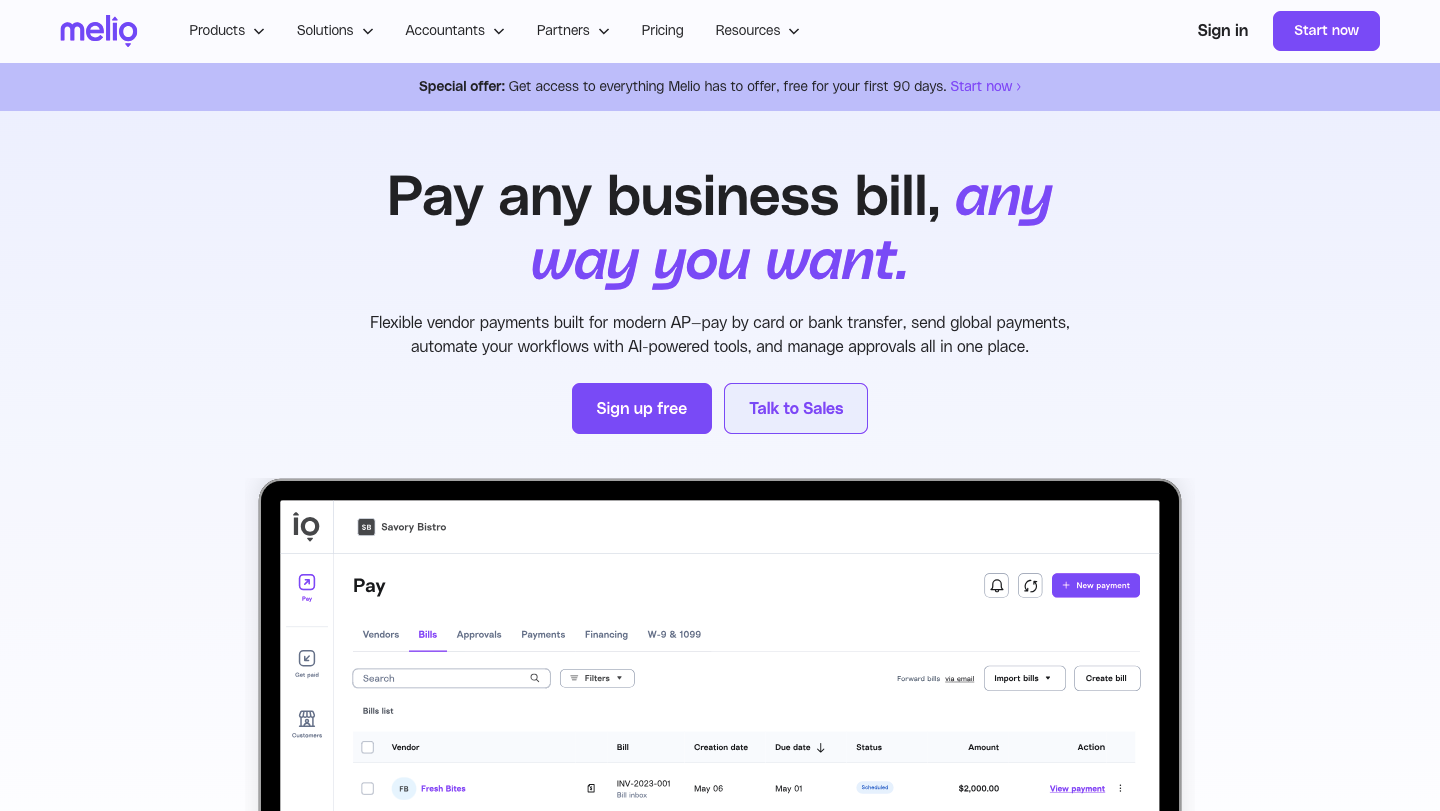
Melio focuses on flexible SMB bill pay through ACH, cards, checks, international payments, batch payments, and accounting synchronization.
Features: Melio lists vendor payments by ACH, card, wire, or check. It also supports international payments in US dollars or local currencies, batch payments, auto-pay, AI bill capture, approval workflows, W-9 collection, and connections with QuickBooks, Xero, and NetSuite.Vendors do not need to create Melio accounts to receive payments. The platform’s business payment features describe these options.
Limitation: Card, instant-payment, international-payment, financing, and free-ACH terms may depend on eligibility, currency, payment method, and plan.
Best for: Small and midsize businesses wanting straightforward vendor bill pay and the option to pay by card.A small distributor should compare its ACH volume, card-payment needs, accounting integration, and international-currency requirements across Melio’s plans.
7. Veem

Veem focuses on simple domestic and international payments for suppliers, contractors, and other business payees.
Features: Veem states that businesses can pay domestic and international suppliers and contractors in more than 100 countries and 70 currencies. It also lists payments using an email address or bank details, payment tracking, accounting connections, and approval workflows through its business payment service.
Limitation: Public materials do not guarantee that every corridor, currency, or payment method is available to every account.
Best for: Small businesses and lean finance teams seeking a simple payment experience with tracking and supplier-facing visibility.A small importer can test a representative supplier payment by country and currency and confirm accounting connectivity.
Choose the payment platform that matches your operating model
Payment-rail priorities and AP-software priorities are not the same. Global trade teams may need corridor access, currency conversion, compliance, and settlement. AP-led teams may prioritize invoice capture, approvals, matching, tax workflows, and ERP connectivity.
Fuze Business supports cross-border payments, access to difficult trade corridors, AED, CNY, EUR, banking-network connectivity, instant currency and stablecoin conversion, enterprise-grade compliance, and faster settlement. Before implementation, confirm supported corridors, currencies, payment limits, onboarding documents, settlement expectations, and integrations. A global supply-chain company could begin with one representative supplier corridor, validate compliance and settlement, then expand after finance and operations approve the workflow.
Fuze Business brings sending, receiving, conversion, settlement, and payment management into one workflow for supplier and partner payments. It also supports cross-border execution across supported corridors, with transaction visibility and compliance controls built into the payment workflow. Explore Fuze Business for cross-border supplier and partner payments.