

Getting paid in multiple currencies means accepting, holding, converting, or settling business receipts in more than one currency. This applies to exporters, marketplaces, software-as-a-service companies, global trade businesses, contractors, and companies handling customer or supplier-related funds across borders.
The concept includes several separate decisions. A business may receive funds in the payer's currency, hold a foreign-currency balance, or convert the funds immediately into its home or settlement currency.
Before choosing a setup, evaluate which currencies and corridors are supported. Also review where foreign exchange occurs, how fees are disclosed, how quickly funds settle, which compliance checks apply, and how transactions are reconciled.
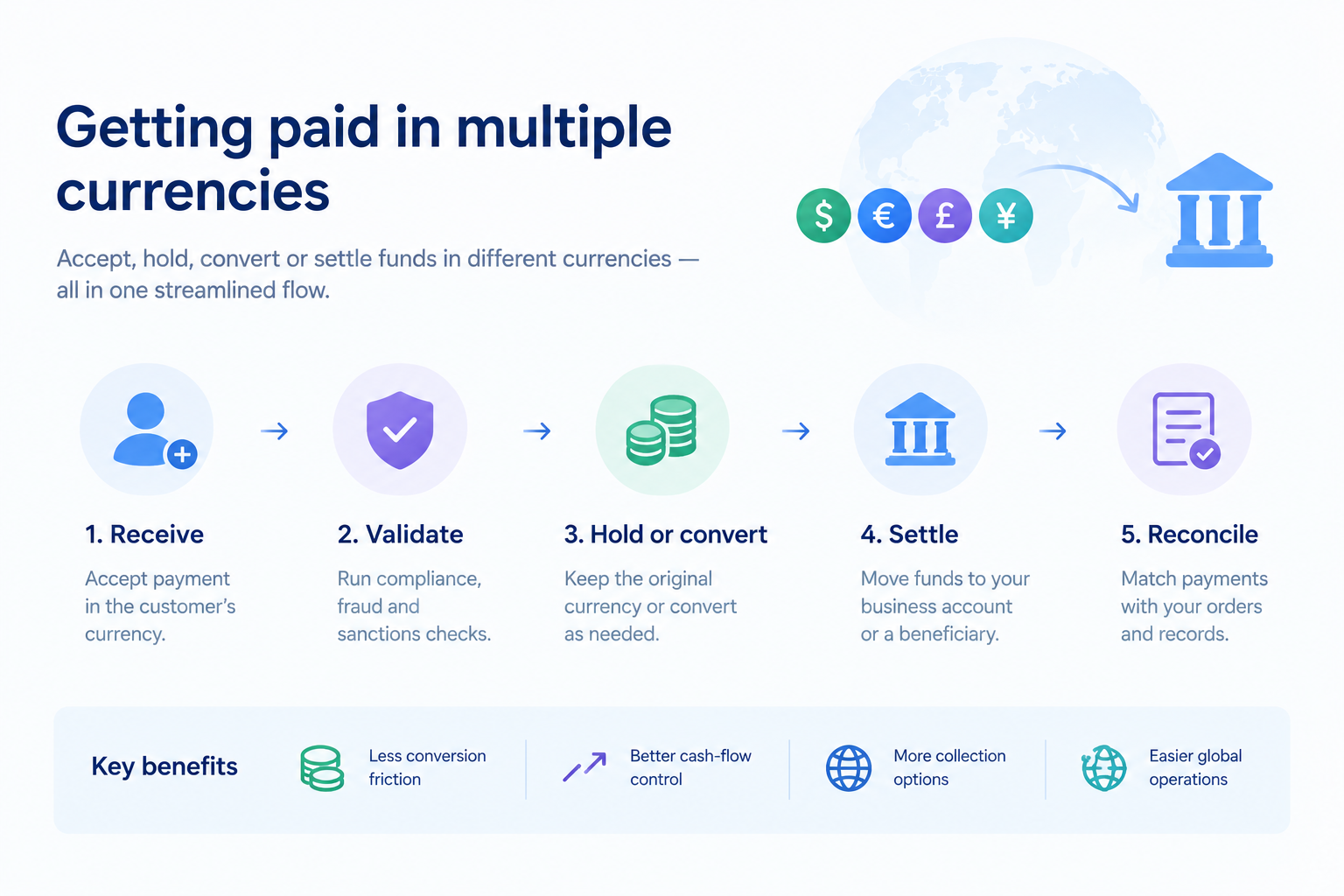
What does it mean to get paid in multiple currencies?
Getting paid in multiple currencies means a business can accept funds in more than one currency and choose when and how to convert or settle them. The process may include payer and beneficiary identification, currency selection, compliance review, payment routing, foreign-exchange conversion, settlement, notifications, and reconciliation.
Receiving a foreign-currency payment does not always mean the business keeps that currency. Some providers convert funds automatically or settle them in another currency. The payment route, account structure, and provider model determine what happens after receipt. Cross-border payment technology can involve multiple systems, jurisdictions, operating hours, intermediaries, and regulatory requirements.
Three states should be kept separate:
| State | What it means |
|---|---|
| Receive | Accept funds in the original currency. |
| Hold | Retain the original currency and its exposure. |
| Convert | Exchange the funds into another currency. |
| Settle | Make the funds available for use in a selected currency. |
For example, a company may invoice a customer in EUR, receive the funds in EUR, and later convert part of the balance into USD to pay a supplier. The workflow is clear when the company can identify the received currency, conversion event, applicable fees, settlement date, and reconciliation record.
How multi-currency payments move from payer to business account
A typical cross-border payment moves through initiation, validation, screening, routing, optional conversion, settlement, notification, and reconciliation. The payer may choose the currency, or the currency may be specified in a contract, invoice, or beneficiary account.
Conversion can occur before payment initiation, during routing, or when the recipient receives the funds. The payment currency can therefore change before final settlement. Cross-border payment targets also distinguish payment progress from final availability.
1.Invoice: The business specifies the amount and currency.
2.Payer sends currency: The customer or partner initiates payment.
3.Validation and compliance: The payment details, parties, and transaction are reviewed.
4.Routing: The payment moves through the relevant payment systems and intermediaries.
5.Optional FX conversion: Funds may be exchanged into another currency.
6.Settlement: Funds become available to the business or beneficiary.
7.Reconciliation: Finance matches the receipt to an invoice, order, or accounting record.
Delivery time and final availability depend on the currency, corridor, payment rail, intermediary structure, compliance review, operating hours, and data quality. A payment marked as initiated is not necessarily settled or ready for use. Global payment settlement speed should therefore be assessed against the specific corridor.
Before choosing a provider, confirm the receiving currency, settlement currency, expected delivery time, total cost, and tracking method. Finance should also be able to answer who paid, which currency was received, which rate and charges applied, when funds became available, and which invoice or order the receipt matches.
Core benefits of getting paid in multiple currencies
Multi-currency receiving can reduce unnecessary conversion steps and give businesses more control over payment timing. Its value depends on currency coverage, corridor access, fee disclosure, compliance requirements, and the provider's settlement model.
•Reduce avoidable conversions: A business may receive and retain the currency needed for a later payment obligation.
•Improve cash-flow timing: Holding funds can let finance teams choose when to convert, although it does not remove foreign-exchange risk.
•Simplify international collections: Accepting local or familiar currencies can support international sales, services, marketplaces, and supplier relationships.
•Match receipts with obligations: Customer receipts can be matched more easily with invoices or supplier obligations in the same currency.
•Increase visibility: Clear information about FX rates, charges, payment status, and settlement timing supports planning and reconciliation.
•Support broader market access: Businesses can collect across supported markets without forcing every payer into one currency.
The value is not simply accepting more currencies. It is controlling where conversion happens, when funds settle, and how each receipt is reconciled. Global payment capabilities should be measured against the business's existing single-currency process.
A benefit is measurable when the finance team can compare total cost, conversion timing, settlement availability, and reconciliation effort with its current process.
Multi-currency receiving use cases by business model
Different business models use multi-currency receiving for different operational reasons. Each model should define the payment direction, supported currencies, receiving destination, conversion policy, approval owner, and reconciliation process.
| Business model | Why receive multiple currencies | Main operational question | Validation signal |
|---|---|---|---|
| Global trade | Match buyer receipts with supplier obligations. | Which currency should be held or converted? | Invoices and payments reconcile without unexplained FX differences. |
| Marketplace | Collect and allocate funds across payees. | Can the ledger preserve currency and payer identity? | Every receipt maps to the correct merchant or order. |
| SaaS and subscriptions | Collect recurring payments from customers in different markets. | Can billing and ledgers record the correct currency? | Recurring receipts match customer accounts and invoices. |
| Supply chain | Receive export proceeds and pay manufacturers, distributors, or logistics partners. | Where should conversion occur? | Supplier payments follow the approved currency policy. |
| Contractors and agencies | Receive or send funds across borders. | Which corridors and settlement methods are available? | Payments meet eligibility, compliance, and settlement requirements. |
Exporters and global trade companies may receive payment from overseas buyers while managing supplier, freight, or inventory obligations in other currencies. A UAE-based trading company buying from China and selling into Europe may need to determine whether receipts arrive in EUR, whether supplier payments require CNY, and where conversion occurs. Paying suppliers globally can therefore require separate receiving and payment decisions.
Marketplaces and platforms also need to identify payers, preserve original currency and amount data, and decide whether to hold, convert, or settle funds for merchants or partners. The ledger must maintain enough information to connect each receipt with the correct payee, order, or transaction.
Compare receiving, holding, converting, and settling in multiple currencies
Receiving, holding, converting, and settling are separate capabilities. A provider may support one without supporting all four in the way a business needs.
| Capability | Core question | Main benefit | Main consideration |
|---|---|---|---|
| Receive | Can the business accept the required currency? | Broader collection options. | Coverage varies by corridor. |
| Hold | Can the balance remain in that currency? | More control over conversion timing. | It creates FX exposure and liquidity decisions. |
| Convert | Can the business exchange funds when needed? | Aligns funds with business obligations. | Rates, spreads, fees, and execution timing matter. |
| Settle | When and where are funds available? | Improves cash-flow planning. | Timing depends on the rail, compliance, and corridor. |
Receiving answers whether a provider can accept funds in the payer's or invoice currency. Holding answers whether the business can retain that balance instead of converting immediately. Converting concerns the exchange rate, timing, and charges. Settling concerns when and in which currency funds become available.
Tracking and reconciliation are separate control layers. A payment can be received without being matched to an invoice, order, shipment, or accounting record. Global payments capability should therefore include operational visibility, not only currency access.
A provider comparison is complete when finance can document the exact answer for each capability across every important currency and payment corridor.
Risks, costs, and controls to review before choosing a multi-currency setup
Multi-currency access improves flexibility, but it does not eliminate FX exposure, payment risk, or regulatory obligations. Foreign-exchange movements can change the home-currency value of receivables, balances, and future payment obligations.
Total costs may include sending fees, receiving fees, intermediary charges, FX spreads or conversion charges, and account or service fees. Compare the total amount received and the final settlement amount, rather than only the visible transaction fee. Cross-border payment costs can vary by route and payment method.
Compliance requirements may also require accurate payer, beneficiary, purpose, and transaction information. Requirements vary by jurisdiction and payment type. Payment transparency requirements should be confirmed for each relevant corridor.
Before implementation, businesses should:
•Confirm total costs and rate disclosure.
•Document who bears FX risk.
•Verify compliance requirements.
•Test a returned or rejected payment.
•Assign reconciliation ownership.
•Define approval thresholds and exception handling.
•Limit activity to approved currencies and corridors.
•Track the payment from approval through settlement.
Difficult corridors may involve limited banking access, currency restrictions, documentation requirements, regulatory complexity, and unpredictable settlement conditions. Faster processing is also not the same as settlement finality. Businesses should define the exact milestone they are measuring.
Treat the setup as ready only when a pilot payment produces a complete audit trail. That record should cover the invoice or contract, approval, conversion, settlement, and reconciliation.
How to get paid in multiple currencies with Fuze Business
Getting paid in multiple currencies can give global businesses more control over collections, conversion timing, settlement, and reconciliation. The right setup still depends on corridor coverage, costs, compliance, and operational controls.
Fuze Business provides a unified platform for sending, receiving, and converting funds across supported cross-border payment corridors. Its capabilities include banking-network connectivity, access to selected trade corridors, currency and stablecoin conversion, and support for business payment workflows involving currencies such as AED, USD, and EUR.
Businesses can use Fuze Business to manage cross-border collections, pay suppliers and partners, and convert currencies or stablecoins within supported payment workflows. Applicable FX rates and fees are shown before payment confirmation, while availability and settlement timing depend on the currency, corridor, counterparty, eligibility, and applicable requirements.
Explore Fuze Business to assess its global payment and conversion capabilities against your business's currency and corridor requirements.