

A wire transfer is an electronic instruction to move a fixed or determinable amount to a beneficiary. It usually travels through bank-operated payment systems.
The exact process varies by bank, country, currency, account type, approval policy, and platform. Before sending a business payment, gather beneficiary details, confirm the purpose and currency, check fees and cutoff times, authenticate the request, and verify the final instructions.
This guide is for finance managers, global trade companies, and supply chain managers sending domestic or international business payments.
Understand what a business wire transfer is before sending one
A wire transfer is an unconditional electronic order directing a bank to pay a fixed or determinable amount to a beneficiary. In the United States, Fedwire is a real-time settlement service operated by the Federal Reserve.
Fedwire supports payment orders and time-critical commercial payments. Once processed, Fedwire transfers are final and irrevocable. This makes careful review essential before authorization.
Domestic and international wires are not interchangeable. International payments may involve correspondent banks, foreign currencies, additional bank identifiers, and compliance screening. To understand how these international payment flows work across markets, read our guide to cross-border payments.
| Payment type | Typical use | Main consideration |
|---|---|---|
| Wire transfer | Electronic bank payment for time-sensitive or high-value business payments | Generally difficult to reverse after processing |
| Domestic payment | Payment within the same country | Usually uses domestic routing and account details |
| International payment | Payment to a beneficiary in another country | May require currency conversion, intermediary banks, and additional identifiers |
Use a wire when delivery certainty and speed matter more than reversibility or low cost. The sending bank or platform determines the available rails, limits, approval requirements, and cutoff times.
A payment instruction is ready for the next step only when you have identified the beneficiary, receiving bank, currency, amount, and payment purpose.
Prepare the beneficiary and bank information
Start with the beneficiary’s legal details and compare them with the invoice, contract, or purchase order. Requirements vary by destination, currency, receiving bank, and sending institution.
For a typical domestic wire, the bank may request the recipient’s legal name and address, routing number, and account number. For an international wire, the bank may also request the beneficiary’s country, an International Bank Account Number (IBAN) or another local identifier, and the receiving bank’s SWIFT/BIC code.
Some destinations require additional local identifiers. Examples include Canada’s Transit Code and India’s IFSC code.
Use this checklist before opening the payment form:
•Beneficiary legal name and address
•Receiving-bank name and address
•Account number or local account identifier
•Domestic routing number or international SWIFT/BIC
•Destination-specific identifier, such as an IBAN or CLABE
•Payment amount and currency
•Payment purpose
•Invoice or purchase-order reference
International payment forms may also require the receiving-account currency and payment purpose. Obtain the details directly from the beneficiary or its bank.
Do not rely on an old vendor profile for a new wire without independently validating changed bank details. Pass this step when the beneficiary’s legal name and account identifier match the payment documentation.
Choose the right sending method for the payment
Businesses can send wires through online banking, a mobile banking application, a branch, a banker-assisted process, or a business payments platform. Select the method based on the corridor, currency, amount, urgency, approval controls, total cost, and reversibility.
Bank workflows may include user permissions, transaction limits, approval rules, security keys, multifactor authentication, or administrator review. For example, Chase’s Payment Center supports comparisons between payment options and domestic or international wires.
| Sending method | Best fit | Important consideration |
|---|---|---|
| Bank portal | Businesses using an existing bank relationship | Review bank-specific limits, fees, and approval rules |
| Branch or banker-assisted process | Payments requiring human support | Confirm different cutoff times or fees |
| Business cross-border platform | International transfers and currency workflows | Confirm corridor availability, compliance requirements, and settlement terms |
Chase lists a wire delivery range of 1–5 business days, a standard fee range of 0–40, and a 6 p.m. Eastern business-day cutoff for its cited business workflow. These details are institution-specific and should not be treated as universal.
A business platform can help when the payment program requires cross-border payments, currency conversion, difficult trade corridors, or consolidated sending and receiving workflows. Use only capabilities confirmed by the platform. If you are comparing providers for international business transfers, explore the best cross-border payment platforms to compare supported corridors, pricing, settlement, and payment visibility.
Choose a method only after confirming that it supports the destination country, sending currency, payment amount, user authorization level, and required delivery date.
Enter the amount, currency, and payment instructions
Enter the amount and currency exactly as stated in the commercial document and beneficiary instructions. A mismatch can delay the payment or change the amount the recipient receives.
For international payments, sending U.S. dollars instead of the recipient’s local currency can affect exchange costs, the received amount, and intermediary-bank handling. Include an invoice, purchase-order, contract, or remittance reference when the bank or platform provides a field.
Review who bears the transfer charges. International payments may involve sender-bank, intermediary-bank, receiving-bank, and foreign-exchange costs.
Before authorization, review:
•Amount you send
•Currency
•Exchange rate
•Transfer fee
•Estimated recipient amount
•Delivery estimate
•Payment reference
Do not assume a displayed exchange rate is final. Confirm the applicable rate, markup, fee, and recipient amount in the bank or platform’s final review screen.
The total cost may include the stated transfer fee, exchange-rate cost, and possible intermediary or receiving-bank charges. The payment is ready for authorization when you can state both the total account debit and the expected amount and currency received.
Review the beneficiary account, routing details, amount, currency, and payment purpose before authorization. Wires are generally difficult or impossible to reverse after processing.
Business accounts may use role-based access, approval workflows, daily limits, and transaction alerts. Configure and follow the organization’s internal controls.
For international payments, U.S. persons and businesses must account for applicable sanctions and compliance obligations. OFAC guidance emphasizes due diligence, sanctions screening, and collecting payment-purpose information.
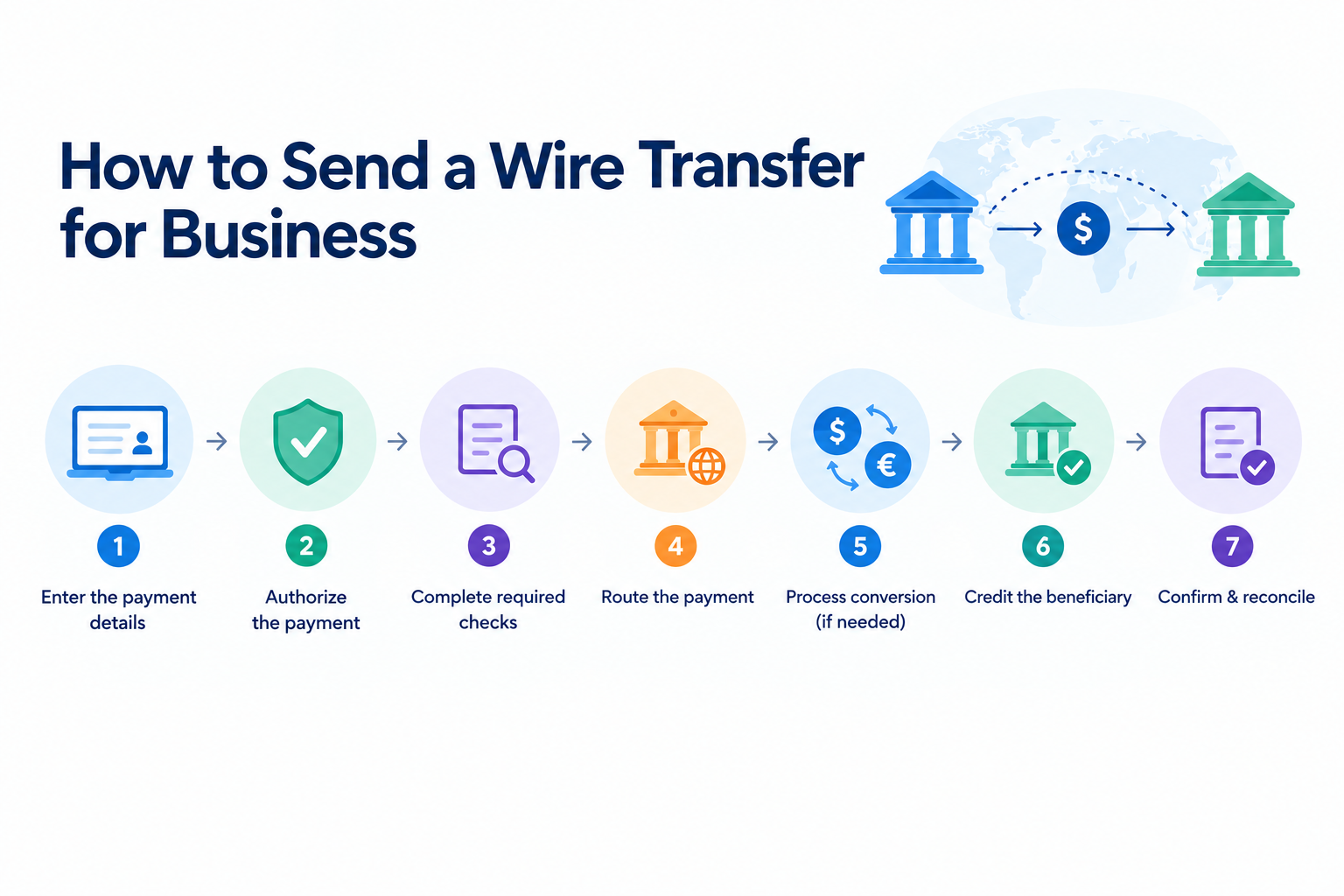
Complete the final review in this order:
1.Compare the beneficiary’s legal name and account details with approved records.
2.Confirm the amount, currency, payment purpose, and invoice reference.
3.Check the exchange rate, fees, recipient amount, and delivery estimate.
4.Confirm that the payment fits the account limit and approval policy.
5.Authenticate through the bank or platform’s approved security process.
6.Submit the wire and save the confirmation, reference number, and instructions.
Stop and verify if any beneficiary detail, payment amount, currency, or bank-change instruction differs from approved records. If a vendor sends changed bank details by email or another unusual channel, validate the change through an independent, trusted contact method.
Separate preparation from approval for higher-risk or higher-value payments when company policy requires it. This step is complete when the platform or bank displays a submission confirmation and the authorized approver accepts the payment.
Track delivery, cutoff times, and exceptions
Domestic wires may arrive the same business day when submitted before the bank’s cutoff. Actual timing still depends on the sending and receiving institutions.
International wires commonly take 1–5 business days. Cutoff times, weekends, holidays, currency, destination, intermediary banks, receiving-bank processing, and compliance reviews can extend delivery.
Bank cutoff times are institution-specific. Bank of America lists a 5 p.m. Eastern cutoff for its cited domestic and international workflow. Chase lists a 6 p.m. Eastern cutoff for its business Payment Center workflow.
| Status | Meaning |
|---|---|
| Submitted | The instruction was accepted for processing |
| Processed or sent | The sending institution released the payment instruction |
| Completed | The sending process finished, but receiving-side confirmation may still depend on the beneficiary’s bank |
| Returned or rejected | Investigate account details, compliance review, funding, limits, or receiving-bank rules |
A payment submitted after the applicable cutoff may be processed on the next business day. For example, plan a Friday international payment entered after cutoff around the next business day rather than weekend delivery.
Monitor the transaction history in the bank or platform. Contact the sending institution if the payment is delayed, rejected, returned, or credited for an unexpected amount.
Control fees, foreign-exchange costs, and operational risk
Wire costs can include an outgoing fee, receiving fee, intermediary-bank charges, and a foreign-exchange spread or markup. Fee schedules differ by account type, payment channel, currency, destination, and whether the payment is self-service or banker-assisted.
International payment providers may display fees and estimated recipient amounts before submission. Intermediary or receiving-bank charges may still apply, so confirm the applicable disclosures.
Common causes of delay or rejection include:
•Incomplete beneficiary data
•Mismatched beneficiary names
•Insufficient funds
•Incorrect currency
•Exceeded transaction limits
•Compliance holds
•Receiving-bank restrictions
For recurring vendor payments, maintain controlled beneficiary records and payment-purpose documentation. Use dual approval where appropriate, retain confirmations, and reconcile each payment after submission.
Compare the all-in debit and recipient amount, not just the advertised wire fee. A payment-control process passes when finance can reconcile the sender debit, stated fees, currency conversion, recipient credit, and any variance against the invoice. For more ways to manage payment costs, improve settlement visibility, and reduce avoidable delays, read our guide to optimizing cross-border transactions.
Simplify international business payments with Fuze Business
Sending international payments involves more than initiating a transfer. Businesses need reliable access to payment corridors, efficient currency conversion, clear settlement timelines, and transaction visibility to pay suppliers and partners across markets.
Fuze Business brings cross-border payments, collections, currency and stablecoin conversion, and transaction tracking together on one platform. With banking-network connectivity, access to difficult trade corridors, faster settlement, and enterprise-grade compliance, it helps businesses manage international payment workflows more efficiently across supported markets.
Explore Fuze Business to simplify cross-border payments, streamline currency conversions, and manage global transfers through a unified platform.