

The sender sees that an international wire was sent, but the recipient still has not received it. Tracking can show where the payment is in the process. It does not prove that usable funds are available in the beneficiary’s account.
Start by gathering the transaction confirmation, amount, currency, sender and recipient details, value date, bank identifiers, MT103, and Unique End-to-End Transaction Reference (UETR), if available. The tracking workflow depends on whether the payment moved through SWIFT, a bank’s own wire network, or another provider.
Business users should also compare visibility, settlement speed, corridor access, fees, compliance requirements, and reconciliation before choosing a payment rail. For more context, read our guide to cross-border transactions.
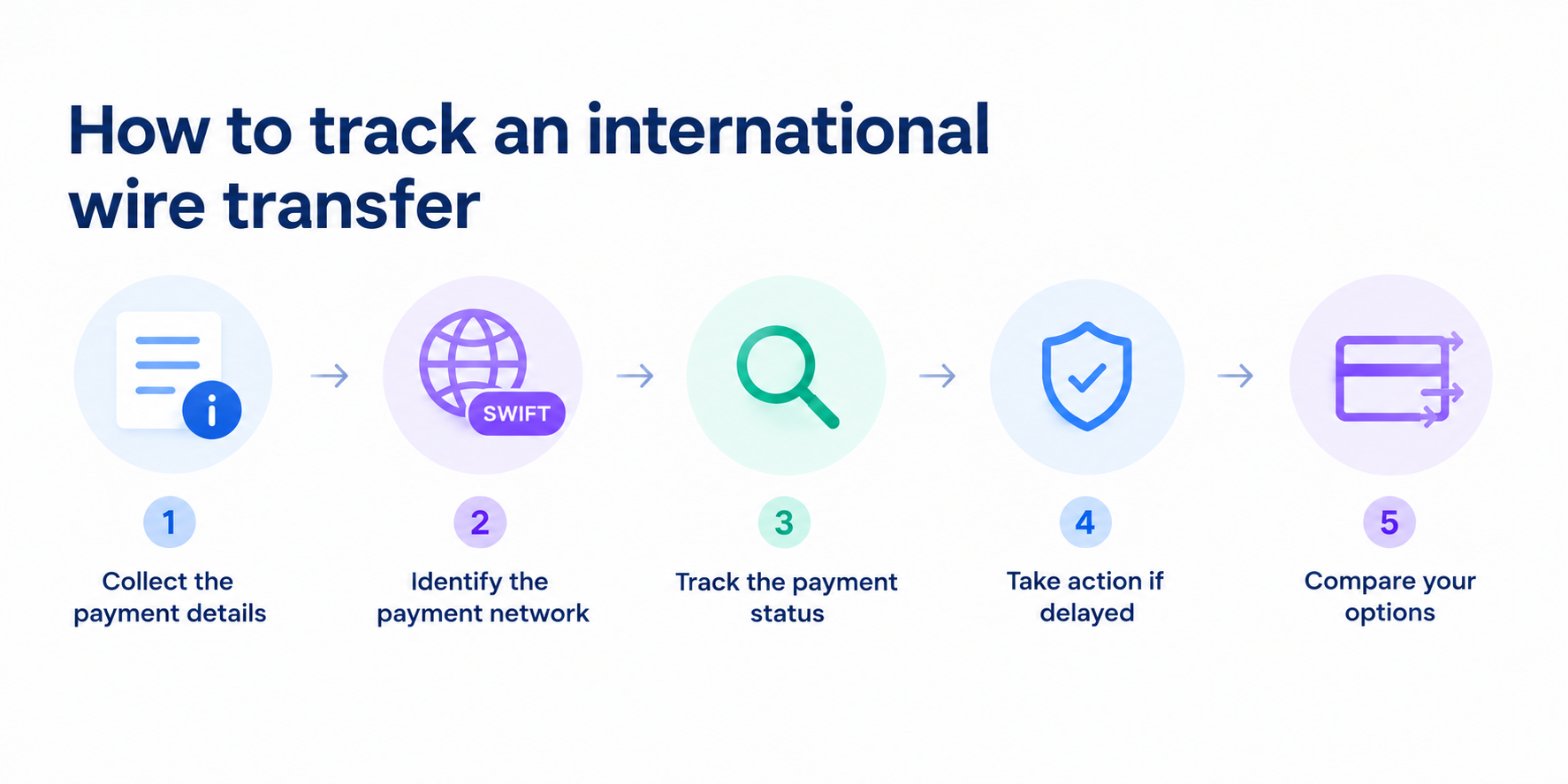
Collect the payment details before you start tracking
The first step is to locate the sender’s confirmation or payment receipt. Record the core details before contacting a bank or provider.
Use this checklist:
•Payment date and value date
•Amount and currency
•Sender account and contact details
•Beneficiary name, account number, or International Bank Account Number (IBAN)
•Beneficiary bank name and Bank Identifier Code (BIC)
•Payment purpose details
•Bank confirmation number or wire reference
•MT103, if available
•UETR, if the payment used SWIFT
•Expected availability date
•Sender-bank contact details
For a SWIFT customer credit transfer, ask the sending bank for the MT103 payment confirmation when available. The UETR is the unique end-to-end reference used in SWIFT payment messages, including MT103 messages, to support tracking across the payment chain.
A bank’s internal confirmation number may not be interchangeable with a UETR. Keep every reference supplied by the sending institution. Also validate the beneficiary’s account number or IBAN, bank identifier, beneficiary bank, and payment purpose before requesting an investigation.
This step is complete when you have a written record of the payment reference, UETR if applicable, value date, beneficiary banking details, and promised availability date.
Identify whether the wire can be tracked through SWIFT, the bank, or another provider
The tracking method depends on the payment rail and the institution that initiated the transfer. SWIFT Global Payments Innovation (GPI) provides end-to-end visibility for participating financial institutions and uses the UETR to identify a payment across the chain.
A bank portal may show statuses such as submitted, processing, sent, credited, returned, rejected, or canceled. The status names and detail vary by institution. A recipient bank may also confirm whether an incoming payment is pending, held, rejected, or credited.
A general public tracker is not a universal solution for bank wires. Many payments require the sending bank or payment provider to query its own network and correspondent institutions.
| Tracking method | Identifier required | Who can access it | Typical visibility | Best use | Main limitation |
|---|---|---|---|---|---|
| Sending-bank portal | Bank reference or login | Sender | Internal processing status | Checking routine updates | Status detail varies |
| SWIFT GPI or UETR inquiry | UETR or related payment data | Sending or participating institutions | Payment events across the chain | Tracking SWIFT payments | Requires participating institutions |
| Recipient-bank inquiry | Sender reference and originating-bank details | Recipient or recipient bank | Incoming payment status | Confirming receipt or credit | The bank may not locate funds without references |
| Provider dashboard | Provider transaction ID | Sender and authorized users | Status, settlement, and balance data | Tracking platform-initiated payments | Coverage depends on the provider |
| Formal bank trace | UETR, MT103, or bank reference | Sending bank | Escalated investigation | Delayed, rejected, or missing payments | May take time and involve other institutions |
When comparing a traditional bank with a specialized business payment platform, review the available payment coverage, tracking method, settlement speed, fees, foreign exchange transparency, compliance requirements, and reconciliation workflow. Choose the SWIFT or bank escalation path when the payment has a UETR or bank reference. Use a provider dashboard when the payment was initiated through a platform that exposes transaction status directly. For an overview of the payment process, see our guide to sending a wire transfer.
Track the SWIFT payment with the UETR or MT103
Ask the sending bank or payment provider whether the payment was sent over SWIFT and whether a UETR is available. For a SWIFT payment, use the UETR as the primary tracking reference.
The MT103 is the SWIFT customer credit transfer message. It can contain important transaction details and the UETR. The sending bank normally provides or interprets the message rather than giving customers access to a public tracking tool.
Follow these steps:
1.Ask the sending bank whether the payment used SWIFT.
2.Request the UETR and MT103, if available.
3.Give the bank the amount, currency, value date, and beneficiary details.
4.Ask the bank to review the latest SWIFT payment event.
5.Request the event date and the institution responsible for the next step.
6.Ask whether the payment was delivered, rejected, held, or credited.
SWIFT tracking may show events such as delivery, rejection, hold, or confirmation of credit. The level of visibility depends on the participating institutions and service used.
A UETR does not prove that the beneficiary has usable funds. The decisive checkpoint is credit to the beneficiary’s account or confirmation from the receiving bank. If the bank cannot provide a UETR, request its internal wire reference, correspondent-bank reference, and payment message details instead.
This step is complete when the sending bank can identify the payment and explain the latest recorded event, date, and responsible institution.
Interpret the wire status and decide what to do next
A wire status shows the payment’s current stage, but the bank’s exact definitions control. Ask the bank to explain any unclear status before assuming the funds have left the account.
| Status | What it usually means | Next action | Escalation trigger |
|---|---|---|---|
| Submitted or processing | The sending institution may still be handling the outbound instruction | Confirm whether the payment has been released | The status remains unchanged |
| Sent or dispatched | The instruction was released by the sending institution | Ask for the UETR or bank reference | The expected delivery date passes |
| In transit or with intermediary | A correspondent or intermediary may still be processing it | Ask which institution has the payment | No update after the expected date |
| On hold | The payment may require review or missing information | Ask for the reason and required action | The bank cannot explain the hold |
| Rejected or returned | The payment was not completed or was sent back | Confirm the reason and return timing | Details or funds are unclear |
| Credited or confirmed delivery | The beneficiary bank may have received or credited the payment | Ask the recipient to verify the account | The recipient cannot access the funds |
“Sent” generally means the sending institution released the payment. It does not necessarily mean the recipient has been credited. Intermediary processing, compliance checks, beneficiary-bank rules, or incorrect payment data may still affect delivery.
Request a formal trace when the expected delivery date has passed, the status has not changed, the payment is on hold or rejected without a clear reason, or the recipient bank cannot locate the funds. No movement plus a missed delivery date is a trace trigger. It is not a reason to send a duplicate payment immediately.
Request a formal trace when the wire is delayed or missing
Contact the sending bank or payment provider first. It controls the original payment instruction and can communicate with correspondent institutions.
Provide the UETR or wire reference, MT103 if available, value date, amount and currency, beneficiary details, and a concise description of the problem. Ask the bank to confirm:
•The last institution that handled the payment
•The latest status and event date
•Whether the payment is on hold or rejected
•Whether the receiving bank acknowledged or credited it
•The case number and next update date
Use a clear request such as:
Please open a trace for UETR [reference]. Confirm the latest payment event, the institution currently holding or processing the funds, and whether the beneficiary bank has acknowledged or credited the payment.
Keep the case number and request a written response. Contact the beneficiary bank with the payment reference when possible, and document every response.
Do not send a replacement wire until you understand the first payment’s status and recall or return prospects. A duplicate payment can create a second financial exposure.
For U.S. consumer remittance transfers, providers generally must investigate qualifying reported errors and provide an outcome. Coverage and rights depend on the transfer type and provider, as explained in the consumer remittance guidance.
The trace is properly opened when you have a case number, a named escalation contact, and a documented next update date.
Handle a lost wire, cancellation request, or reversal attempt
Treat a “lost wire” as an unresolved payment status until the sending bank confirms whether it was delivered, rejected, returned, or held. The phrase does not identify the cause.
Contact the sending institution immediately if the wire went to the wrong account, appears fraudulent, or must be stopped. Cancellation windows and recall procedures depend on the provider, transfer type, and payment status.
For example, Chase states that eligible personal international wires may be canceled within 30 minutes. Bank of America describes post-send recalls as requests that require cooperation from the beneficiary bank or other institutions. These examples do not guarantee that a particular payment can be canceled or recovered.
A cancellation before release differs from a post-send recall. A recall starts a recovery attempt but does not guarantee that funds will return. The beneficiary bank or recipient may refuse to return the funds. Fees and exchange-rate differences may also affect the amount recovered.
For a suspected scam or unauthorized payment, use the bank’s fraud or wire-recall escalation immediately. Preserve communications, invoices, recipient-change requests, and account details. Do not publish UETRs, account numbers, or personal information in public forums.
Compare payment options by speed, visibility, and operational control
Traditional correspondent-bank wires may involve several institutions, cut-off times, compliance checks, currency conversions, and recipient-bank processing. These steps can affect when funds are credited and how easily a business can locate a delay.
Compare each option across separate criteria. Initiation speed is not the same as settlement speed. A payment can be easy to submit but difficult to monitor or reconcile.
| Payment option | Visibility | Settlement considerations | Operational fit |
|---|---|---|---|
| Traditional bank wire | Bank-specific status and formal traces | May involve correspondent banks and cut-off times | Suitable when existing bank corridors meet business needs |
| SWIFT GPI-enabled workflow | UETR-based payment events where supported | Visibility depends on participating institutions | Useful for tracking eligible SWIFT payments |
| Specialist business payment platform | Provider dashboard and transaction monitoring | Depends on route, currency, compliance, and eligibility | Useful when teams need centralized tracking and reconciliation |
| Stablecoin-enabled settlement workflow | Platform-level transaction visibility | Can support faster settlement than some traditional chains | Useful when the corridor and compliance requirements support it |
Fuze Business uses banking-network connectivity and stablecoin rails to support faster settlement than traditional correspondent-banking chains. Learn more about stablecoin cross-border payments and how they can support international payment flows. This is a platform claim, not a guarantee for every corridor or transaction.
A finance team has adequate control when it can identify the payment status, expected settlement time, applicable fees and foreign exchange treatment, and reconciliation owner without contacting several disconnected institutions. For more ways to improve payment efficiency, read our guide to optimizing cross-border transactions.
How Fuze Business helps with international payment tracking
Tracking an international wire transfer starts with the payment reference, the transfer route, and the latest status from the sending or receiving bank. If a payment misses its expected delivery date, requesting a trace can help identify delays and determine the next steps.
Fuze Business helps businesses send, receive, convert, monitor, and reconcile cross-border payments through one platform. By combining stablecoin-enabled payment rails with banking-network connectivity, it offers an alternative to relying solely on traditional correspondent-banking chains.
Businesses can access 60+ jurisdictions, go live within 48 hours, and settle eligible payments within 24 hours, subject to the route, currency, compliance checks, and transaction eligibility. Real-time transaction monitoring and balance reconciliation also help finance teams maintain better visibility into payment status and balances.
For businesses looking to simplify international payment tracking and gain greater visibility across global transactions, explore Fuze Business.