

Wire transfers are a common way to move money electronically between financial institutions. They are often used for large, urgent, or international payments.
The term has a broad everyday meaning and a narrower technical meaning. In general use, it can describe an electronic account-to-account payment. Technically, it refers to a funds transfer between bank or credit-union accounts, as the Consumer Financial Protection Bureau explains.
Domestic and international wires are not identical. They can involve different payment networks, intermediaries, currencies, regulations, fees, and delivery times. This guide explains how wires work, what information they require, how long they take, what they cost, and what businesses should check before sending one.
What is a wire transfer?
A wire transfer is an electronic payment sent from one financial institution to another, usually using account and routing details supplied by the sender.
The sender may initiate the payment through a bank, credit union, payment provider, or another eligible financial institution. The recipient’s institution then processes the payment and credits the beneficiary account.
The word “wire” describes the transfer method broadly. The underlying network and rules can differ by country, currency, provider, and transaction type. Therefore, not every electronic payment is a wire transfer.
A domestic wire involves accounts within the same country. An international wire involves a transfer between countries. International transactions may require currency conversion, additional bank identifiers, intermediary institutions, and cross-border compliance checks.
Consumer and business payments may also have different legal treatment. A consumer sending money from the United States to someone abroad through a remittance transfer provider may receive specific disclosures and protections under federal remittance rules. Business payments should not automatically be treated as identical to consumer remittances.
For example, a U.S. company might send a supplier payment from its commercial bank account to another U.S. bank account. That is generally a domestic wire. If the supplier’s account is abroad, it is an international wire.
How a wire transfer works from sender to recipient
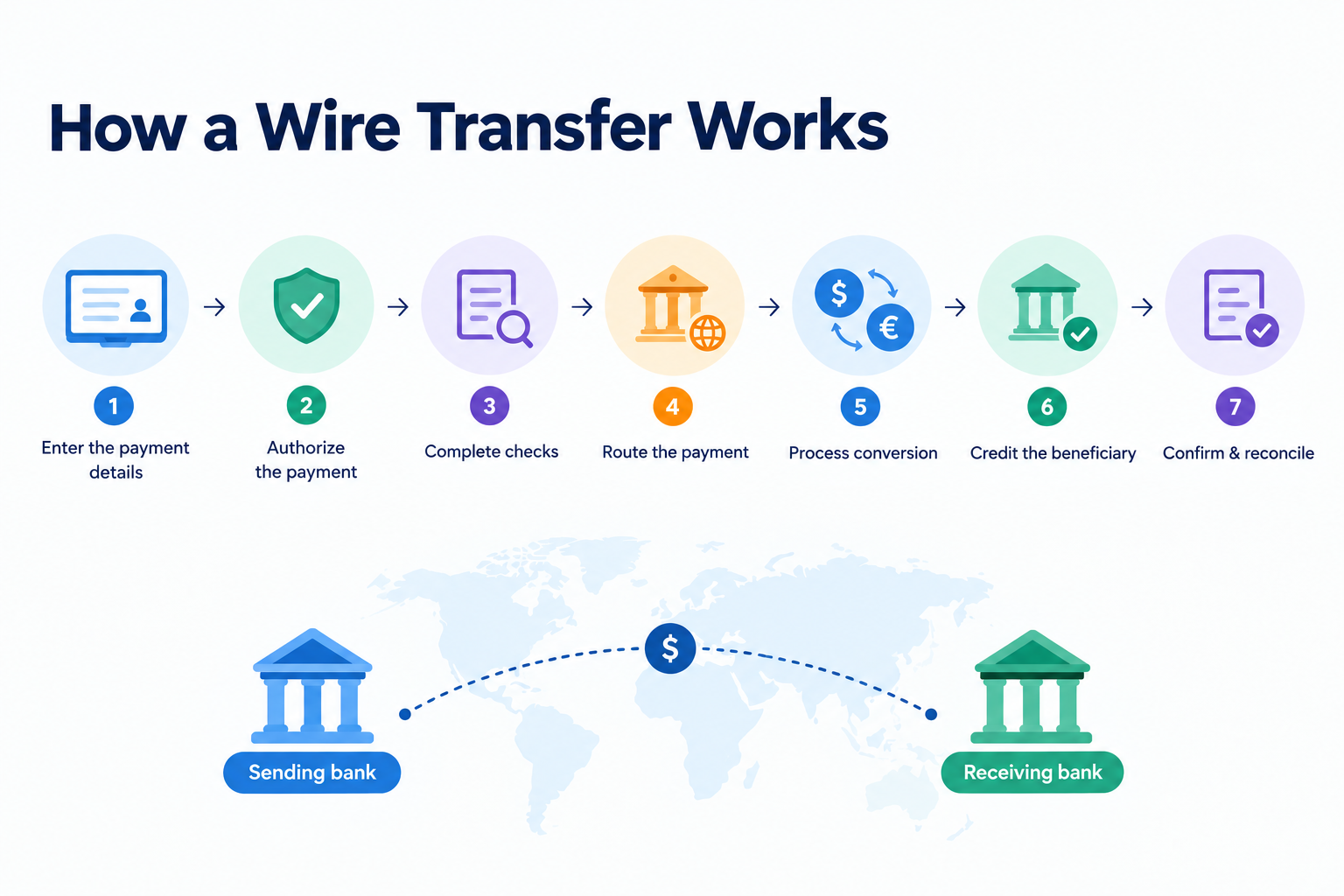
A wire transfer moves through several stages. The process is complete only when the receiving institution credits or makes the funds available to the intended beneficiary.
1.Enter the payment details. The sender provides the beneficiary name, account number or International Bank Account Number (IBAN) where applicable, bank identifier, amount, currency, and any required purpose or reference.
2.Authorize the payment. The sender confirms the instruction through the bank, provider, or payment platform.
3.Complete required checks. The sending institution may check the account balance, authorization, fraud indicators, sanctions requirements, and other compliance conditions.
4.Route the payment. A domestic transfer may use a domestic wire system. An international payment may pass through correspondent institutions or other intermediaries.
5.Process conversion if needed. If the payment uses a different currency, the bank or provider may exchange the funds before or during settlement.
6.Credit the beneficiary account. The receiving institution applies its own processing, cut-off, and account-availability rules.
7.Confirm and reconcile. The sender and recipient confirm the transaction and record it for accounting or treasury purposes.
The Federal Reserve describes Fedwire as a real-time gross settlement service for eligible participating financial institutions. Other domestic and international transfers can follow different routing and settlement processes. Businesses handling international wire transfers should also understand how cross-border payments move between markets and how currency conversion, intermediaries, and settlement affect the process.
Before authorizing a payment, confirm the beneficiary name, account number or IBAN, bank identifier, currency, amount, purpose, and expected delivery date. A wire can be difficult or impossible to reverse after processing, so accurate details matter.
Domestic, international, bank, and provider-based wire transfers compared
The type of wire affects its routing, timing, information requirements, and risks. A bank-originated wire starts with a bank or credit union. A provider-arranged payment is organized through a money-transfer or payment-services company.
The following table compares common categories:
| Type | Typical use | Information commonly needed | Timing variables | Principal watchouts |
|---|---|---|---|---|
| Domestic wire | U.S.-based account movement | Domestic bank details | Business-day cut-offs and bank processing | Fees and reversal difficulty |
| International wire | Supplier, payroll, or trade payment across borders | Recipient and international bank identifiers | Corridor, currency, intermediaries, compliance, and time zones | Exchange-rate spread, intermediary deductions, and delivery uncertainty |
| Fedwire-based transfer | U.S. high-value or time-sensitive payment | Participating-institution routing details | Fedwire operating schedule and receiving-bank availability | Finality after processing |
| Provider-arranged international payment | Business cross-border payment | Provider-specific beneficiary and compliance data | Provider, corridor, settlement, and eligibility rules | Pricing, regulatory scope, and supported corridors |
Fedwire is a specific U.S. payment system. It is not the same as Automated Clearing House (ACH), FedNow, or every service marketed as a “wire.” The Federal Reserve’s regulatory definitions help distinguish specific payment-system terms.
If a provider claims that a payment is “same day,” check what that means. It may refer to sender-side submission, payment-system settlement, or recipient-account availability. These are different milestones. Businesses comparing alternatives to traditional bank wires can explore the best cross-border payment platforms to evaluate supported corridors, settlement times, pricing, and payment visibility.
How long do wire transfers take, and what do they cost?
There is no universal wire-transfer delivery time. Domestic and international routing, payment-network schedules, bank cut-off times, weekends, holidays, currency, compliance reviews, intermediaries, and recipient-bank posting can all affect delivery.
A payment may settle within a payment system before the recipient can use the funds. For example, Fedwire processes transfers in real time within its operating framework. That does not guarantee immediate availability in every recipient account.
International wires may take longer because they can involve multiple institutions and settlement stages. Time zones, incomplete beneficiary details, foreign-exchange processing, and compliance reviews can also cause delays.
Costs can include:
•The sender’s transfer fee.
•A foreign-exchange spread.
•Intermediary or correspondent-bank deductions.
•Recipient-bank fees.
•Applicable taxes.
A practical cost formula is:
Total cost = explicit transfer fee + exchange-rate spread + intermediary or receiving-bank deductions + applicable taxes.
Compare the amount the recipient receives, not only the fee shown at checkout. For covered U.S. consumer remittance transfers, providers generally disclose fees, exchange-rate information where applicable, the expected delivered amount, and when funds should be available under remittance disclosure requirements.
Those rules do not make every business wire subject to the same disclosures. Business customers should review the provider’s pricing, exchange rate, delivery estimate, and third-party deductions.
Treat “same day” as a qualified estimate unless the provider defines the clock, cut-off, corridor, and recipient-availability condition. The CFPB has warned that claims about delivery times and “free” transfers may be deceptive when they do not reflect the actual charges or timing.
Before sending an international wire, identify the displayed fee, applied exchange rate, expected recipient amount, expected availability date, and any stated third-party deductions. For practical ways to reduce payment friction and improve cost, timing, and settlement visibility, see this guide to optimizing cross-border transactions.
Key business benefits and trade-offs of wire transfers
Wire transfers are useful for high-value and time-sensitive business payments. Companies commonly use them for suppliers, partners, payroll, treasury activity, and international trade.
A processed Fedwire transfer provides immediate, final, and irrevocable settlement within that system. This can support payment certainty between participating institutions. However, that finality also makes incorrect beneficiary details costly.
International wires can help businesses pay overseas counterparties. They can also introduce correspondent-bank chains, currency conversion costs, cut-off differences, compliance reviews, and fragmented tracking.
| Business factor | Potential benefit | Trade-off or control question |
|---|---|---|
| Speed | Can support urgent payments | Does the estimate cover recipient account availability? |
| Reach | Can support domestic and cross-border payments | Is the required corridor and currency supported? |
| Settlement certainty | Can provide a formal account-to-account payment path | Is the transaction difficult to reverse after processing? |
| Cost | May suit high-value payments | What are the total fee, exchange-rate, and intermediary costs? |
| Transparency | Can provide payment records and references | Can the business track all settlement stages? |
| Reversibility | Clear authorization creates payment control | What error-recovery process exists if details are wrong? |
Businesses should choose the payment route based on the transaction’s corridor, currency, value, urgency, and control requirements. The best method may differ by payment type rather than remaining the same for every transaction.
A finance manager should be able to explain why a selected route fits the payment’s destination, deadline, value, currency, and reconciliation process before releasing funds.
Simplify cross-border payments with Fuze Business
Managing international payments involves more than transferring funds. Businesses need reliable access to payment corridors, transparent currency conversion, predictable settlement, and clear transaction tracking to pay suppliers and partners efficiently.
Fuze Business brings cross-border payments, collections, currency and stablecoin conversion, and transaction tracking together on one platform. With banking-network connectivity, access to difficult trade corridors, and enterprise-grade compliance, it helps businesses manage global payment workflows across supported markets.
Explore Fuze Business to simplify cross-border payments and manage global transfers through a unified platform.