

Multi-currency payment methods are the operational and technical ways a business can accept, process, convert, settle, and reconcile payments in more than one currency.
Three terms matter from the beginning. Presentment currency is the currency shown and charged to the customer. Settlement currency is the currency ultimately received by the business or its bank account. The payment method may also have its own supported currency requirements.
A customer may pay in EUR while the processor settles the business in USD. Supported currencies, local payment methods, payout currencies, banking access, foreign exchange conversion, regulatory requirements, and gateway approval vary by provider and jurisdiction.
Before choosing a workflow, identify your target markets and currencies. Then decide whether you need card checkout, bank-transfer collection, supplier payments, treasury conversion, or a combination. Also decide which system owns order state, FX data, reconciliation, and compliance records.
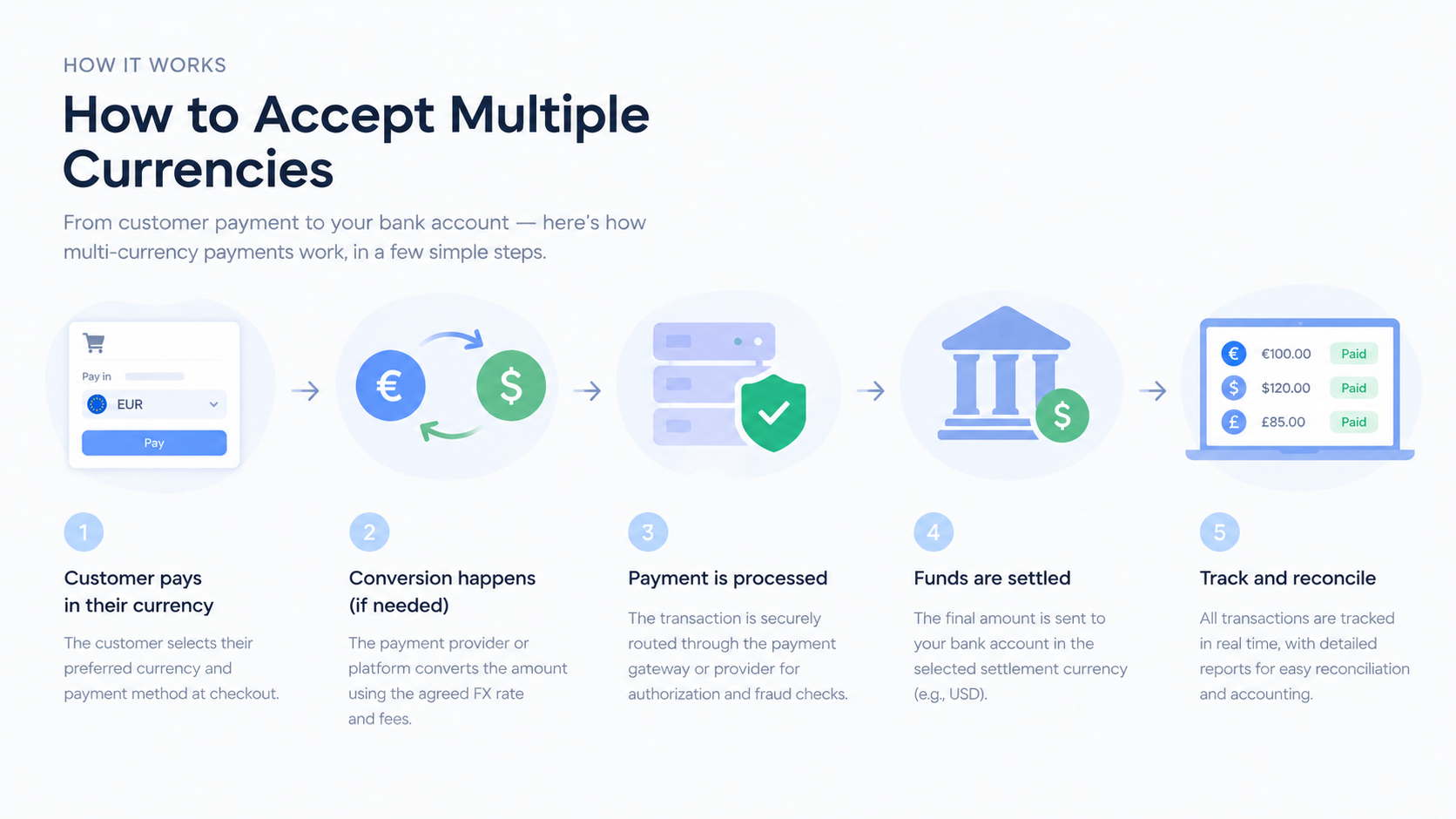
Define the currencies, corridors, and settlement model
Start by separating the currencies involved in every payment flow. A single transaction can include the currency supported by the payment method, the currency charged to the customer, and the currency accepted by the business’s account.
| Currency concept | Meaning |
|---|---|
| Presentment currency | The currency displayed and charged to the customer |
| Settlement currency | The currency received by the business or its payout account |
| Conversion owner | The provider, bank, platform, or business responsible for FX conversion |
| Payout destination | The bank account or financial account receiving settlement |
| Reconciliation currency | The currency used to match transactions, fees, conversions, and payouts |
A payment can be displayed and charged in one currency while being converted into another for settlement. Cross-border payments commonly involve at least two currencies and an FX transaction or conversion step.
Payment methods do not all support the same currency set. Card payments may support different currencies from local payment methods, and local methods may be restricted to specific currencies. API amount formatting can also vary. For example, Stripe requires amounts in minor units and identifies zero-decimal currencies that need different handling in its currency documentation.
Ask this question before selecting a provider: Do customers need to pay in local currency, or does the business only need to receive and convert funds after collection? A currency converter can help businesses compare currency values when estimating international payment amounts before conversion.
For example, a buyer may be charged in EUR while the processor settles the merchant in USD. The accounting system should retain both the original EUR amount and the USD settlement value.
Every supported flow should document its charge currency, settlement currency, FX conversion point, and reconciliation rule.
Choose between hosted checkout, gateway, direct API, and unified platform workflows
Choose the payment method based on the control your business needs and the operations it can support.
| Option | Best suited to | Main trade-off |
|---|---|---|
| Hosted checkout | Fast implementation and provider-managed payment UX | Less front-end control; currency and payment-method coverage must be verified |
| Gateway integration | Balanced control and implementation effort | The provider manages core processing, but onboarding and configuration remain necessary |
| Direct API | Custom pricing, order state, currency selection, and reconciliation | Highest engineering and compliance-operational burden |
| Unified business payments platform | Cross-border collections, payments, conversion, and settlement workflows | Corridor and currency availability must be confirmed |
Hosted checkout reduces the payment-page infrastructure your business must build. The provider still controls supported currencies, payment methods, authentication flows, and settlement behavior.
A gateway or processor integration usually requires provider onboarding, currency approval, merchant configuration, and payout-account setup. Multi-currency transactions may not work until these steps are complete. Review the provider’s currency support requirements before building the customer flow.
A direct API gives the business more control over pricing, order state, retries, currency selection, and reconciliation. It also requires secure backend development, monitoring, webhook processing, and operational support.
A unified cross-border payments platform may be more suitable when the main requirement is receiving, sending, converting, and settling funds across corridors. Cross-border payment programs can involve several providers and operational responsibilities, so compare the best cross-border payment platforms and their available workflows.
Choose hosted checkout when speed and provider-managed payment UX matter most. Choose a direct API when the business needs a custom order, pricing, and reconciliation model. Your decision should cover target currencies, payment methods, settlement destinations, integration ownership, and fallback handling.
Configure the gateway, payment methods, and settlement accounts
Confirm support for each target currency across the intended payment method, merchant country, acquiring setup, and payout destination. A provider’s general currency list may not apply identically to every method or country.
Before enabling live payments, document:
•Target markets and ISO currency codes
•Payment methods and presentment currencies
•Settlement currencies and payout accounts
•FX markup and customer-facing rate source
•Refund and chargeback currencies
•Test credentials and webhook endpoints
•Reconciliation exports and reporting requirements
Distinguish authorization or presentment currency from settlement currency. Some payout currencies require a local bank account or a specific regional payout arrangement. Check the provider’s supported currency conditions for the account, method, and region involved.
Gateway onboarding may require approval for multi-currency accounts and banking arrangements. Without the required configuration, transactions may process in the default or home currency instead of the currency displayed to the customer.
Also document how the provider handles FX fees, card-network or issuer conversion, refunds, chargebacks, and customer-facing exchange rates.
Before launch, submit a test payment in each target currency. Confirm that the gateway records the intended presentment currency, returns the expected payment status, and routes settlement to the intended account.
Each currency-method-country combination should have a documented status: supported, unsupported, or pending provider approval.
Build a currency-aware API payment workflow
Build one authoritative payment record for each customer session. Store the amount, ISO currency code, provider reference, customer, order state, and conversion metadata.
Suggested internal fields include:
•order_id
•payment_attempt_id
•amount_minor
•currency
•presentment_amount
•settlement_amount
•exchange_rate
•fee_amount
•provider_payment_id
•idempotency_key
•status
•created_at
•settled_at
Send amounts in the format required by the provider. Do not assume that every currency uses two decimal places. For example, a two-decimal currency may use the smallest-unit amount as an integer, while a zero-decimal currency follows a different provider rule. Use the provider’s currency-specific amount guidance.
Treat currency as part of the payment identity. A retry or update that changes the currency should create a deliberate new payment attempt or pass the provider’s validation rules. It should not silently mutate the original transaction.
Use idempotency keys for retryable write requests. They help prevent duplicate payment operations when a network failure leaves the result uncertain. Providers such as Stripe document this behavior in their idempotent request guidance.
A practical API sequence is:
1.Calculate the price on the server.
2.Validate the currency and payment method.
3.Create the payment object.
4.Confirm the payment or redirect for authentication.
5.Receive the asynchronous payment status.
6.Update the order and accounting ledger.
Keep secret API credentials on the server. Do not trust client-submitted amounts or currency codes without validating them against the order and pricing rules. Payment objects should retain the original currency and amount throughout their lifecycle, consistent with the provider’s payment intent model.
The workflow should reject a changed amount or currency, or handle it as a new explicit payment attempt. Replaying the same request with the same idempotency key should produce one payment attempt.
Connect webhooks, reconciliation, and compliance controls
Do not rely only on the browser redirect or synchronous API response. Payment status can change later during redirects, bank transfers, authentication, disputes, refunds, and other asynchronous flows.
Webhook processing should follow this sequence:
1.Verify the signature or other authentication.
2.Record the raw event.
3.Deduplicate by event identifier.
4.Return a successful response promptly.
5.Process the event asynchronously.
6.Update the ledger and internal order state.
7.Alert on unknown event types or currency mismatches.
Use webhooks to update fulfillment, inventory, payout status, refunds, disputes, and reconciliation records. Follow the provider’s webhook handling guidance and account for different webhook event types.
Reconciliation should compare provider transactions, fees, FX conversions, refunds, chargebacks, payouts, and bank or account statements. Use stable references to connect each record.
Useful reconciliation fields include provider reference, order reference, presentment amount, settlement amount, currency, fee, FX rate, refund or chargeback status, payout date, and ledger status.
Cross-border payment programs also require risk-based compliance controls. Requirements vary by jurisdiction and payment flow. Consider customer and business verification, payment-transparency data, anti-money-laundering controls, sanctions or fraud screening, record retention, and provider or regulator requirements. Check applicable rules against current FATF recommendations.
FX settlement risk can arise when one side of a currency transaction delivers funds while the other side does not deliver the corresponding currency. Settlement controls should reflect transaction size, timing, corridor, and risk profile. These considerations are also important when planning cross-border payment execution.
A payment that returns “pending” in the browser should remain pending internally. Mark it successful only after a trusted provider event or provider-side status check confirms the outcome. A replayed webhook must not duplicate revenue, fulfillment, refunds, or ledger entries.
Test every currency path before going live
Test each currency with every relevant payment method, country, settlement route, refund path, and failure state. Testing only one successful card payment is not enough.
Validate decimal and zero-decimal amount handling, rounding, minimums, maximums, FX display, tax or fee calculations, and customer receipts. Also simulate authorization failures, pending status, timeouts, duplicate webhooks, expired payments, refunds, partial refunds, chargebacks, payout delays, and currency mismatches.
Use a test matrix with currencies as rows and payment creation, authentication, authorization, capture, refund, webhook, settlement, and reconciliation as columns. Preserve both the original transaction currency and settlement currency wherever conversion occurs.
Track operational metrics after launch, including successful payment rate by currency, pending duration, webhook failure rate, unmatched settlement count, FX variance, refund completion time, and manual exceptions.
Do not enable a currency until its payment, refund, webhook, settlement, and reconciliation tests pass. Any failed test should have an approved operational fallback before production enablement.
How to receive multiple currency payments with Fuze Business
To manage multi-currency payments, first map the currencies and corridors you need. Then choose the right collection and settlement workflow. Keep presentment, conversion, and reconciliation records separate so every payment can be traced.
For finance managers, global trade companies, and supply chain managers, Fuze Business provides a unified platform for sending, receiving, and converting funds across global cross-border payment workflows.
Fuze Business gives access to difficult trade corridors, a banking network, cross-border payments, faster settlement, enterprise-grade compliance, and instant conversion of currencies and stablecoins.
Confirm current currency and corridor availability for your company’s onboarding profile. If you need a unified way to manage international money movement, explore Fuze Business for your cross-border payment workflow.