

Wire transfers support high-value and time-sensitive payments, but their statistics require careful interpretation. Results vary by payment rail, geography, currency, and transaction type.
The latest U.S. Fedwire benchmark shows 217.3 million transfers originated in 2025, with $1.148 quadrillion in value. However, the Federal Reserve Payments Study excludes wire transfers from its core noncash-payment totals. International payments commonly involve correspondent banks, and final delivery depends on local infrastructure, compliance checks, currency controls, and banking hours. Headline volume alone does not measure speed, cost, accessibility, or operational friction.
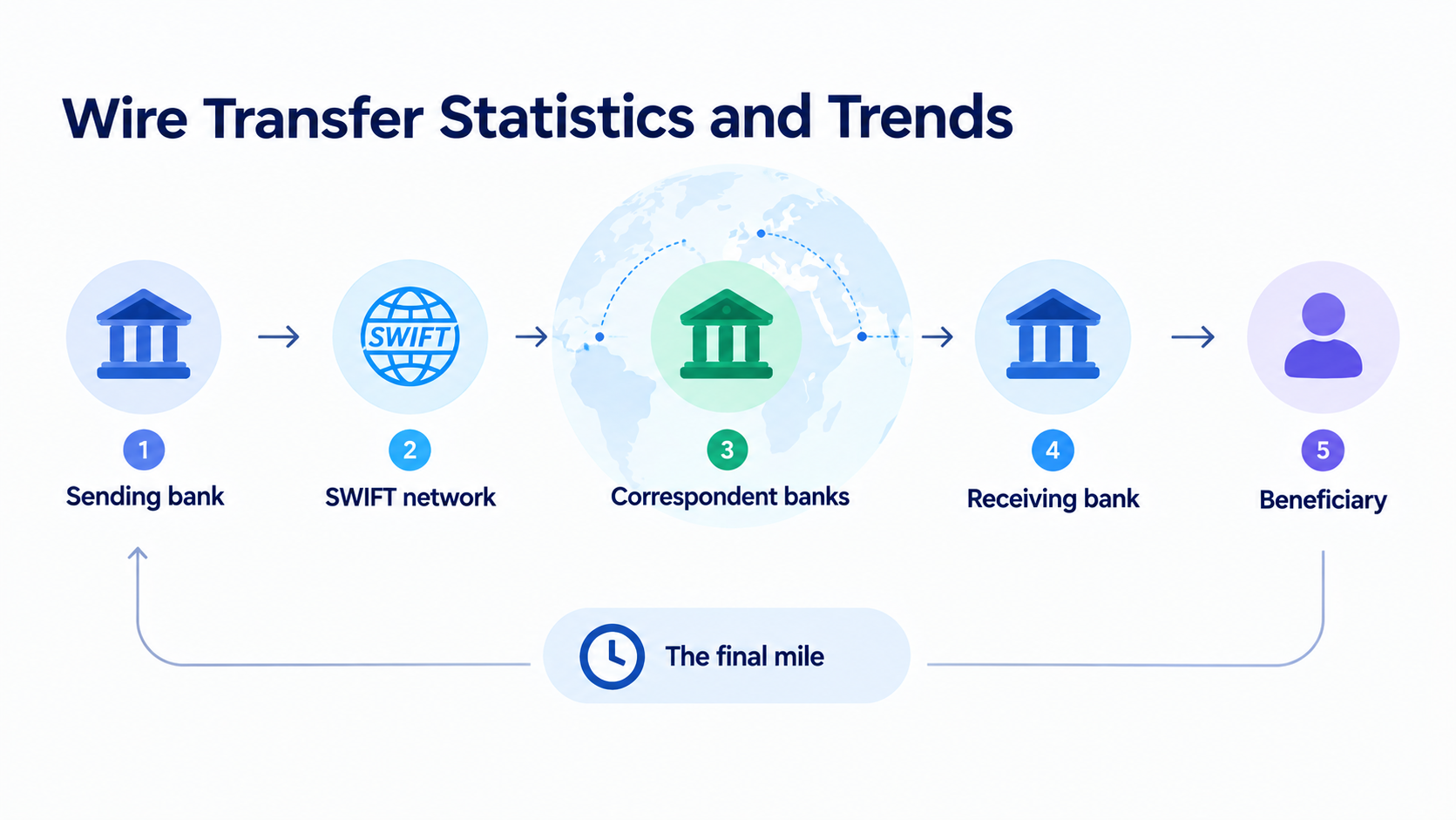
What wire-transfer statistics measure and why the datasets differ
There is no single worldwide wire-transfer total. The most useful benchmark depends on whether the question concerns a domestic settlement rail, international payment messages, bank-to-bank value, or end-user delivery.
“Wire transfer” is an umbrella term rather than one globally standardized payment rail. U.S. examples include Fedwire and CHIPS. International payments may use correspondent-banking networks that exchange payment instructions through SWIFT.
The Federal Reserve Payments Study’s 2025 initial release covers U.S. noncash payments during 2024. It explicitly excludes wire transfers from its core national totals because wires primarily support large financial transactions. Therefore, its ACH figures should not be presented as wire-transfer figures.
The Federal Reserve describes the Fedwire Funds Service as an interbank service for domestic, time-critical, and often high-value payments. Correspondent banking works differently. Banks provide local account and payment services for banks based abroad, and one cross-border payment may involve multiple correspondent banks. For a broader explanation of how these international payment flows work, see our guide to cross-border payments.
Useful comparisons should separate:
•Payment count and payment value
•Average transaction size
•Message traffic
•Settlement time and beneficiary-credit time
•Remittance cost and business-payment cost
A U.S. analysis can use Fedwire as a direct domestic wire benchmark. It should not present the Federal Reserve Payments Study’s $104.06 trillion ACH figure as a wire-transfer figure.
Latest U.S. Fedwire statistics on transaction volume, value, and average transfer size
Fedwire originated 217,296,700 transfers in 2025, worth approximately $1.148 quadrillion. The Federal Reserve’s annual Fedwire statistics show that volume increased 3.5% from 2024.
The value of transfers increased 1.3% from 2024. Average value per transfer was approximately $5.28 million in 2025, compared with $5.40 million in 2024.
| Measure | 2024 | 2025 |
|---|---|---|
| Fedwire transfers originated | 209,916,835 | 217,296,700 |
| Annual value | Approximately $1.133 quadrillion | Approximately $1.148 quadrillion |
| Average transfer value | Approximately $5.40 million | Approximately $5.28 million |
| Average daily volume | Not specified here | 869,187 transfers |
| Average daily value | Approximately $4.5 trillion | Approximately $4.593 trillion |
Commercial ACH operated at a different scale. It processed 21.585 billion transactions worth $47.101 trillion in 2025, according to the Federal Reserve’s ACH data.
These figures describe different payment use cases. ACH carries far more transactions, while Fedwire carries much larger average payments.
Adoption trends in wire transfers and ACH
Fedwire adoption increased by both volume and value in 2025, but volume grew faster than value. Transfers increased from 209,916,835 in 2024 to 217,296,700 in 2025. Annual value increased from approximately $1.133 quadrillion to $1.148 quadrillion.
That produced 3.5% volume growth and 1.3% value growth. The lower value-growth rate coincided with a slightly smaller average transfer value.
Commercial ACH also expanded. Volume increased from 20.109 billion items in 2024 to 21.585 billion in 2025. Value increased from $42.497 trillion to $47.101 trillion.
The Federal Reserve’s 2025 Payments Study found that ACH represented 74% of U.S. core noncash-payment value in 2024. However, the study excluded wires from those national noncash totals, so the figures cannot establish that ACH is replacing wires.
The evidence supports a segmented adoption pattern:
•ACH supports high-volume, recurring, and batch-oriented activity.
•Fedwire supports lower-count, high-value, and time-critical settlement.
•Businesses may use both rails for different payment needs.
For example, a company paying thousands of suppliers may use ACH for batch payments. It may reserve wires for urgent, high-value, treasury, settlement, or cross-border obligations. Wire adoption should therefore be read through value and use case, not transaction count alone.
How long wire transfers take with same-day domestic rails vs. variable international delivery
Domestic Fedwire is designed for mission-critical, same-day transactions. Actual availability still depends on business days, operating hours, message cutoffs, holidays, and the sender’s bank procedures. For a step-by-step explanation of the process, read our guide on how wire transfer works.
The Fedwire operating schedule runs from 9:00 p.m. Eastern Time on the preceding calendar day until 7:00 p.m. Eastern Time on each funds-transfer business day. Applicable schedules and cutoffs still affect processing.
International timing is harder to summarize. The financial-institution leg is only one part of the end-to-end journey. A payment may reach the beneficiary bank quickly but take longer to reach the final account.
Swift reported in 2026 that 75% of payments traveling over its network reached beneficiary banks within 10 minutes. It also reported that the international leg represented less than 20% of the overall journey on average, according to its analysis of cross-border payment speed.
The last mile can create delays through:
•Regulatory reporting
•Currency and foreign-exchange controls
•Limited 24/7 infrastructure
•Manual compliance reviews
•Local banking hours and processing procedures
There is no defensible universal average international wire time without specifying the corridor, currency, route, cutoff time, beneficiary bank, compliance status, and endpoint. Fast network transmission does not guarantee instant beneficiary access.
Global benchmarks for cost, access, safety, and reversibility
Cross-border payments commonly involve correspondent banks, intermediary institutions, foreign-exchange conversion, compliance reviews, and local settlement. These layers can affect cost, speed, transparency, and access.
The BIS states that cross-border payments are generally slower, more expensive, and more opaque than domestic payments. Its materials also identify correspondent banking as the dominant network for many cross-border payment flows.
Remittance data provides useful context but does not represent every business wire. The World Bank recorded a global average remittance cost of approximately 6.0% to 6.6% through 2025 Q3. The G20 average was 6.39% in 2025 Q3, according to the Remittance Prices Worldwide report. These figures are not universal corporate wire fees, foreign-exchange spreads, or correspondent-bank charges. Businesses looking to manage these costs and reduce payment delays can explore our guide to optimizing cross-border transactions.
Wire payments are also difficult to reverse once released. A bank may submit a return or recall request, but success depends on timing, receiving-bank cooperation, fraud status, and applicable rules.
The FTC advises contacting the sending company or bank immediately after a fraudulent wire. The bank may be able to request a reversal, but recovery is not guaranteed.
Businesses should treat wire instructions as high-impact, low-reversibility instructions. Relevant controls include:
•Independently verifying beneficiary details
•Using dual approval and segregation of duties
•Calling a known contact through independently sourced details
•Screening sanctions and compliance requirements
•Reconciling the payment after settlement
•Escalating unexpected account or instruction changes immediately
A supplier-payment fraud attempt may involve a changed bank account number in an email. An independent callback and dual approval can address the instruction before release. A post-settlement correction may be harder.
Simplify global payments with Fuze Business
Wire-transfer statistics show why businesses still need high-value payment infrastructure. They also reveal friction around cross-border timing, currencies, corridors, and compliance. Fedwire carries large-value payments, while ACH handles far more transactions by count. International delivery depends heavily on the last mile. To compare providers based on pricing, coverage, currency support, and settlement workflows, see our guide to the best cross-border payment platforms.
Fuze Business is a unified platform for sending, receiving, and converting funds. It supports cross-border payments, access to difficult trade corridors, banking-network connectivity, and faster settlement.
Finance managers, global trade companies, and supply-chain teams can use Fuze Business to explore cross-border payment workflows. The platform also supports instant conversion of currencies and stablecoins, including AED, USD, GBP, EUR and more, with enterprise-grade compliance.